
Correspondent
Shillong, Jun 5: Meghalaya Chief Minister Conrad Sangma on Friday called for a stronger people-centric approach in government programmes, even as he asked public representatives and officials to focus on honouring citizens rather than being felicitated themselves.
Addressing a World Environment Day 2026 programme at Mawrah, East Khasi Hills district, Sangma said that instructions would be issued to departments to ensure that during government programmes, the focus remains on recognising and celebrating citizens and community members. Reaffirming government’s commitment to environmental conservation, sustainable tourism and community-led development, the Chief Minister also welcomed plans to develop similar environmentally sustainable and community-driven tourism destinations across the State.
As part of the programme, the Chief Minister distributed Green Meghalaya cheques to beneficiaries under the State’s Payment for Ecosystem Services (PES) initiative—a grassroots-level initiative for ecosystem enhancement and sustainable management of Meghalaya’s natural resources, encouraging communities and individuals to actively participate in conservation efforts by recognising and incentivising environmental stewardship.
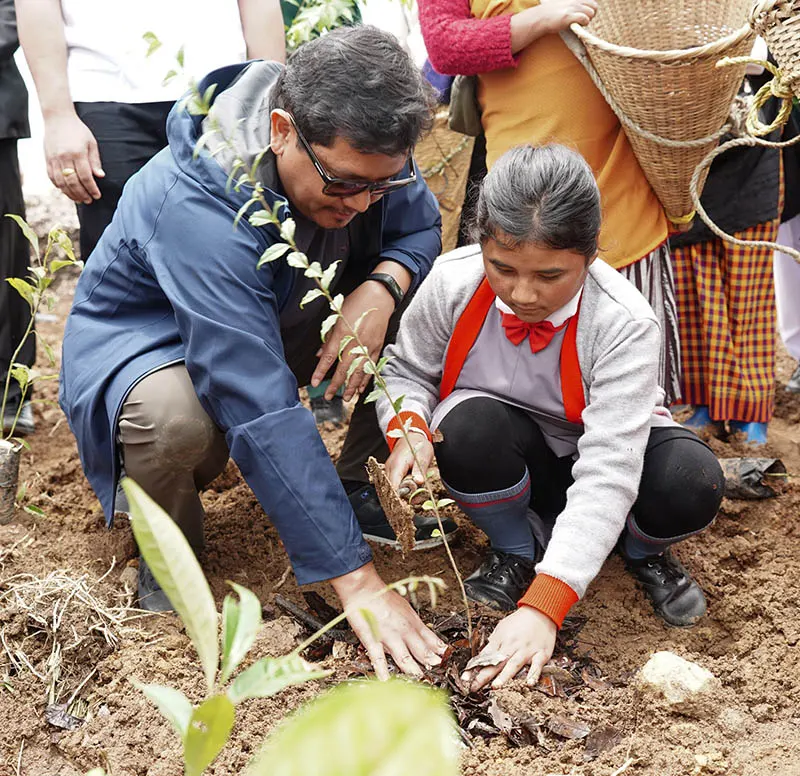
Sangma also participated in a plantation drive in Mawrah village undertaken using the Miyawaki method, an afforestation technique designed to accelerate the growth of dense, native forests and support ecological restoration. Described Mawrah village as a powerful example of what can be achieved when communities and government work together, Sangma noted the transformation of the village. “Only a few years ago the locality faced water scarcity, declining vegetation, and environmental degradation. Today, because of the dedication of the community and the efforts of the Soil Conservation Department and other agencies, Mawrah has become a model for others. What many thought was impossible a few years ago is now a reality before our eyes,” the Chief Minister said.
Sangma highlighted how the rejuvenation of springs, restoration of vegetation, and creation of water storage infrastructure had transformed the village into an emerging tourism destination while simultaneously addressing local water requirements and creating livelihood opportunities.
Speaking about the inauguration of the Eco-Cottages and the Glass House Restaurant, he described the facilities as among the most unique tourism attractions in Meghalaya and said they would offer visitors a memorable experience.
However, he emphasised that tourism extends beyond physical infrastructure.
“Tourism is not just about infrastructure. Tourism is not merely about a restaurant or a cottage. Tourism is about experience,” he said, noting that the success of the destination would ultimately depend on the hospitality, warmth, and participation of local residents.
Drawing a parallel with healthcare services, he remarked that buildings alone do not create meaningful experiences.
The Chief Minister urged local communities to work collectively towards creating a welcoming environment for visitors and stressed the importance of skill development and hospitality training.
He also called for greater participation of local artists, musicians, and youth in showcasing Meghalaya’s rich cultural heritage through music, dance, folklore, fashion, and other cultural expressions.
In this regard, he suggested exploring the development of a small amphitheatre at the site where cultural performances could be organised on a fixed schedule, enabling tourists to enjoy authentic local experiences while creating opportunities for artists and performers.
The Chief Minister further underscored the need to ensure that tourism development directly benefits local communities.
Referring to the government’s homestay initiatives, Sangma encouraged local residents to establish homestays and tourism-linked enterprises so that economic gains remain within the community.
Calling for integration of local farmers, producers, and entrepreneurs into the tourism value chain by supplying vegetables, fish, poultry, and other locally produced goods to tourism establishments, the Chief Minister said, such linkages would create stronger local economies while enhancing visitor experiences.