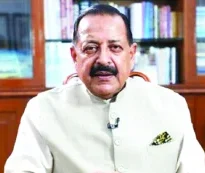
AHMEDABAD, JUN 11 (PTI): Union minister Jitendra Singh on Thursday said there was a need to change the mindset and scale up private investment as well as participation in India’s space sector to make it more competitive.
He also said that in the 1980s, China made large-scale investments into the science and technology sector without any government schemes, as it believed that science requires only money and not freedom of speech or freedom of press.
Supporting research and development (R&D) for the welfare of mankind is also a form of worship and philanthropy, the minister noted.
Singh was speaking at the 10th Indian National Space Promotion and Authorisation Center (In-Space) Industry Connect in Ahmedabad.
“The mindsets are taking longer to open up on both (private and government) sides. It would take one or two generations, because the earlier generation of our scientists were used to working in a wing of secrecy. So we need to scale up private investment and private participation in order to be more competitive, and also to be more aggressive in our future missions,” the Minister of State for Science and Technology said in response to a query on India’s space sector during an interaction at the event.
The government will also have to give up its inhibition or reservation about letting the private sector come in, he said.
Singh also emphasised the need to foster a culture of research and development to advance the country’s development. “We don’t have a culture of philanthropy as far as science and research is concerned in India. Philanthropy here means donating for ‘bhandara’ (free community feast) or ‘kirtan’ (devotional singing)…That’s good, but doing R&D for the welfare of mankind is also worship,” he said.
Singh said he doesn’t blame the private sector as the earlier governments perhaps functioned differently. “We are just about five years into this new mold of approach,” he said. Singh was interacting with IN-SPACe chairman Dr Pawan Goenka in the presence of Indian Space Research Organisation (ISRO) chairman V Narayanan and industry leaders.
During the interaction, Singh said the biggest challenge to scaling up technology is raising money.
“We need to have more investments coming in domestically, internationally, whether they are from philanthropists, foundations or business players,” he said.
Despite all the contradictions and heterogeneity, India is quite resolved to do this, the minister asserted.
He said, “People often compare China’s growth with India’s, but China dumped all the money into science and technology in the 1980s without any government schemes.”
“They (China) believed science doesn’t require freedom of press, freedom of speech, it requires only money. So, no schemes like Ayushman, Ladli Beti, Ujjwala, PM-Kisan. But in spite of that, if we are competitive, that is our strength,” Singh said.
During the event, the government announced that an agreement was signed between In-Space and the Gujarat Department of Science for the development of a state-of-the-art space manufacturing park at GIDC Khoraj, equipped with advanced Common Technical Facilities (CTF).
Later, while speaking at the Indian Institute of Technology (IIT) Gandhinagar after launching the Department of Science and Technology (DST)-funded Central Instrumentation Facility (CIF) and three research clusters, Singh said the true value of scientific research lies not merely in publications, but in its ability to create tangible societal and economic impact.
India requires a robust ecosystem where discoveries move seamlessly from laboratories to deployment through effective collaboration between academia, industry and government, he said.
Singh noted that India’s critical challenges in materials self-reliance, clean energy and affordable healthcare require sustained efforts beyond research publications.
The newly-launched clusters embody a translational research approach where scientific discovery is carried through pilot development, validation and technology transfer, he said.
Singh said that India’s research ecosystem must draw strength from its diversity by bringing together expertise from science, humanities and social sciences to address national challenges in a holistic manner.
He launched DST-funded CIF and three new Research Clusters at IIT Gandhinagar Advanced Materials Research Cluster (AMRC), Energy Research Cluster (ERC), and Healthcare & MedTech Research Cluster (HMRC) aimed at transforming cutting-edge research into deployable solutions for national development, the release noted.