
Correspondent
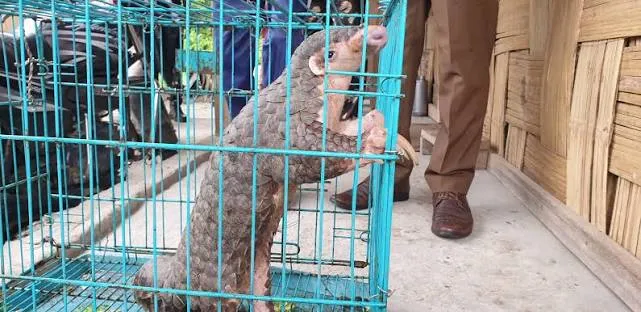
SHILLONG, JUN 26: Meghalaya State Zoo released a rescued Chinese pangolin (Manis pentadactyla) and an Asian palm civet (Paradoxurus hermaphroditus) into Nongkhyllem Wildlife Sanctuary in Ri-Bhoi district after rehabilitation and health assessments, a wildlife official said on Friday.
“The release of both the species in the wildlife sanctuary play vital roles in maintaining ecological balance, with the Chinese pangolin is listed as Critically Endangered by the International Union for Conservation of Nature and Natural Resources (IUCN) and is protected under Schedule-I of the Wild Life (Protection) Act, 1972 providing the Pangolins the highest degree of legal protection under the national statute, and the Asian palm civet contributing to forest regeneration through seed dispersal,” P.K. Agrahari, IFS, the Chief Conservator of Forests (Wildlife), said.
The Chinese pangolin was rescued by staff of Nongpoh (Wildlife) Range from NH 6 at Nongpoh. The Asian palm civet was rescued from Jaintia Hills in a severely injured condition. Both were shifted to Meghalaya State Zoo for veterinary treatment, care and monitoring.
Following a period of rehabilitation, veterinary experts certified both animals fit for release, Agrahari said, noting that wildlife rescue, rehabilitation, and release are essential components of conservation efforts. The release of the species iinto Nongkhyllem Wildlife Sanctuary was carried out jointly by Meghalaya State Zoo and Nongpoh (Wildlife) Range under Khasi Hills Wildlife Division, Shillong,
The Chinese pangolin is highly threatened by illegal wildlife trade and the species continues to face threats from illegal wildlife trade and habitat loss.
“Pangolins play a vital role as ‘ecosystem engineer’ and natural pest controllers in forests and agro-ecosystems. They primarily feed on ants and termites, consuming them in vast quantities. This helps prevent termite infestations that damage forests, crops and soil structures. Their presence indicates a balanced and healthy ecosystem,” Agrahari explained. He said Pangolins are the most heavily trafficked mammals in the world, accounting for up to 20 per cent of the entire global illegal wildlife trade.
An estimated one million pangolins were poached worldwide over a recent decade. “Palm civets are vital to tropical ecosystems as keystone seed dispersers and forest regenerators. By eating fruits and defecating seeds across wide ranges, they maintain plant biodiversity and help reforest degraded areas,” the wildlife official added. Agrahari said the successful release reflects the Department’s continued commitment to wildlife conservation and animal welfare executed through the officials and staff of Meghalaya State Zoo and Khasi Hills Wildlife Division, Shillong.
He also appealed to people to assist in rescue of wild animals by informing the Forest and Wildlife officials about such wild animals in distress, so that they can be treated and released.