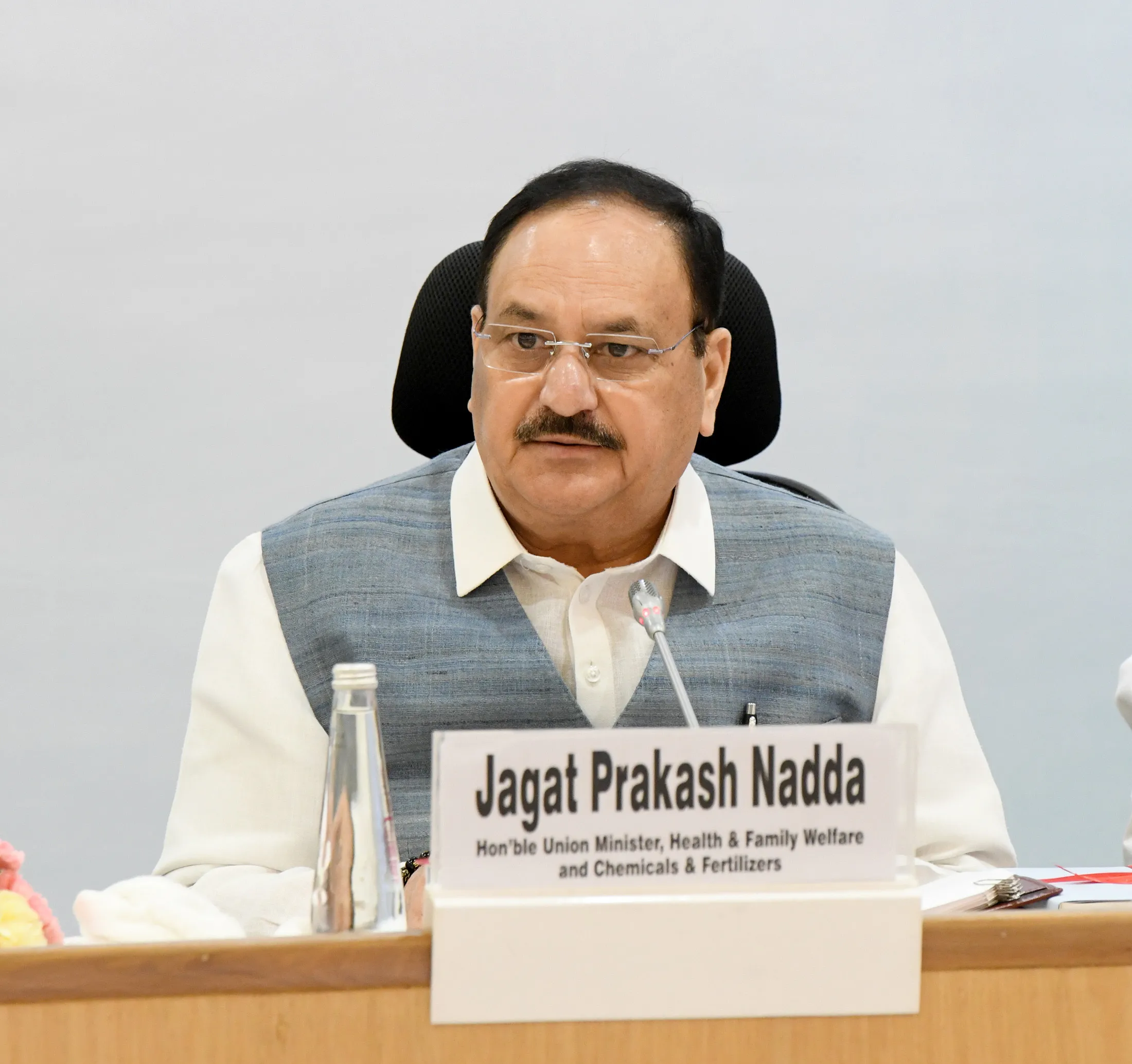
NEW DELHI, JUN 29 (PTI): Union Health Minister J P Nadda on Monday said health is the cornerstone of Viksit Bharat 2047 and the states are equal partners in India’s health success story, asserting that every achievement in the health sector belongs equally to the states and Union Territories as health is a state subject.
Chairing the 16th Conference of the Central Council of Health and Family Welfare (CCHFW), Nadda said, “Health is a state subject; every achievement in the health sector belongs equally to the states and Union Territories.”
“While the Union government provides policy guidance, technical support and financial assistance, successful implementation depends upon the commitment and proactive efforts of the states,” he said.
Addressing the conference, he said that under the leadership of Prime Minister Narendra Modi, India has set the goal of becoming a Viksit Bharat by 2047 when the country completes 100 years of Independence.
He emphasised that “a developed India cannot be achieved without a healthy India and that health remains one of the most critical pillars of national development.”
The Union minister said the last 12 years have witnessed transformational changes in India’s healthcare sector and noted that the National Health Policy, 2017 ushered in a paradigm shift by shifting the focus from predominantly curative care to a “holistic, inclusive and comprehensive healthcare system encompassing preventive, promotive, curative, palliative and rehabilitative care.”
Nadda said nearly 1.85 lakh Ayushman Arogya Mandirs have been established across the country as the first point of contact for citizens, while tertiary healthcare infrastructure has been strengthened through 23 new AIIMS and more than 157 medical colleges, particularly in aspirational and underserved districts.
Highlighting improvements in health indicators, he said the Maternal Mortality Ratio has declined from 130 per one lakh live births in 2014 to 87. Citing the UN Maternal Mortality Estimation Report 2024, he said India has achieved an 86 per cent decline in maternal mortality compared with the global decline of 48 per cent.
He said India’s Under-Five Mortality Rate has declined by 79 per cent since 1990, neonatal mortality by 70 per cent, the Total Fertility Rate has reached 2.0 and life expectancy has increased to 70.3 years.
The minister said Mission Indradhanush has vaccinated 5.46 crore children who had missed routine immunisation and 1.32 crore pregnant women, while more than 50 lakh adolescent girls have been vaccinated under the nationwide HPV vaccination drive launched on February 28 this year.
On communicable diseases, Nadda said India has achieved a 21 per cent decline in tuberculosis incidence against the global decline of 12 per cent and treatment coverage has reached 92 per cent.
He said the country has eliminated neonatal tetanus, achieved polio-free status, made substantial progress towards kala-azar elimination and reduced malaria cases by 81 per cent and malaria-related deaths by 80 per cent.
Emphasising preventive healthcare, he said Ayushman Arogya Mandirs have screened over 42 crore people each for hypertension and diabetes since 2018, leading to the diagnosis of 7.3 crore hypertension and five crore diabetes cases besides screening crores for oral, breast and cervical cancers.
On the occasion, Nadda launched several landmark policy documents and programme initiatives aimed at strengthening healthcare delivery across the country.