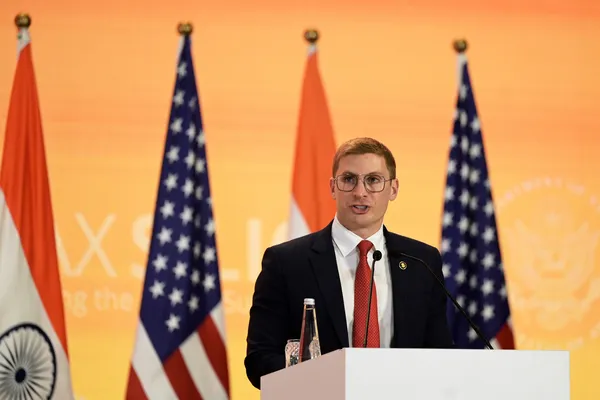
WASHINGTON, JUNE 30 (IANS): India is “the only country on earth that fundamentally rivals China” in the depth of its engineering workforce and talent pool, a senior Trump administration official said, calling New Delhi a critical partner in building secure technology ecosystems and reducing global dependence on China.
Jacob Helberg, the US Under Secretary of State for Economic Growth, Energy and the Environment, made the remarks during a fireside conversation with Tucker Foote, Chief Government Affairs and Policy Officer at Mastercard, at the ninth US-India Strategic Partnership Forum Leadership Summit in Washington.
“For us, India is an incredibly important partner,” Helberg said, noting that India was an early signatory to the PAX Declaration and a key participant in the administration’s technology and artificial intelligence diplomacy.
He said he had travelled to India in February for India’s AI Impact Summit, where the two sides marked India’s accession and published a joint statement on AI opportunity.
The statement, he said, later helped shape a broader declaration co-signed with 35 countries at a subsequent summit.
Helberg said India stood out because it combined democratic alignment, engineering talent, mineral refining capacity and a growing technology ecosystem. “India is especially interesting because it is not only a country with who we have a deep values alignment, but India obviously is the only country on earth that fundamentally rivals China as with respect to the depth of its engineering workforce and talent pool,” he said. He also pointed to India’s “very deep mineral refining industry” and its “true nascent technology ecosystem”, saying the country was making important contributions at the application layer of technology.
That application layer, he said, would be essential for wider diffusion of new technologies.
Helberg said the United States did not view technological progress as a zero-sum contest among partners.
“We don’t view it as a zero sum game,” he said, adding that Washington was not threatened by the success of other companies in the technology space because the technology industry was “a pie that grows”.
He said India’s scale and talent made it a natural partner in building what he called a shared developer ecosystem.
“The reason that India is such an important partner in this endeavor is because, it has so many engineers, because of the size, the needs of its population are, are so substantial by virtue of a demographic size as well as its rapid economic growth,” Helberg said.
Helberg said the current global supply chain structure could not continue because it was too geographically concentrated and vulnerable to disruption.
“The supply chains are, as they stand today, are too overly concentrated geographically and thematically in some places. And they need to be diversified,” he said.
He said the objective was to reduce overdependence on China and build greater production capacity elsewhere.
“Broadly speaking, we want to increase production capacity outside of China in order to de-risk our overall over concentration with China,” Helberg said.
He cited India’s role in memory capacity, mineral refining and AI applications as areas where the two countries could deepen collaboration.
At the physical supply chain level, he said India and the United States had opportunities to work together on key inputs. At the software level, he said India could become a “transformative partner” in developing a dynamic AI developer ecosystem.
“We think India can be a transformative partner to develop a very, very dynamic AI developer ecosystem,” Helberg said.