
Correspondent
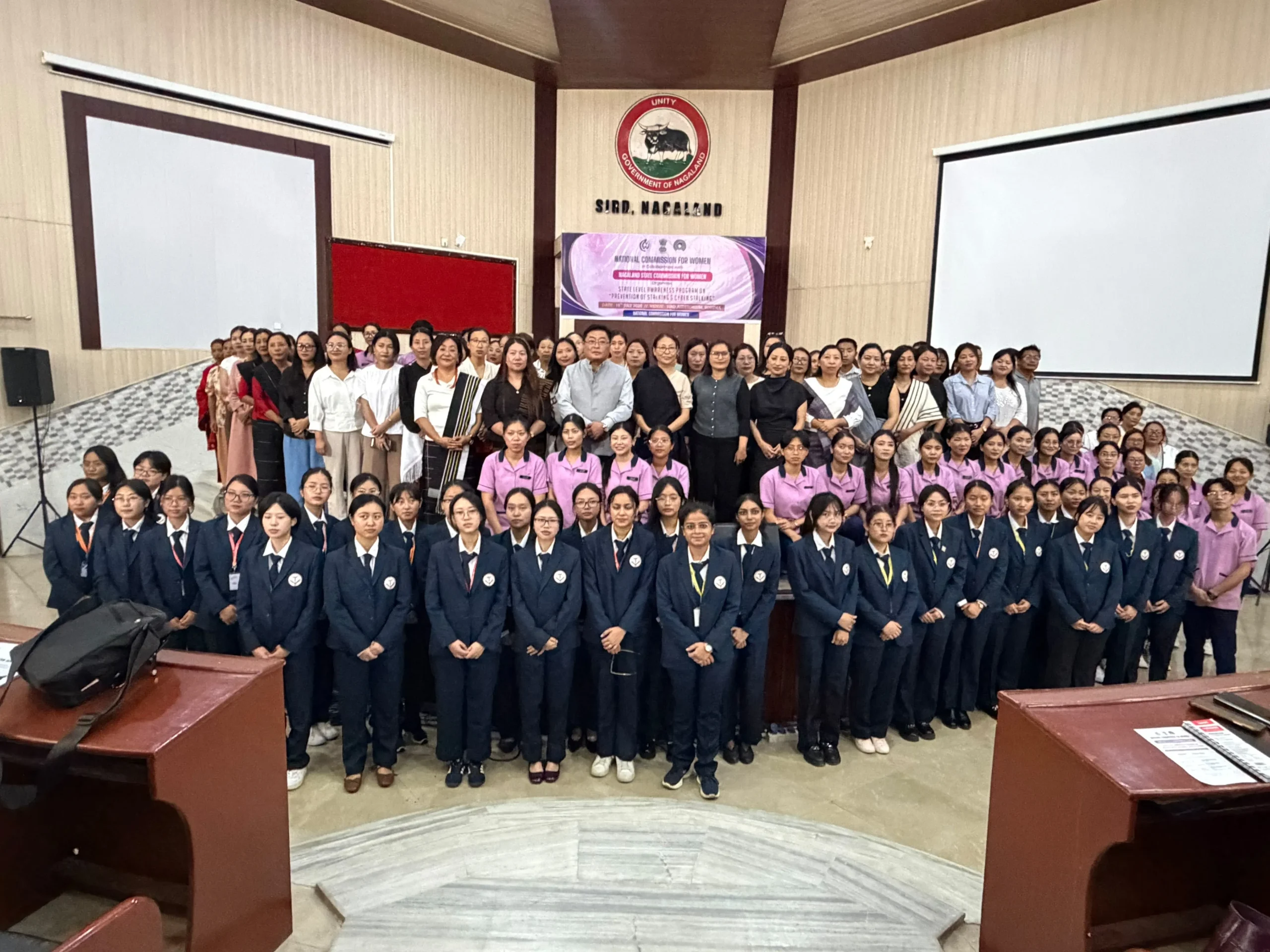
KOHIMA, JUL 15 (NPN): National Commission for Women (NCW), in collaboration with the Nagaland State Commission for Women (NSCW), organised a state level awareness programme on “Prevention of Stalking and Cyber Stalking” at the SIRD Auditorium, Kohima, on Tuesday.
Speaking at the programme, Justice Lanusungkum Jamir, chairman of the Nagaland State Human Rights Commission, described stalking as a widespread yet often trivialised violation of human dignity that causes fear, emotional distress and psychological trauma. He explained that stalking encompasses repeated unwanted attention such as following a person, persistent calls or messages, uninvited visits, surveillance, unsolicited gifts and threats. Stressing that behaviour perceived as persistence by one person can be deeply intimidating to another, he said Section 78 of the Bharatiya Nyaya Sanhita (BNS) recognises both physical and cyber stalking as punishable offences.
Justice Lanusungkum pointed out that stalking remains a bailable offence for first time offenders, allowing perpetrators to re enter society quickly and potentially continue harassing victims. He also noted that the existing legal definition identifies the offender as a “man” and said the law should evolve to reflect the gender neutral nature of both physical and online harassment. Calling for a change in societal attitudes, he urged people to reject cultural narratives that glorify persistence over consent. He advised victims to communicate a clear refusal, document repeated harassment and preserve evidence to strengthen legal action.
Highlighting the growing threat of digital harassment, Lanusungkum said the COVID 19 pandemic accelerated the shift from physical to online stalking, facilitated by spyware, stalkerware, social media platforms and other technologies. He said cyber stalking includes online surveillance, identity theft, threats, misuse of personal information and continuous digital harassment. Although India’s legal framework, including the Bharatiya Nyaya Sanhita and the Information Technology Act, provides robust provisions to address such offences, enforcement continues to face challenges due to jurisdictional limitations, evolving technology and low digital literacy. He urged citizens to protect online privacy, preserve digital evidence, block offenders, report abuse to platforms and promptly approach law enforcement when harassment continues.
Delivering the keynote address, NSCW chairperson W. Nginyeih Konyak described stalking and cyber stalking as “modern plagues” that threaten the freedom, dignity and safety of women and girls. She said Nagaland has long been regarded as a society where communities protect one another, but warned that smartphones and digital connectivity have introduced invisible threats directly into homes. According to her, cyber stalking now takes the form of persistent online messaging, constant social media monitoring, unauthorised location tracking and misuse of personal information.
Referring to the latest National Crime Records Bureau (NCRB) report, Nginyeih said Nagaland recorded 56 cases of crimes against women, the lowest among all States and Union Territories. While describing this as a reflection of the state’s strong community values, she cautioned that low physical crime figures can obscure the growing incidence of digital offences and violations under Special and Local Laws.
To illustrate the impact of cyber stalking, she cited the case of a college student in Kohima who allegedly became the victim of an anonymous online stalker. The perpetrator reportedly tracked her movements through social media posts, sent persistent messages, used artificial intelligence to create explicit morphed images and attempted to extort her by threatening to circulate the fabricated content. The victim withdrew from college and social life after suffering severe anxiety and depression.
Nginyeih stressed that educational institutions must play a leading role in preventing digital harassment by establishing confidential reporting mechanisms, incorporating cyber safety into campus policies and educating students about offences under the Information Technology Act and the Bharatiya Nyaya Sanhita. She also called for statewide awareness campaigns on digital hygiene, stronger cyber forensic capabilities, improved cyber crime infrastructure and wider implementation of the Centre’s Cyber Crime Prevention against Women and Children (CCPWC) scheme.
Appealing to society to reject victim blaming, she urged families, churches, educational institutions and civil society organisations to support survivors and ensure offenders face prompt legal action rather than allowing victims to suffer social stigma. The programme was chaired by Kekhrienuo Meyase, member of the Nagaland State Commission for Women, and concluded with a technical session moderated by Grace Aye, State Mission Coordinator, Mission Shakti, Department of Social Welfare.