
Staff Reporter
DIMAPUR, JUL 28 (NPN): Awareness programmes on rainwater harvesting and water conservation was conducted across Nagaland on July 27 and 28, 2026 under the nationwide Jal Sanchay Jan Bhagidari (JSJB) campaign themed “Catch the Rain.”
In Dimapur, the East Dimapur Town Council (EDTC) organised an awareness campaign at East Dimapur Market, Purana Bazar, urging residents and traders to conserve rainwater and adopt sustainable water management practices.
Speaking to Nagaland Post, EDTC Ward 10 councillor Krishna Mech said the campaign was part of the nationwide initiative aimed at creating awareness on rainwater conservation. She explained that the market was chosen as the venue since it is one of the busiest public spaces in East Dimapur, allowing the council to reach a larger section of the community.
Mech informed that while the existing market lacks rainwater harvesting infrastructure as it functions from a rented premises, the new East Dimapur Market complex under construction will incorporate such facilities. The ground floor of the new market has recently been completed, and the council plans to install water storage tanks to harvest and utilise rainwater. She added that the proposal is at the planning stage, with funding likely to come from council resources and possible external support.
She further said EDTC intends to expand similar awareness campaigns to schools, colonies and other public places to encourage wider participation. Appealing to the public, Mech urged residents to support the Catch the Rain campaign and become active partners in creating a water secure Dimapur. “Together we can turn every rainfall into a resource and every citizen into a water champion,” she said.
In Atoizu, an awareness programme was held at DBs Hall, chaired by Inali Yesca, Councillor, Atoizu Town Council, who emphasised that water conservation is a shared responsibility requiring active involvement of all sections of society. The programme began with an invocation by Ghunato Achumi, Youth Pastor, SBAK Nito Mount.
Welcoming the gathering, Ivuka Katty, Deputy Chairman, Atoizu Town Council, underscored the importance of collective efforts in promoting rainwater harvesting as a practical measure to address water scarcity. Delivering the keynote address, Er. Liza Sumi, Junior Engineer, Water Resources Department, Zunheboto, spoke on the growing need to conserve water through sustainable practices. She explained the principles and methods of rainwater harvesting, highlighting its role in enhancing water security and encouraging households and institutions to adopt simple conservation measures.
An interactive session followed, enabling participants to seek clarifications and share experiences on local water issues. In his concluding remarks, Dr. Samuel Akho Konyak P, Extra Assistant Commissioner, Atoizu, urged participants to put the knowledge gained into practice and spread awareness within their churches, organisations and families.
The programme concluded with a benediction pronounced by Tozheli Awomi, President, Sumi Totimi Loka (STL).
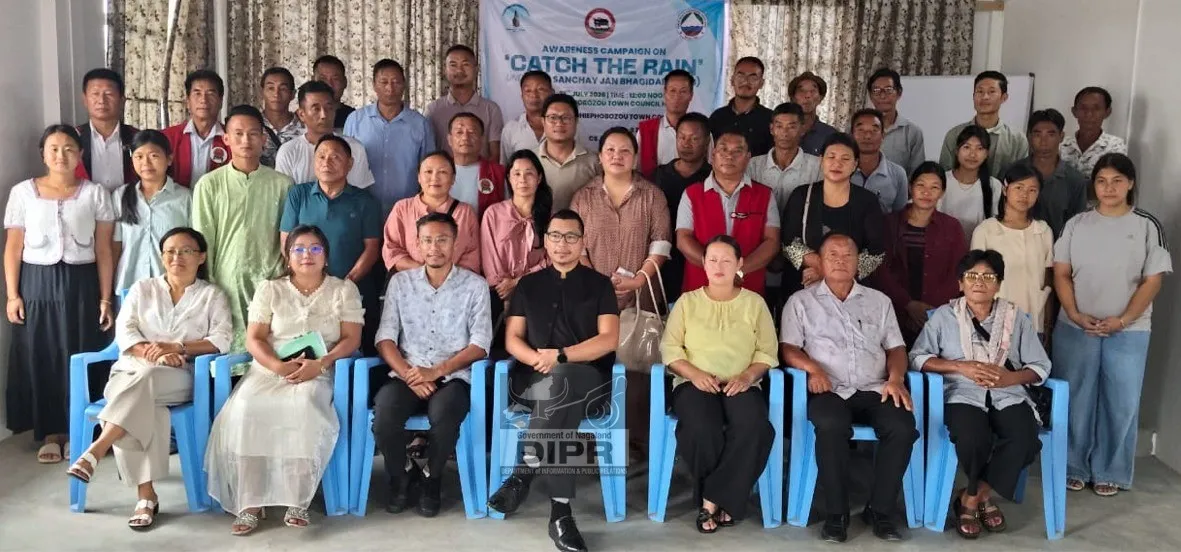
In Chiephobozou, the programme was organised by the Town Council at Town Council Hall. Delivering the keynote address, ADC & EO, Chiephobozou Town Council, Vekusheyi Rhakho, highlighted the objectives and significance of the campaign. He emphasised the need to conserve every drop of water and make rainwater harvesting a collective responsibility. Pointing out that Nagaland receives rainfall well above the global average, he said proper planning and conservation could ensure greater water security for the State.
Rhakho noted that Chiephobozou and surrounding areas face recurring water supply challenges, making rainwater harvesting especially relevant. He appreciated the community’s ongoing efforts and encouraged residents to strengthen initiatives and transform water conservation into a people’s movement.
Resource person Er. Kethosenou Usou, JE (PHED), elaborated on the importance of optimum utilisation of harvested rainwater for drinking, domestic use and agriculture. She explained methods of rainwater harvesting and groundwater recharge, stressing their role in enhancing long term water security.
An interactive session followed, where participants discussed local water scarcity and practical conservation measures suited to the terrain. Rhakho also cited the traditional ‘Zabo’ system of Kikrüma village as an exemplary indigenous practice integrating rainwater harvesting, conservation and agriculture.