
Staff Reporter
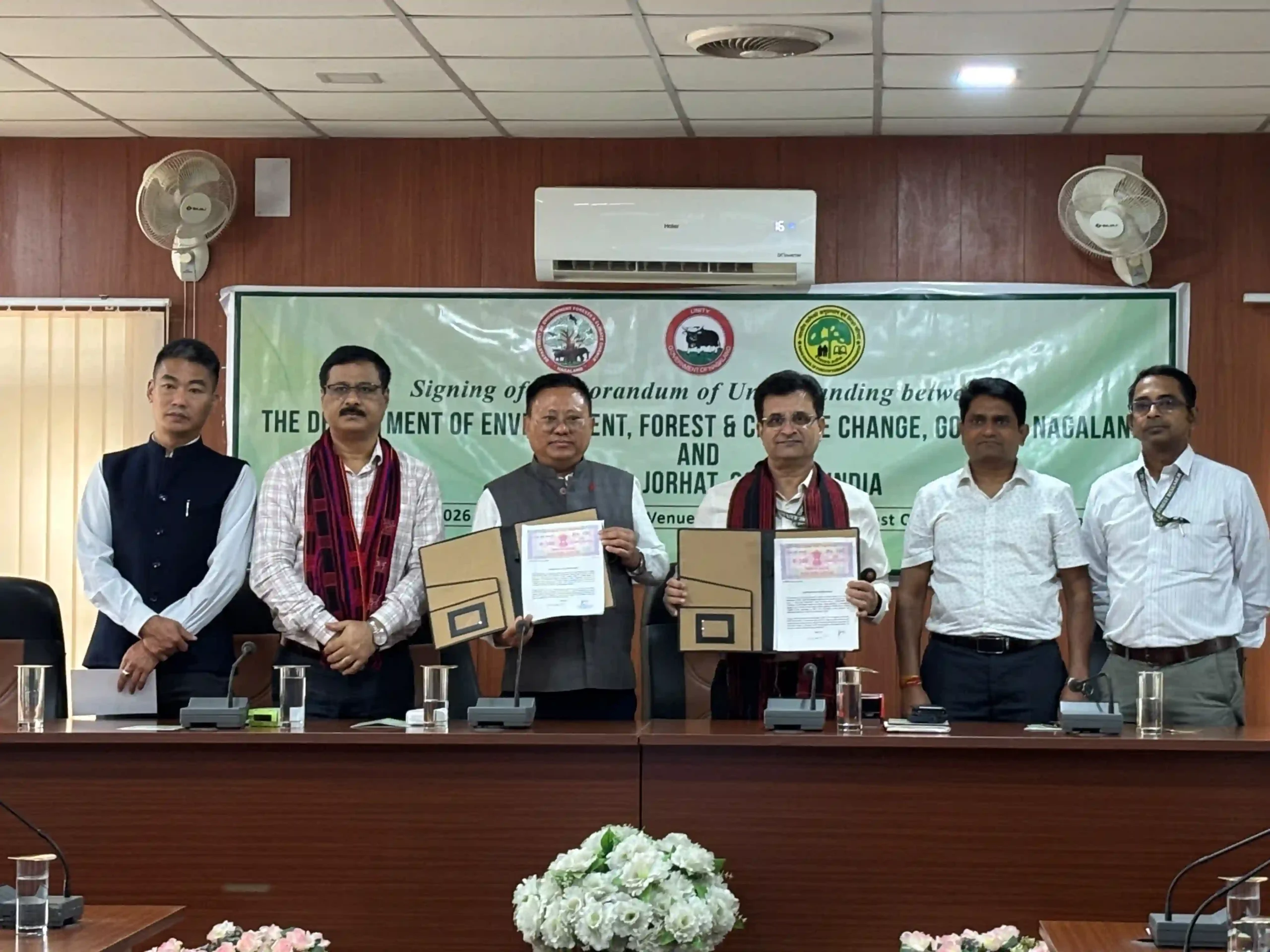
DIMAPUR, AUG 1 (NPN): In a landmark initiative to promote scientific cultivation and commercial utilisation of agarwood, the Department of Environment, Forests and Climate Change (DEFCC), Government of Nagaland, signed a Memorandum of Understanding (MoU) with the Rain Forest Research Institute (RFRI) Jorhat on Saturday, under the Indian Council of Forestry Research and Education (ICFRE).
The agreement was formalised at the Forest Office Complex, Dimapur by Principal Secretary, DEFCC and Development Commissioner, Nagaland, Y. Kikheto Sema and RFRI Director Dr. Nitin Kulkarni, in the presence of senior forest officials.
Sema highlighted that although agarwood has existed in Nagaland for generations, the absence of a dedicated policy prevented farmers and entrepreneurs from fully benefiting from the resource. He noted that around 96 per cent of India’s agarwood is found in the Northeast with Assam and Tripura dominating production and exports due to established policies. Nagaland, despite its rich natural resources, had been utilising only about two per cent of the national quota.
He explained that traders from neighbouring states often procured agarwood from Nagaland without local processing facilities or organised marketing systems. To address this, the State Government formulated the Nagaland Agarwood Policy after consultations with RFRI in March 2026. The policy was approved by the State Cabinet on May 6, paving the way for the MoU.
The partnership will enable scientific identification of suitable agarwood varieties, soil testing, quality sapling distribution, farmer training, harvesting protocols, processing techniques, transportation and export management. Sema also introduced RFRI’s “Sashi Inoculation” technology, which allows artificial resin formation in agarwood trees with a success rate of over 90 per cent. This will replace unregulated private inoculation practices, ensuring farmers receive reliable and affordable technical support.
He further expressed optimism that Nagaland could establish agarwood processing infrastructure similar to Assam’s Golaghat unit, sanctioned in the Union Budget. Stressing the economic potential, he said agarwood could generate 40–50 times higher returns than traditional jhum cultivation, while providing sustainable livelihoods for farmers and unemployed youth. He also mentioned plans to collaborate with RFRI on improved clonal teak varieties, which mature in 20 years compared to conventional 40–50 years.
Dr. Kulkarni acknowledged Nagaland’s immense natural resources, particularly agarwood, which remains underutilised. He said the collaboration would focus on surveying existing agarwood resources, assessing quality, expanding plantations, promoting agroforestry, and applying scientific technologies such as artificial inoculation to improve resin formation and commercial value.
He emphasised that the MoU was not limited to agarwood but would also pave the way for scientific collaboration in sustainable utilisation of other forest resources. Kulkarni expressed confidence that the partnership would enhance rural livelihoods through research-based interventions and contribute to the prosperity of the State.
Delivering the keynote, Chief Conservator of Forests, Sidramappa Chalkapure described the MoU as a milestone in strengthening forestry research and improving farmer livelihoods. He traced the history of forestry management in India, noting its evolution from the Vedic period to the British era, when scientific working plans were introduced.
Highlighting Nagaland’s favourable soil, climate and moisture conditions, he stressed the responsibility of the government to ensure these natural advantages translate into economic benefits for farmers. He revealed that the collaboration with RFRI was initiated following suggestions from Union Minister of State for Environment, Forest and Climate Change, Kirti Vardhan Singh, who encouraged Nagaland to adopt modern technologies in forestry management, agroforestry and agarwood cultivation.
Chalkapure said the State Government’s approval of the Agarwood Policy would provide a framework for cultivation, research, value addition and marketing. He added that the MoU would facilitate research and technology transfer in agarwood, teak, bamboo and other forestry resources, enabling farmers to adopt scientific practices and improve returns.
The signing ceremony was chaired by Additional Principal Chief Conservator of Forests (Territorial), Supongnukshi Ao. The event marked a significant step towards advancing forestry research, sustainable livelihoods and value addition in Nagaland through closer cooperation between the State Government and RFRI.