
Staff Reporter
DIMAPUR, AUG 2 (NPN): In the light of allegations blaming rains in Nagaland for the recent flood in upper Assam and the response from the Konyak Union, the scientific facts however, reveal a broader picture.
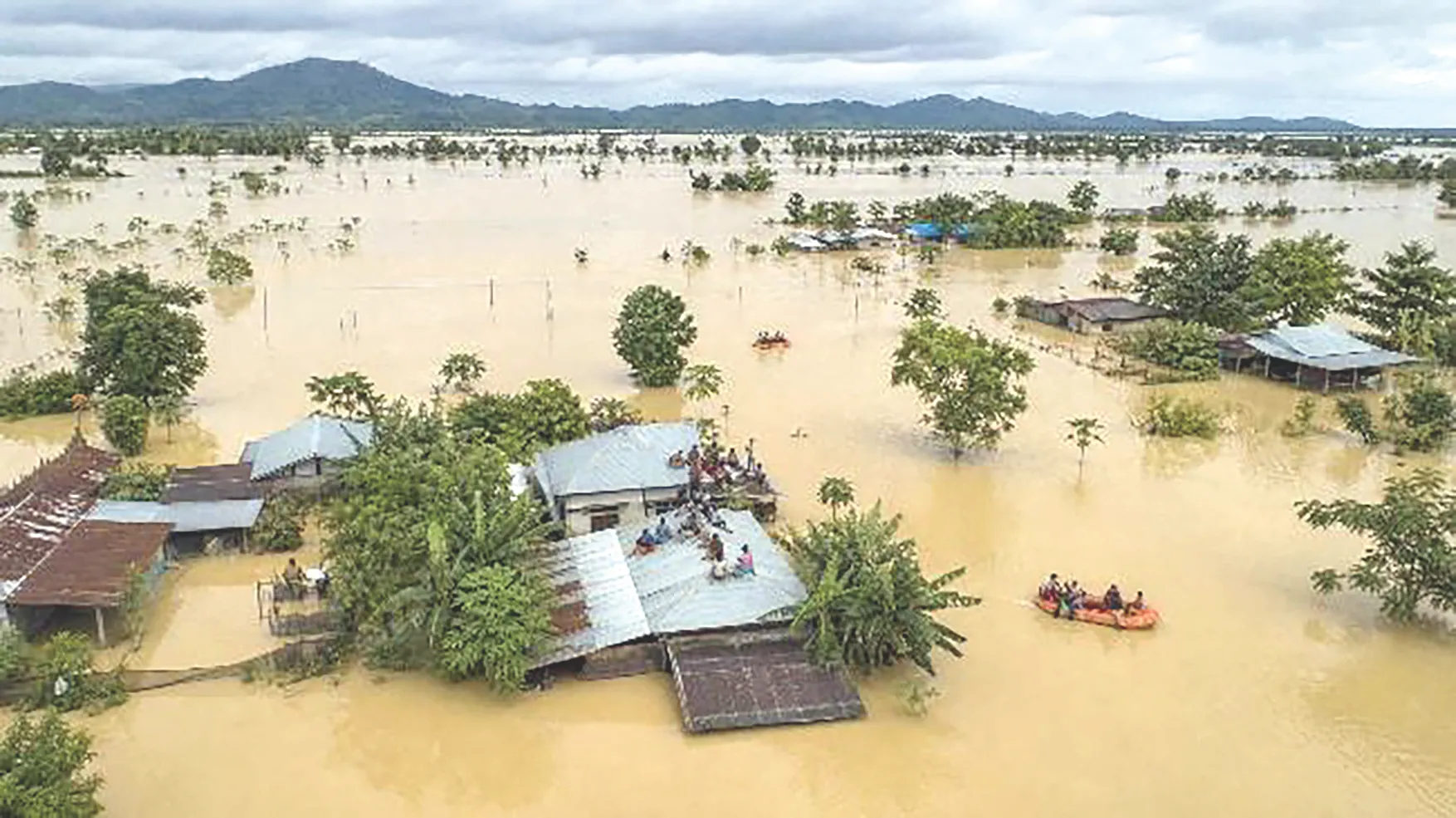
The recent catastrophic floods in the upper Assam districts of Jorhat, Sivasagar, and Charaideo have sparked intense debate regarding the primary causes of the inundation. Konyak Union on July 31 issued a strong statement in response to various allegations and claims in social media which blamed cloud burst in Nagaland for the deluge that flooded several districts in Upper Assam.
Assam chief minister Himanta Biswa Sarma who initially inferred that cloudburst in the hills may have precipitated the flood, later retracted by clarifying that the IMD had reported there were no such cloudbursts. It may be recalled that even on earlier floods at Guwahati, the Assam chief minister had alleged that the downpour at upstream in Meghalaya had caused the flood.
The misery caused by the flood in Upper Assam, may have also led to ‘finding someone to blame’ when wild allegations surfaced of water gushing down from the adjoining hills of Nagaland. While the visual impact of torrents descending from higher elevations is undeniable, a comprehensive scientific analysis reveals a far more complex reality.
An examination of the July 2026 floods that devastated the upper Assam districts of Jorhat, Sivasagar, and Charaideo, critically evaluates the allegations of water gushing down from the adjoining hills of Nagaland.
Nature of catchment basins: The assertion that an uphill area is entirely responsible for flooding in the plains contradicts fundamental principles of hydrology. ‘
Floods are system-wide phenomena that arise from a combination of meteorological events, topography, land use, and infrastructure across an entire drainage basin. Recent data indicates that the region experienced an unprecedented weather event. For instance, Charaideo in Assam recorded rainfall 436% above normal during the same period.
Though huge volumes of water flowed from the hills as in monsoon, the plains were already saturated and receiving intense rain, leaving virtually no room for natural drainage.
Downstream urbanization: A critical, often overlooked component of the flood equation lies within the plains themselves. Plains are naturally prone to flooding due to their low gradients, which slow drainage and cause water to pool.
However, human modifications have drastically worsened this natural vulnerability.
Urbanization in the plains replaces absorbent soil and vegetation with impervious surfaces like roads and roofs, eliminating natural water storage and accelerating runoff.
Furthermore, rapid urban growth frequently outpaces the development of drainage infrastructure, resulting in undersized drains that cannot handle the increased volume of water.
Encroachment on natural floodplains and the destruction of wetlands further remove essential buffers that historically absorbed and slowed floodwaters.
When these downstream factors combine with the simultaneous heavy rainfall and the silt-laden runoff from the hills, the result is the unprecedented flooding witnessed in Assam.
Shared responsibility: The scientific consensus is clear, that – upstream and downstream areas are hydrologically linked, and effective flood management requires a catchment-based approach rather than assigning blame to a single segment.
Addressing this recurring crisis demands coordinated action.
It requires rigorous watershed management and reforestation in the hills to reduce runoff and soil erosion.
Simultaneously, it necessitates strengthening embankments, restoring wetlands, and upgrading drainage infrastructure in the plains.
Ultimately, blaming the hills ignores the complex, system-wide nature of flood generation.
Only through collaborative, science-based strategies across state borders can the region hope to mitigate the devastating impacts of future monsoons.