
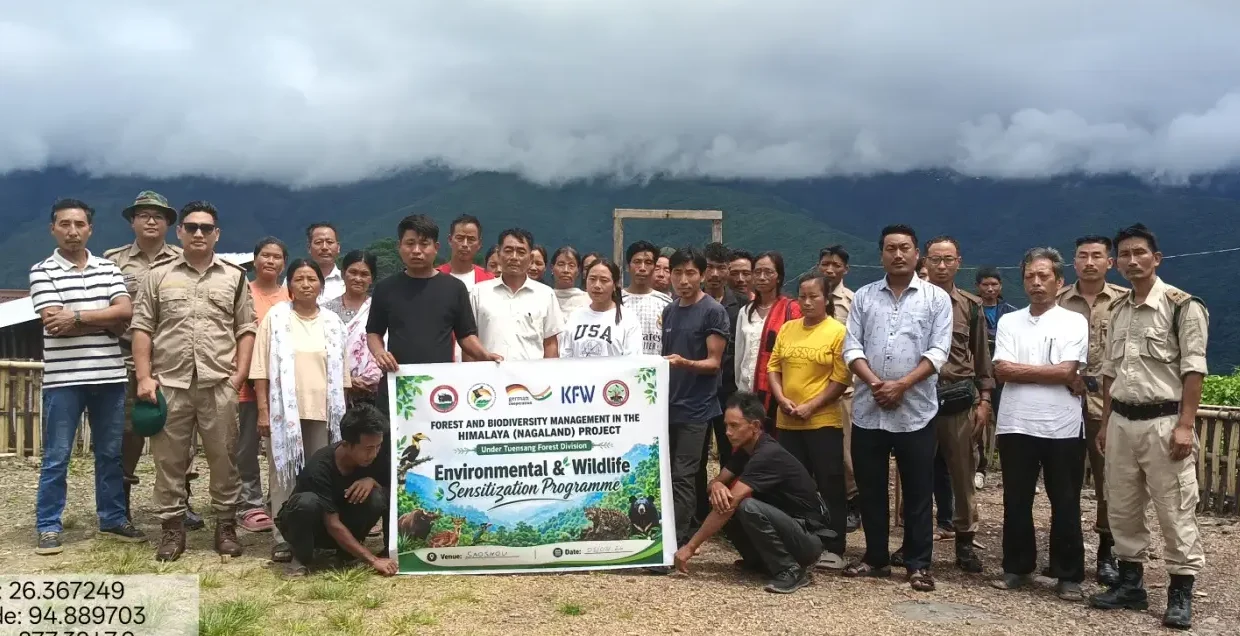
DIMAPUR: Tuensang Forest Division organised a comprehensive ‘Environmental & Wildlife Sensitization Programme’ at Saoshou Village Community Hall under the Forest and Biodiversity Management in the Himalaya (Nagaland) Project (FBMP), co financed by the Federal Republic of Germany through KfW.
The programme began with a guided nature walk, giving participants practical exposure to local flora, fauna and wildlife signs, while helping them understand the forest ecosystem.
At the formal session chaired by T. Surotsa Sangtam, FGD, Menya Wongto, RFO, highlighted the crucial roles of churches, Community Conservation Area (CCA) committees and students in environmental protection.
Speaking on local governance, K. Chuba, VCC, detailed village council resolutions and enforcement methods, stressing the strict ban on hunting and tree felling within the CCA. He noted that the community was actively guarding the area to ensure effective conservation.
Representing a local Self Help Group, I. Chingyang underscored the vital role of women in conservation, drawing inspiration from the historic Chipko movement. She urged participants to plant more trees, avoid deforestation and follow forest department guidelines.
A technical session on illegal hunting and wildlife crime was conducted by N. Imlong Chang (FGD, INP), who referenced the Wildlife Protection Act 1972, Biodiversity Act 2002, and Article 371(A). He clarified that hunting, selling or killing wild animals and birds is strictly prohibited, and that Article 371(A) does not permit unrestricted exploitation of resources.
Officials stressed the need to protect endangered species and warned of strict punishments for wildlife crimes. They reminded villagers to report environmental crimes or forest fires immediately to authorities.
The programme concluded with an interactive session between villagers and forest officials, followed by a vote of thanks delivered by I. Khamba, GB.