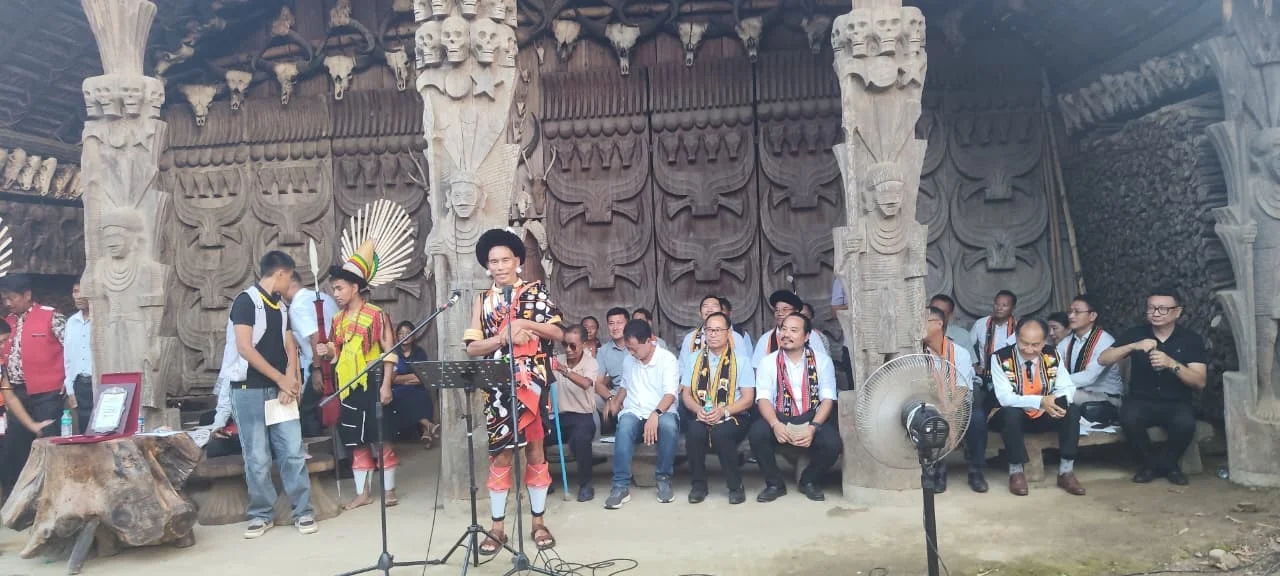
A grand reception was accorded to Guru Vevoshuo Phesao at his residence here on Friday following his historic achievement as the first Naga recipient of the prestigious Sangeet Natak Akademi Award.
The reception was attended by community leaders, cultural organisations and well-wishers, who hailed the honour as a significant milestone for Naga cultural heritage. Phesao had arrived in Dimapur after receiving the award from President Droupadi Murmu in New Delhi.
The programme was chaired by Zhokhoi Chüzho, while pastor of Naga United Village Baptist Church, Kühüsheyi Chotso offered the invocation. The Chakhesang Züve Cultural Club presented a traditional folk song, highlighting the rich musical heritage of the Chakhesang community.
Chairman of Naga United Village Council and president of CZK Naga United Village Samuel Therieh, recounted Phesao’s journey and read out his biographical profile prepared for the Sangeet Natak Akademi. He highlighted Phesao’s lifelong dedication to documenting, preserving and promoting Chakhesang folk songs and traditional performing arts, describing his contribution as an inspiration for future generations.
Western Chakhesang Hoho president Yeushulnl Ngatsi said the community had never imagined witnessing such a historic moment. Describing Phesao as the first Naga to receive the country’s highest recognition in the performing arts, he said the award had elevated the identity of both the Chakhesang and Naga people on the national stage.
Ngatsi credited Phesao with helping Naga folk songs gain wider recognition across the country and said the honour belonged not only to the awardee but to the entire community. He also praised Phesao for continuing to train villagers and young people even after retirement, urging him to regard the award as a milestone rather than the culmination of his work.
Director of the North East Zone Cultural Centre (NEZCC), Alobo Naga, congratulated Phesao on behalf of the institution and described him as a champion of cultural preservation.
Alobo, who assumed office about a month ago, said he had frequently heard Phesao’s name associated with the creation of cultural pavilions, morungs and traditional artistic works across the region. Recalling his first meeting with Phesao at the airport while travelling to Delhi, he said he immediately recognised the artist whose contributions had earned widespread respect.
He also noted that Phesao had earlier been conferred the title of Guru under the Ministry of Culture’s Guru-Shishya Parampara programme in recognition of his lifetime contribution to teaching and preserving traditional arts. Expressing concern over the growing unfamiliarity of millennials and Gen Z with authentic Naga folk songs and dances, Alobo warned that oral traditions could disappear within decades if they were not actively preserved. He called for collective efforts by communities across Nagaland and the Northeast to safeguard indigenous cultural heritage.
He further said the Sangeet Natak Akademi Award represented the highest aspiration for many artists and reaffirmed NEZCC’s commitment to supporting master artists through training schemes that enable them to mentor younger generations. Representatives of the Western Chozubami Welfare Union and Meshusayi Tetseo, managing director of the Chakhesang Cultural Research Institute, also spoke on the occasion and lauded Phesao’s enduring contribution to preserving the cultural identity of the Chakhesang community.
Earlier, interacting with the media at Dimapur airport, an emotional Phesao thanked God and the people for the overwhelming honour accorded to him.
He described receiving the award from the President as one of the happiest moments of his life, while admitting that he felt nervous and humbled by the recognition. He expressed gratitude to everyone, from elders to children, who gathered to welcome him despite his fatigue following his journey from Delhi. Reflecting on his journey, Phesao said his love for Naga culture began during childhood and that he never turned down opportunities to perform or represent the community. He recalled participating in cultural programmes at the Indira Gandhi Rashtriya Manav Sangrahalaya (IGRMS) in Bhopal, where his family presented Naga folk songs before international visitors. He described those experiences as important stepping stones that eventually led to the national recognition. Phesao also expressed gratitude to the Directorate of Art & Culture, Government of Nagaland, NEZCC and the Sangeet Natak Akademi offices in Guwahati and New Delhi for their encouragement and support. The programme concluded with a benediction by Rev. Dr. Phuveyi Dozo.
(Staff Reporter)