
Staff Reporter
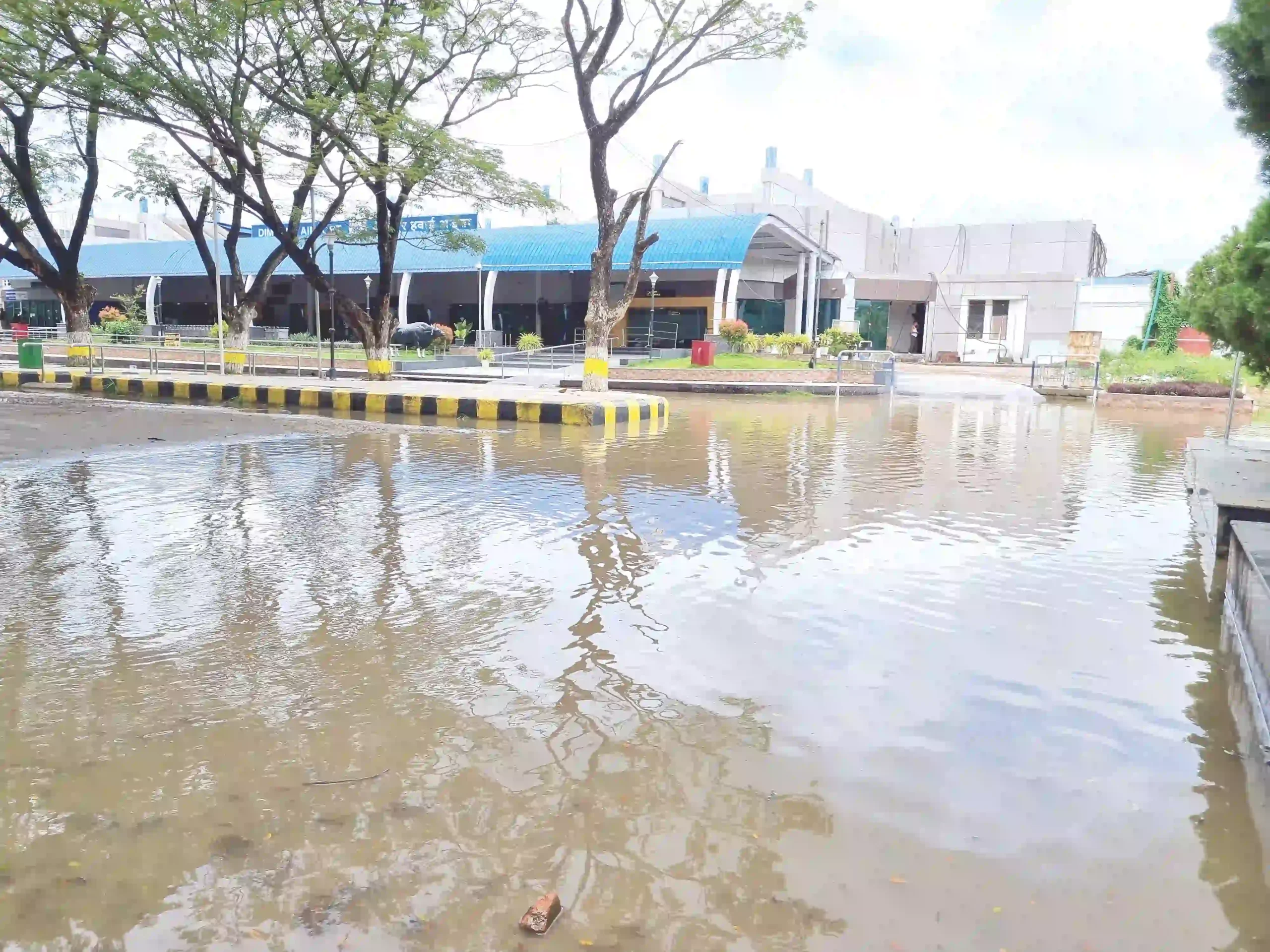
DIMAPUR, AUG 16 (NPN): The repeated waterlogging of the runway at Dimapur Airport should no longer be treated as a seasonal inconvenience or an isolated operational problem. It is a warning that the airport is facing a deeper ecological and infrastructure crisis that cannot be solved through repeated short term repairs.
Despite interventions by the Airports Authority of India (AAI) and the state Water Resources department, flooding continues to disrupt airport operations during heavy monsoon spells. The recurrence of the problem raises a larger question: can the existing site realistically meet Nagaland’s future aviation needs?
The fundamental problem is not simply the airport’s ageing infrastructure but the location and topography of the site.
Situated in a low lying area close to the Chathe River and surrounded by drainage constraints, the airport is particularly vulnerable to waterlogging. Its proximity to the nearby Hills also creates limitations for runway alignment and future expansion.
Water from areas around the former Sugar Mill village and the North East Zone Cultural Centre (NEZCC) flows towards the airport. The situation is made worse by an inadequate urban drainage system, with several local nullahs blocked by garbage, encroachment and restricted water flow.
The raised embankment of National Highway 29 is another major concern. Instead of allowing water to follow its natural course, the highway embankment obstructs the flow and contributes to water collecting around the airport.
During intense rainfall, the consequences become severe. When water on the runway rises to around 60 millimetres against an operational safety threshold of about 3 millimetres, flights have to be cancelled. This is not simply an airport management issue. It points to a larger problem with the location and surrounding infrastructure.
The airport also faces serious physical limitations. Residential structures and a cemetery are located close to the security perimeter, leaving little room for meaningful expansion or the creation of adequate buffer areas. The existing runway, measuring about 7,513 feet in length and 147 feet in width, is also limited when viewed against the requirements of modern aviation.
If Nagaland wants Dimapur to function as a major regional or international gateway, the state will eventually need a substantially longer and wider runway, potentially in the range of 8,000 to 9,000 feet in length and up to 200 feet in width. Such expansion, however, cannot be considered in isolation from the surrounding terrain.
Dimapur Airport currently handles roughly 3.37 lakh passengers a year, or about 900 passenger movements a day, making reliable and future-ready air connectivity a necessity rather than a luxury for Nagaland.
Recent AAI-reported data shows that on August 9, 2026, Dimapur handled three arrivals and three departures, or six scheduled movements, with 1,102 passengers.
This limited capacity should not be mistaken for limited demand. Rather, it demonstrates the need to plan ahead for an airport capable of handling substantially greater passenger and aircraft traffic as Nagaland’s economy, tourism and business activity expand
In order to expand the airport with modern facilities etc, land is needed.
The Assam Rifles has handed over 18.8 acres to AAI for Phase I of the Dimapur Airport expansion. The remaining roughly around 129 acres is to be transferred for Phase II, subject to approval from the competent authorities.
The other aspect of the Dimapur Airport is its constraint by hilly terrain on several sides, particularly toward the south-east, north-east and north-west.
The terrain is especially significant on the Runway 30 side, which has contributed to the airport’s largely unidirectional operation, with aircraft landing from the Runway 12 end
According to an official source, a recent court record concerning the airport expansion states that the airport is presently operated essentially as a unidirectional runway because of the hilly terrain on the Runway 30 side. It says aircraft land from the Runway 12 end.
A south west to north east alignment could provide a more suitable flight corridor by keeping the hills largely to the sides rather than directly along the aircraft approach and departure paths. But achieving such an alignment at the existing site would require land, space and terrain conditions that are extremely difficult to secure.
This is why the debate should move beyond another round of drainage works and temporary flood control measures. The fundamental question is whether it is worth continuing to invest in an airport whose geography places a permanent limit on its expansion and operational reliability.
A new airport at Chümoukedima deserves serious and immediate consideration. The area offers greater scope for planning a modern airport from the beginning, including a longer runway, safer alignment, better drainage, adequate safety zones and room for future expansion.
A properly planned airport could become more than a replacement for Dimapur Airport. It could become the foundation of Nagaland’s future economic connectivity.
The urgency is greater because neighbouring Assam is also expanding its aviation ambitions. A proposed airport at Chotalangfer, or Borlangphar, under the Diphu revenue circle, could eventually provide direct air links to major cities such as Kolkata, Delhi, Bengaluru, Chennai and Mumbai. The proposed site is only about 45 kilometres from Nagaland’s border with Assam, making the competition for regional connectivity real.
Nagaland therefore cannot afford to remain trapped in a cycle of repairing the old while postponing decisions about the future. Every major disruption at Dimapur Airport should be seen as a reminder of what is at stake.
Air connectivity is no longer a luxury. It is central to tourism, business, investment, education, health services and regional economic growth. If Nagaland wants to build a modern economy, it needs modern infrastructure to support it.
The state government must therefore begin a serious technical and feasibility assessment for an alternative airport at Chümoukedima and make the findings public. The issue should not be reduced to another political announcement or a seasonal response to flooding. Nagaland needs a long term aviation plan.
If Dimapur Airport has reached the limits imposed by its geography, the answer is not to keep fighting the geography. The answer is to plan a better location. Otherwise, the state’s ambitious economic plans may remain disconnected from the very infrastructure needed to make them possible.