
KOHIMA, AUG 19 (NPN): A two day Living Morung initiative programme on “Sharing on Concept of Traditional Knowledge and Cultural Heritage” was organised by the department of Art & Culture at the State Academy of Music and Dance, Kohima, on August 19, with Alobo Naga, director NEZCC Dimapur, as special guest.
In his address, Alobo Naga said the theme was deeply relevant to present times, stressing that culture should not merely be preserved but kept alive. Drawing from his experience as a musician, educator and cultural practitioner, he emphasised that culture must be seen not only as heritage but also as an opportunity for learning, empowerment and connection.
He highlighted the traditional Morung as a place of learning where elders imparted knowledge, stories, songs, skills and values to the younger generation, adding that the spirit of the Morung remains relevant today. “Our traditional songs, dances, crafts, weaving, languages, stories and indigenous knowledge are not merely things of the past. They are part of who we are,” he said.
Alobo cautioned that knowledge survives only when shared, warning that if elders stop teaching and youth stop listening, centuries of wisdom could be lost within a single generation. He urged the present generation to document, share and teach cultural heritage to make it relevant for the future. He further maintained that tradition and modernity need not compete, and that technology and contemporary creativity can be embraced while remaining rooted in heritage.
He expressed hope that the Living Morung initiative would serve as a bridge between elders and youth, tradition and modernity, and the Northeast and the world, contributing to preservation of heritage, celebration of diversity and transmission of knowledge across generations.
Delivering the welcome address, director of Art & Culture, Adela Moa, said the Morung was traditionally an indigenous learning institution where discipline, defence skills, social responsibilities, moral values and folk songs were passed down from elders to youth. She noted that rapid modernisation had led to the decline of this institution, resulting in the gradual loss of indigenous knowledge, skills and cultural identity. State Government, she said, introduced the Living Morung initiative to revitalise Morungs as culturally relevant spaces for intergenerational learning, skill development and heritage conservation.
Resource persons Petekolie Khawakhrie spoke on bamboo and bamboo crafts, while Neivozonuo Kire shared insights on loin loom weaving in the context of Angami (Tenyimia). Moko Koza, recipient of the Governor’s Award (Music) 2025, presented a special song. Folk presentations included Rüsokhrie Krotho (Kohima) with Tati, Soyim Students’ Union (Ao) with folk dance, and Tobu Area Shekho Ukhong (Kohima) with folk song. The programme began with traditional horn blowing by Lhiivepra Venyu.
The second session featured cultural presentations including indigenous games, folk dances, Tati, horn blowing, flute performance, drum beating, bird sound mimicry, action songs and war cry/yodelling.
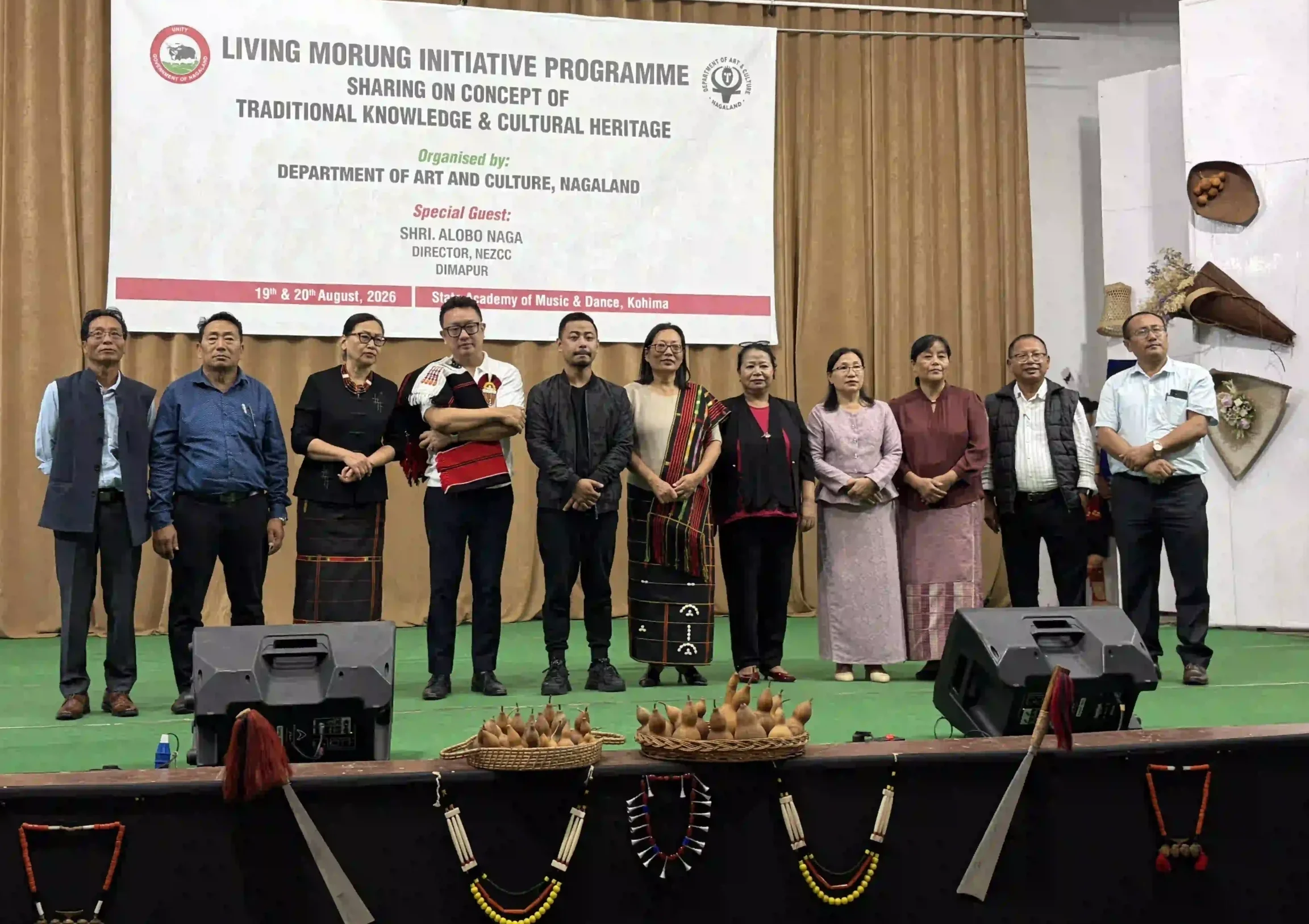
Living Morung initiative held in Kohima
Correspondent