
Kohima, AUG 26 (NPN): The second edition of the Millet Festival, conceptualised and organised by the Kezoma Village Council in collaboration with the Department of Agriculture and allied sectors, Government of Nagaland, was held at Kezoma Village Ground on August 26.
Speaking at the event, Agriculture Production Commissioner (APC) and Commissioner and Secretary, Agriculture and Land Revenue, Dr. Zasekuolie Chusi, said millet had long survived the difficult terrains and slopes of Nagaland where other crops had failed.
He noted that millet’s global importance had resurfaced and assumed particular significance for Nagaland due to its climate resilience.
Chusi explained that millet can withstand drought like conditions, irregular rainfall, heat and poor soil, while its short maturity period and low input requirements make it suitable for cultivation in the state’s hilly and marginal lands. Certain varieties, he added, can even be cultivated more than once a year.
Describing millet as vital for food and nutritional security, Chusi said its relevance extended beyond nutrition, with ongoing research exploring medicinal properties and health benefits.
He urged farmers and communities to reflect on changing agricultural practices, pointing out that many villages were gradually abandoning paddy cultivation as it was no longer economically viable.
He called for integrating traditional knowledge with modern technology to build sustainable livelihoods and strengthen the rural economy.
Referring to Kohima district and Angami areas, Chusi said the region was endowed with favourable conditions for cultivation, including good weather, rainfall, water resources and forests. He urged communities to explore other avenues such as cash crops, poultry and allied activities to enhance rural livelihoods.
Highlighting reports of recurring drought in the Kezo range, Chusi said millet cultivation had helped farmers improve incomes, with some reportedly doubling their earnings. He called for greater convergence among government departments and urged officials from agriculture, veterinary and allied sectors to engage directly with Kezoma farmers and extend assistance in seeds, irrigation, land use, soil conservation and animal husbandry.
Director of Agriculture, Sanuzo Nienu, described the revival of millet cultivation as a “reawakening” among community farmers and assured departmental support to committed farming communities. District Agriculture Officer, Kohima, Kekhrieletuo Yhome, lauded Kezoma for adopting improved practices such as the System of Rice Intensification (SRI), with nearly 98 per cent of its paddy cultivation under SRI.
He also highlighted the adoption of double cropping and provision of threshing and milling machines to reduce labour, save time and minimise post harvest losses.
More than 20 stalls from Kezoma and neighbouring villages showcased local produce. Over 1,000 kilograms of millet harvested in July were sold during the festival, along with organic vegetables, fruits and other village products.
The programme was chaired by organising committee convener Mhasivi Naki, with invocation by Ketholesie Mekro, catechist of St. Mary’s Church, Kezoma. Kezoma Village Council chairman, Kikrosa Naki, delivered the welcome address, while the Kezoma Village Women Society presented a folk tune. The vote of thanks was proposed by organising committee secretary Kedivi Mekro.
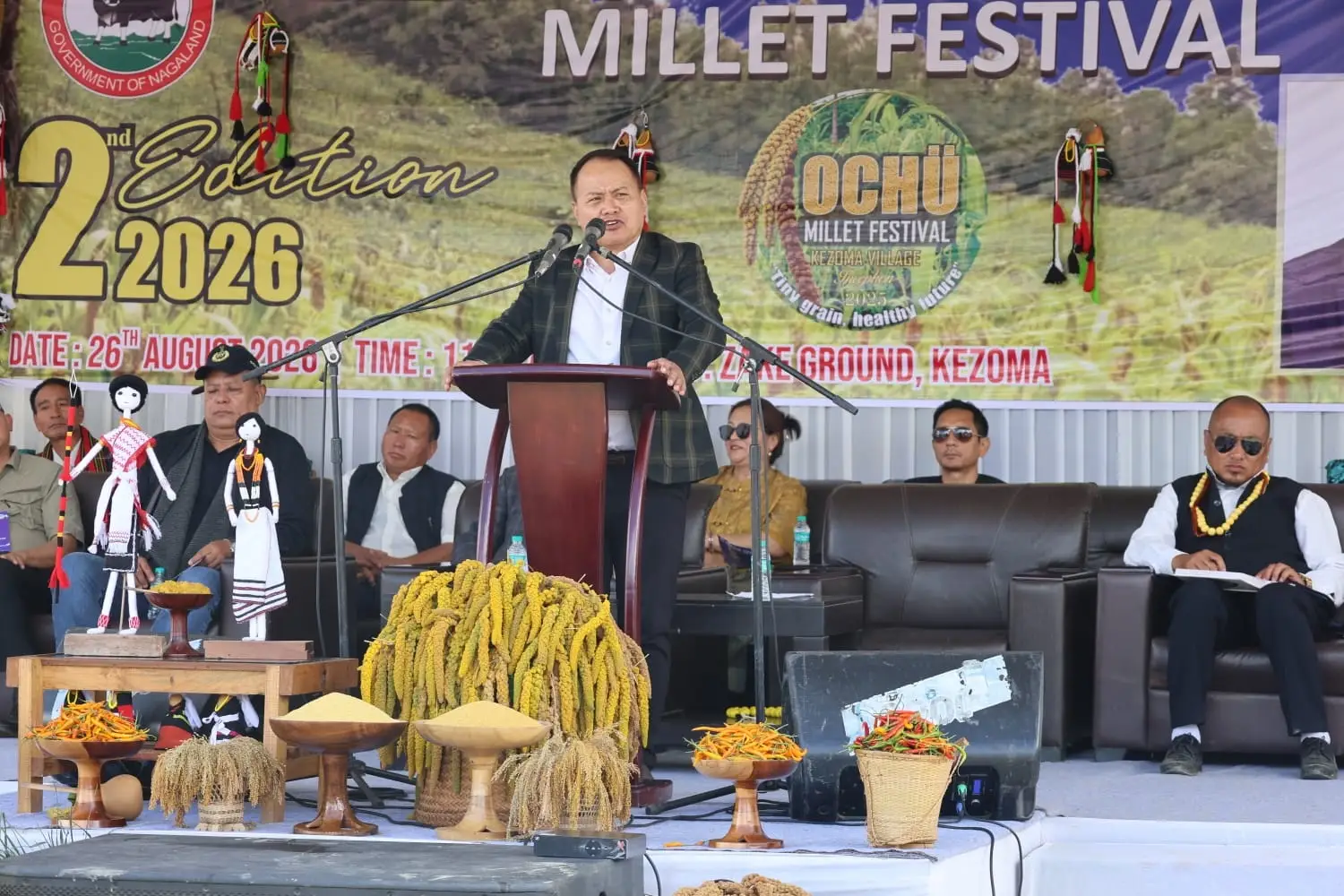
2nd Millet Festival celebrated at Kezoma
Correspondent