
SHILLONG, AUG 26 (NPN): The Meghalaya Assembly on Wednesday unanimously adopted a government resolution opposing mining of uranium and establishment of any uranium ore-processing facility in the state.
The resolution was moved by Chief Minister Conrad Sangma and all members across party lines, including the BJP, supported it.
While tabling the government resolution in the House, the Chief Minister said the House records the opposition of the people of the state to the mining of uranium and establishment of any uranium ore processing facility within the State.
“The resolution will urge the central government, the Department of Atomic Energy, and the Uranium Corporation of India Limited (UCIL) not to permit, pursue, or undertake any uranium mining operations in the state, including the Kylleng Pyndengsohiong Mawthabah uranium mining project, and to close any activity relating to uranium mining anywhere in th state,” he told the assembly.
Sangma said tribal areas of Meghalaya are administered under the Sixth Schedule to the Constitution of India.
“Land within the autonomous districts is held predominantly under community, clan and individual customary tenure. The transfer of land is regulated by the Meghalaya Transfer of Land (Regulation) Act, 1971,” he said.
The Chief Minister also referred to the Supreme Court’s 2019 judgment in State of Meghalaya versus All Dimasa Students Union, which held that in Meghalaya, private land owners as well as community owners have both the “surface right as well as sub-soil right” and thus the tribals in the state own the land and also the minerals.
Uranium-bearing deposits have been identified in Domiasiat, Wahkijn and Lostoin areas of West Khasi Hills and South West Khasi Hills districts, and the Kylleng Pyndengsohiong Mawthabah.
The Chief Minister said the state-owned Uranium Corporation of India Limited (UCIL) contemplates open cast mining of uranium ore and the establishment of an ore processing plant within the Kylleng Pyndengsohiong Mawthabah.
The people, however, through their traditional institutions, autonomous district councils, student and civil society organizations and elected representatives, have consistently opposed mining of uranium in Meghalaya.
“The free, prior and informed consent of the affected communities has at no stage been obtained, and no mining lease for uranium has at any time been granted in the state,” Sangma said.
The Chief Minister said the area where the UCIL had proposed an open cast uranium mining receives very high rainfall, has steep terrain, is landslide-prone and forms the catchment of rivers and streams critical for drinking water, agriculture and livelihoods, and containment of tailings and effluents has not been assured to the satisfaction of affected communities.
While referring to the Office Memorandum issued by the Union Ministry of Environment, Forest and Climate Change, which exempts atomic mineral mining from public consultation, Sangma told the assembly that the Union Minister of State for Atomic Energy had stated in Shillong that no final decision has been made on uranium mining in Meghalaya, as the issue remains under review.
Supporting the government’s resolution against uranium mining, Leader of the Opposition Dr, Mukul Manda Sangma said the people of Meghalaya had opposed uranium mining for decades.
“The resolution should not be viewed merely as a political statement or the achievement of anyone government. But the resolution represented the culmination of a decades-long movement and the collective opposition expressed by the people of Meghalaya,” Dr. Mukul said.
Following the passage of the resolution, the former Chief Minister suggested that the state government should engage with the central government to ensure that no uranium mining or related processing activity is pursued in Meghalaya.
“Governments may change, but the state’s position on an issue involving the health, environment, land and future of its people must remain consistent,” Mukul said.
Opposition Voice of the People Party legislator (VPP) Ardent Miller Basaiawmoit also supported the resolution but questioned the sincerity of the government.
“What will be the fate of this resolution?” he asked, pointing to the 2019 resolution adopted by the Meghalaya Assembly that urged the central government to implement the Inner Line Permit in the state.
Basaiawmoit further asked : “How serious is the need for uranium by the government of India. Does it have any alternative to uranium?”
Meghalaya has an estimated 9.22 million tonnes of uranium ore deposits. Meghalaya is the third uranium-rich state in the country after Jharkhand and Andhra Pradesh.
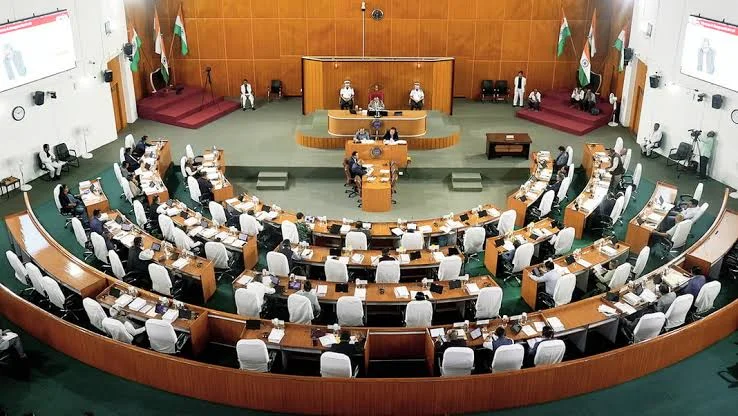
M’laya assembly resolves to oppose uranium mining in state
Correspondent