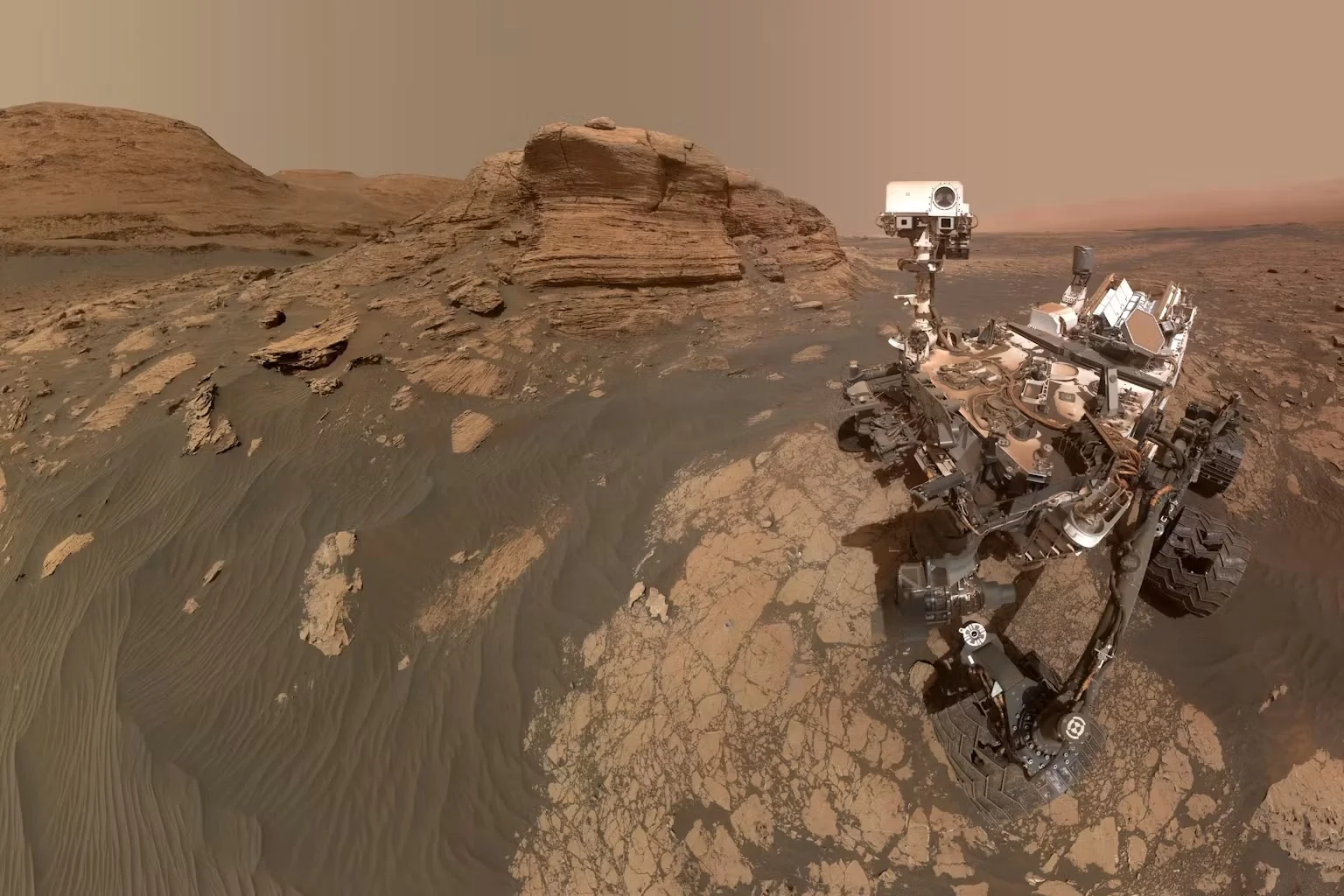
Lights blink on as I enter the Rover Operations Center at NASA’s Jet Propulsion Laboratory in Pasadena, California, at 7:30 a.m. I’m the first to arrive, even though I already feel late.
Sometime during the night on Earth, the Curiosity rover finished its day exploring on Mars and beamed its latest collection of images and measurements to a Mars orbiter zooming by overhead. The orbiter relayed the data to Earth, where it now waits on servers here and at partner institutions around the globe.
Once our rover operations shift kicks off at 8:15 a.m., a few dozen engineers and scientists will have just three hours to check the health of the rover, analyze the new science data and agree on the next set of rover activities. Then we’ll spend another four hours turning those plans into rover commands for tomorrow, making sure they are safe and fit within the rover’s available time and energy. Not long after that, the Sun will rise on Mars, and Curiosity will look toward Earth, expecting its next instructions.
As Curiosity’s project scientist, it’s my job to ensure that what emerges from this rush is a set of measurements that advance the mission’s science objectives and keep it on track to achieve what our team promised NASA and, ultimately, the public. It’s a seemingly overwhelming task given everything that must happen in the next seven hours. But after repeating it over a thousand times since Curiosity landed in 2012, our team has gotten pretty good at it.
NASA Curiosity project scientist Ashwin Vasavada guides this tour of the rover’s view of the Martian surface. NASA created Curiosity to search for evidence of ancient habitable environments, such as those with liquid water and the chemicals, nutrients and energy sources required for life. The investigation called for a long-lived, mobile spacecraft that would allow scientists on Earth to virtually explore a local area on Mars, select and acquire rock samples, and analyze them in onboard laboratories.
JPL responded with the car-size, drill-equipped Curiosity rover. NASA added a suite of scientific instruments and a science team from the United States and around the world.
NASA sent Curiosity to Mars’ Gale Crater to climb Aeolis Mons, a mountain whose 3 miles (5 kilometers) of sedimentary rock layers hold a record of environmental conditions from about 3.5 billion years ago. The evidence suggests that back then a thicker, ancient atmosphere sheltered flowing streams and sparkling lakes.
Curiosity has climbed through a vertical half-mile (1 kilometer) of rock layers so far, finding clay-rich, mudstone layers that give way at higher elevations to younger sandstones full of salty minerals. Our team determined that lakes persisted for millions of years before the climate became arid and sand dunes overtook the lakes, although groundwater occasionally breached the surface to produce streams that wove among the dunes.
Samples Curiosity drilled from the lake sediments contain small organic – meaning carbon-based – molecules, the raw materials for potential life. The association of wet environments, organic molecules and a mix of chemicals similar to those that microbes harness for energy on Earth allowed our team to conclude that conditions in Gale were once capable of supporting life. Determining conclusively whether life actually took hold will require bringing such rocks back to laboratories on Earth.
As my colleagues arrive in the building and online, I’m lost in the latest images. Curiosity is well into the higher and drier strata of Aeolis Mons, yet the rocks have salts, scours and other signs of ancient water. These images suggest that perhaps even Mars’ dry period provided habitats for life. During our previous shift, I asked the engineers who plan the rover’s route to take it into an area that appears exceptionally smooth and flat on images taken from orbit. After years of rough offroad driving, they were excited to open up the throttle and let the rover drive 120 feet (37 meters) across this Martian “parking lot” – a pretty long distance for Curiosity. (Yahoo News)