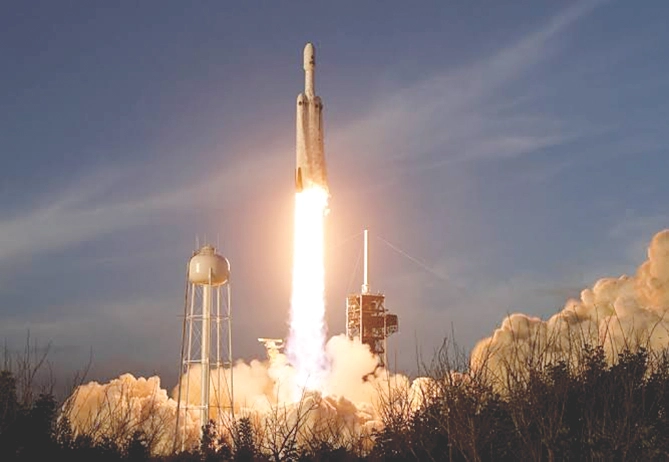
NASA’s newest crown jewel blasted off Sunday to hunt for planets around other stars, explore secret dark energy and survey the cosmos like never before.
SpaceX launched the USD 4.3 billion Roman Space Telescope shortly after daybreak aboard a triple-the-firepower Falcon Heavy rocket from Kennedy Space Centre. Roman blazed toward an observation point 1 million miles (1.6 million kilometres) away that’s home to the Webb Space Telescope, one of NASA’s other big-ticket eyes in the sky.
The bus-sized telescope — named after the late Nancy Grace Roman, NASA’s first chief astronomer — will take more than three months to reach its destination. Once there, it will cast the widest gaze yet on the hidden parts of the universe from space, uncovering the unimaginable with unsurpassed speed.
“It’s going to find thousands of supernovae, tens of thousands of planets, billions of galaxies and tens of billions of stars,” said NASA science mission director Nicky Fox. “It’s going to be able to do things that we’ve never been able to do before with its massive field of view.”
Roman’s field of view is more than 100 times wider than that of NASA’s Hubble Space Telescope, still churning out celestial glamour shots after 36 years in orbit. Webb joined the effort several years ago with an even narrower yet spot-on vision capable of zooming in on objects almost as old as the universe-creating Big Bang.
These three orbiting powerhouses will join forces — along with the European Space Agency’s Euclid spacecraft and the National Science Foundation’s Vera C. Rubin Observatory in Chile — to reveal some of the universe’s biggest secrets.
Inside the countless galaxies awaiting discovery are stars with planets. Once these new worlds are spotted by Roman, the more powerful and sensitive Webb will take aim to fill in the blanks.
“Roman’s vast reach will allow us to find the weird, the rare and the unusual,” senior project scientist Julie McEnery said on the eve of launch. “We’ll redefine what it means to find a needle in a haystack.”
Perhaps even more important, astronomers expect Roman to shed light on the dark matter and dark energy that make up most of the universe yet remain concealed. Roman’s catalogue of galaxies will help scientists ascertain how quickly the universe is expanding due to these puzzling, unseen forces. (AP)