
Staff Reporter
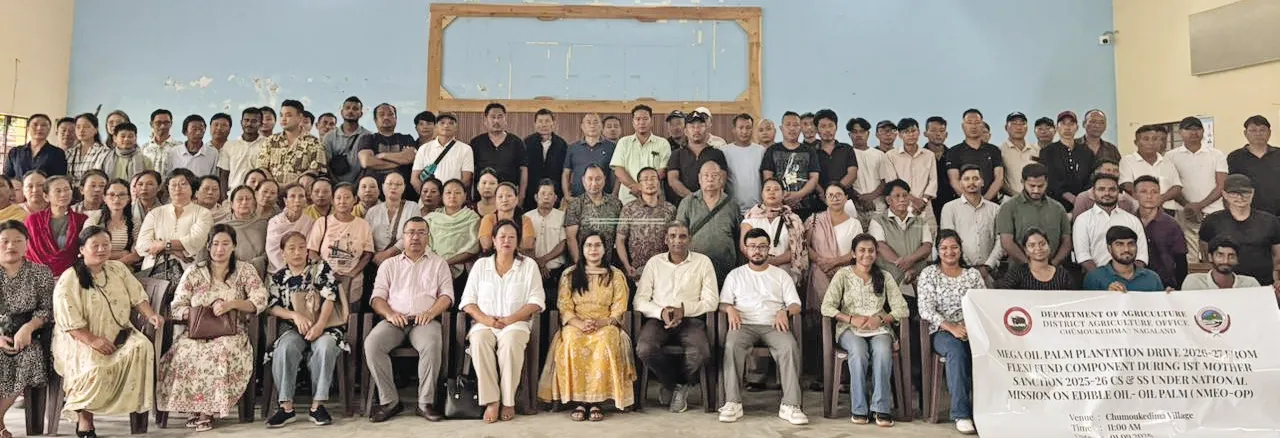
DIMAPUR, SEP 2 (NPN): A Mega Oil Palm Plantation Drive under the National Mission on Edible Oils–Oil Palm (NMEO OP) for 2026 27 was launched on September 1, 2026 at the Chümoukedima Village Council Hall.
Gracing the programme as special guest, Shreyansee Jain, SDO (Civil), said the initiative would help improve farmers’ livelihoods while promoting economic and environmental sustainability in Chümoukedima district. She congratulated the Department of Agriculture for undertaking the drive and urged farmers to avail benefits under the scheme.
Jain described oil palm as not merely an agricultural crop but a commercial and sustainable crop capable of providing economic returns for 30–35 years.
She noted that while farmers in Niuland, Dimapur and Dhansiripar had shown proactive participation, Chümoukedima had witnessed comparatively less interest. She expressed hope that the awareness programme would encourage farmers in the block to take part.
Highlighting India’s dependence on palm oil imports-around 60% sourced from Southeast Asia-Jain said promoting oil palm cultivation would contribute towards self reliance and strengthen production capacity.
She also pointed out that Nagaland’s oilseeds are known for their quality and high oil content, noting that the proposed processing unit at Ganeshnagar would provide market linkages and logistical support.
Delivering the keynote address, Moainla Pongen, DAO Chümoukedima, said oil palm cultivation could improve livelihoods, generate employment and reduce India’s dependence on imported edible oil. She informed that India imports around 140 lakh tonnes of edible oil annually, making it one of the largest importers and consumers.
Pongen explained that the NMEO OP, launched by the Prime Minister in August 2021, aims to reduce import dependence and promote domestic oil production, with special focus on the Northeast due to favourable ecological conditions. She highlighted assured markets for Fresh Fruit Bunches (FFB) with companies like Godrej Agrovet procuring produce, and added that government fixed pricing mechanisms protect farmers against market uncertainty.
She stressed that oil palm is a long term crop capable of providing returns for 25–30 years, urging farmers not to treat free planting material casually. Farmers were advised to inter crop during the initial three years before harvesting begins.
Pongen also noted that Nagaland has two nurseries at Niuland and Tizit, while another is being established by Godrej Agrovet, and that technical approval has been received for a processing mill at Niuland.
She emphasised that merely planting oil palm would not suffice, urging farmers to nurture the trees properly. Giving an estimate, she said one tree could provide a minimum income of around Rs. 5,000 per year, while one hectare (approx. 7.5 bighas) could accommodate 143 trees. She cautioned farmers not to plant beyond their capacity, stressing that smaller areas could yield better returns if properly managed.
Dr. Benjongtoshi Imchen, Senior Officer, GAVL Nagaland, spoke on the scope, opportunities and challenges of oil palm cultivation, citing success stories. The programme concluded with a vote of thanks delivered by Meciesunu Sakhrie, AO.