
FNTA TO ADDRESS DECENTRALISED GOVERNANCE; DEVELOPMENT DISPARITIES IN EASTERN NAGALAND
Correspondent
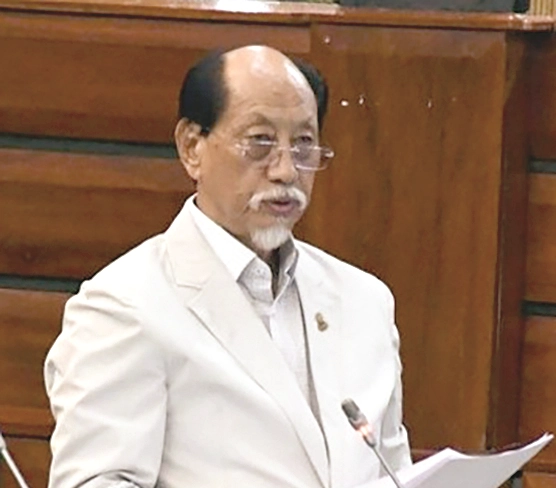
KOHIMA, SEP 3 (NPN): State chief minister Dr. Neiphiu Rio on Thursday said the Frontier Nagaland Territorial Authority (FNTA) would provide an institutional mechanism to address longstanding developmental disparities in Eastern Nagaland while ensuring inclusive growth and strengthening the unity and progress of Nagaland.
Following the discussion, the revised and amended Frontier Nagaland Territorial Authority Bill, 2026 was passed unanimously by the Nagaland Legislative Assembly.
Earlier, taking part in the discussion chief minister Dr. Neiphiu Rio said the State Government remained committed to equitable development and acknowledged that the six eastern districts had suffered developmental deficits because of historical factors, difficult geography and limited state resources.
The revised and amended Bill was subsequently passed unanimously by the Assembly, marking a significant step in the long process towards establishing the special institutional arrangement sought by the people of Eastern Nagaland.
The six districts to come under the proposed FNTA are Tuensang, Mon, Longleng, Kiphire, Noklak and Shamator. Rio said the authority was intended to provide a unique self-governing institutional framework within Nagaland to address the social, economic, educational, cultural and linguistic aspirations of the region through democratic and decentralised governance.
The FNTA proposal emerged from the longstanding demand of the Eastern Nagaland Peoples’ Organisation (ENPO) for a special institutional arrangement to overcome developmental and administrative disadvantages. Rio said the State Government had worked with the ENPO and the Government of India to arrive at a constitutional and peaceful solution.
A major milestone was the signing of a tripartite Memorandum of Agreement (MoA) on February 5, 2026, among the Government of India, Government of Nagaland and ENPO. Under Clause 3.3 of the agreement, the FNTA was to be constituted through special State legislation in consultation with the Ministry of Home Affairs (MHA).
The initial draft Bill, after being vetted by the Advocate General, was submitted to the MHA on March 17 and introduced in the Assembly on March 26 at the request of ENPO. However, on the day of introduction, the MHA asked the State Government to await its views on the proposed conferment of legislative powers.
While ENPO pressed for adherence to the MoA, the Eastern Nagaland Legislators’ Union (ENLU) sought deferment of the Bill until its provisions and concerns were clarified. The Bill was therefore returned and its consideration deferred.
The State Government subsequently revisited the provisions of the MoA and held consultations with stakeholders. Rio said the government remained firm that the special safeguards under Article 371(A) of the Constitution would not be amended or diluted.
Following a June 10 request from ENPO for expeditious constitution of the authority, Rio led a Cabinet delegation to New Delhi on June 24 to meet Union Home Minister Amit Shah. The delegation discussed the constitutional and legal aspects of the proposed authority and requested the MHA to consult ENPO.
The State Cabinet on July 6 decided to convene a special Assembly session to legislate on the FNTA, including legislative powers over transferred subjects and departments, in consultation with the MHA and in conformity with the Constitution.
At the same time, the Cabinet reaffirmed that Article 371(A) safeguards were inviolable and decided to seek an increase in the proposed special development grant from Rs 5,000 crore to at least Rs 10,000 crore.
A revised Bill was prepared on the advice of the Advocate General and submitted to the MHA on July 16. After examining the proposal and consulting the Ministry of Law and Justice and ENPO, the MHA communicated its suggestions on August 11. These included changes to the preamble, wider consultation on postings of officers and enhanced powers for the FNTA relating to transfers and postings.
Rio said he subsequently chaired a meeting with ENPO on August 25, following which the Cabinet incorporated the suggested changes. The revised Bill was again submitted to the MHA in accordance with the MoA and introduced in the Assembly on September 1.
Under the proposed arrangement, funding from the State would take into account population and geographical size, while the Centre would provide necessary funds considering the region’s underdevelopment and infrastructure deficit. The FNTA would prepare annual plans based on grassroots needs, supported by appropriate planning and financial mechanisms, with the State Government responsible for timely release of funds.
Rio stressed that the FNTA should be viewed as more than an administrative arrangement. He described it as a commitment to equitable development and an attempt to bring governance and development closer to people living in the State’s remotest areas.
The Bill received broad support from ministers, advisers and legislators, who repeatedly emphasised that the arrangement was not a demand for separation from Nagaland but an effort to correct regional inequalities.
Minister Bashangmongba Chang termed the Bill a historic moment and said the development of Eastern Nagaland would be integral to the vision of Bharat 2047. Given the region’s strategic location, he said it could emerge as a gateway for Act East initiatives, trade and commerce with Southeast Asia.
Advisor S. Keoshu Yimchunger said the demand was aimed at securing better roads, schools, hospitals and employment opportunities rather than being directed against fellow Nagas. He emphasised that the FNTA would remain within Nagaland and was not a separate State. He also welcomed the provision for a 10-year review of the arrangement.
Advisor Sethrongkyu noted that the aspiration had been pursued for nearly one-and-a-half decades, thanking the Union and State governments, tribal bodies, student organisations, churches and civil society for their contributions. He reiterated that the FNTA was intended as an integral arrangement based on mutual respect, peace and progress.
MLA Dr. Sukhato A. Sema stressed the need for equitable resource distribution and balanced regional development, identifying roads, healthcare, education, water and sanitation, electricity, connectivity, livelihoods, markets, skills and employment as key priorities, particularly for young people.
Advisor Achumbemo Kikon placed the demand in its historical context, referring to the perception of Eastern Nagas as a “backward tribe”. He said the situation had also been shaped by historical circumstances and miscommunication, and maintained that the State Government had not intended to neglect, subjugate or sideline Eastern Nagaland.
Kikon cautioned against future blame games and stressed that responsibility for addressing developmental gaps should not be placed entirely on one side. Importantly, he said the FNTA process would not affect the ongoing Naga political talks or the aspiration for integration of Naga-inhabited areas. He described the arrangement as a “second opportunity” that should be used judiciously for development and called for continued Naga unity.
Advisor Dr. Kekhrielhoulie Yhome said the FNTA could help the State move beyond labels associated with backwardness and urged a new approach to development. Referring to the proposed transfer of 46 subjects, he said economic, human and natural resources should form the basis for measuring progress.
Advisor Z. Nyusietho Nythe said the six eastern districts had been disadvantaged by their distance from the State capital and limited administrative reach and expressed confidence that resources from both the State and Centre would be used judiciously.
Ar Jwenga Seb, MLA said he had initially feared that the FNTA could dilute the momentum of the Naga political issue and create further divisions. After studying the Bill, however, he said he had changed his view and regarded the arrangement as necessary to maintain social cohesion through equitable development.
He emphasised that the Bill was not an instrument of division, but a means of addressing widening regional disparities while protecting Nagaland’s territorial and political integrity. He pointed to the proposed decentralised governance framework, including the transfer of 46 executive subjects to a 62-member regional council and financial autonomy, as mechanisms that could direct resources towards schools, healthcare, infrastructure and employment.
NLA session adjourned sine die
Speaker of the Nagaland Legislative Assembly Sharingain Longkumer on Thursday concluded the ninth session of the Assembly, thanking members for their enthusiastic participation, constructive engagement and valuable contributions. The two-day session witnessed the consideration and passage of six Bills, adoption of one resolution and deliberations on various matters of public interest, apart from Question Hour. The Speaker then adjourned the session sine die.