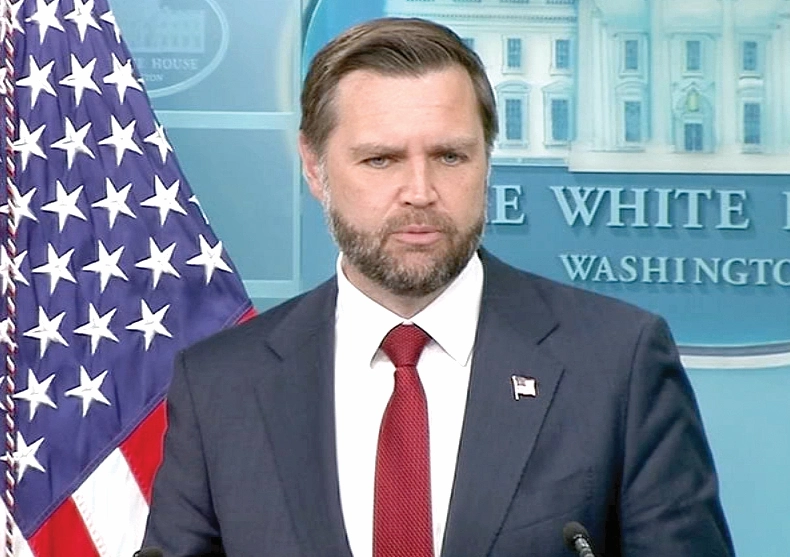
WASHINGTON, SEP 4 (AP): Vice President JD Vance on Thursday rejected the use of the word “war” to describe the US fighting with Iran as he steered clear of predicting that the six-month-old conflict would be over by November’s midterm elections, in which Republicans are trying to hang on to their narrow majorities in Congress.
“I wouldn’t call it a war,” Vance said after being asked during a White House press briefing about whether the fighting could be wrapped up before voters cast their ballots in the November 3 congressional elections. “Right now, there is no active shooting.”
Vance’s assertion came even as Iran fired at US Gulf ally Kuwait on Thursday as it continued to retaliate for rounds of US strikes on Iran earlier in the week.
The vice president said the US had a “responsibility” to carry out this week’s strikes because Iran continues the targeting of commercial vessels passing through the Strait of Hormuz.
Vance’s attempt to minimize the intensity of the fighting illuminates the difficult task at hand for Trump and his administration as he tries to persuade American voters to keep Republicans in control of Congress, even as the unpopular conflict — one the White House said at its outset would last a matter of weeks — has driven up gas prices and left consumers grappling with higher inflation. Vance said he didn’t want to set “artificial timelines.”
“But when you ask, ‘When will this end?’ You’re asking me a question like, ‘When will the Iranians stop shooting at ships?’” Vance said. “I think the reality is, I don’t know the answer to that question. You would have to ask the Iranians.”
The administration in July faced scrutiny after it reclassified four fallen soldiers as well as dozens of wounded troops in its Defence Casualty Analysis System, which Pentagon officials have repeatedly pointed to as the definitive source on the numbers of dead and wounded from the conflict.
Those killed or wounded in fighting after a brief ceasefire between the US and Iran fell apart were classified in a new category called “Overseas Operations” after initially being tallied in the totals from the war.
WH insists more oil is getting out of Gulf, but prices remain high
Brent crude prices hovered above USD 95 per barrel on Thursday. The international benchmark was around USD 72 per barrel the day before the conflict began.
Still, Trump and his aides have sought to push that the US Navy is in control of the Strait of Hormuz, which accounted for about 20 per cent of the flow of the world’s oil prior to the start of the war. They insist a near pre-war level of Gulf oil is now making its way out of the critical waterway.
Vance at Thursday’s press briefing said the US escorted about 15 million barrels of oil on Wednesday. This is after Energy Secretary Chris Wright told CNBC on Wednesday that 17 million barrels were carried through the strait on Monday with assistance from the US Navy. About 20 million barrels of Gulf oil flowed through the strait prior to the start of the war.
But ship traffic through the strait remains well below pre-war levels, according to independent firms that track marine traffic.
There were 102 transits last week and 126 the week before, according to shipping data company Lloyd’s List Intelligence, compared with 130 or more per day before the war.
Over the past 28 days, 5 million barrels a day have exited the strait on average, according to TankerTrackers.com. Other recent estimates have varied from 2 million barrels per day to 6 million barrels per day.