
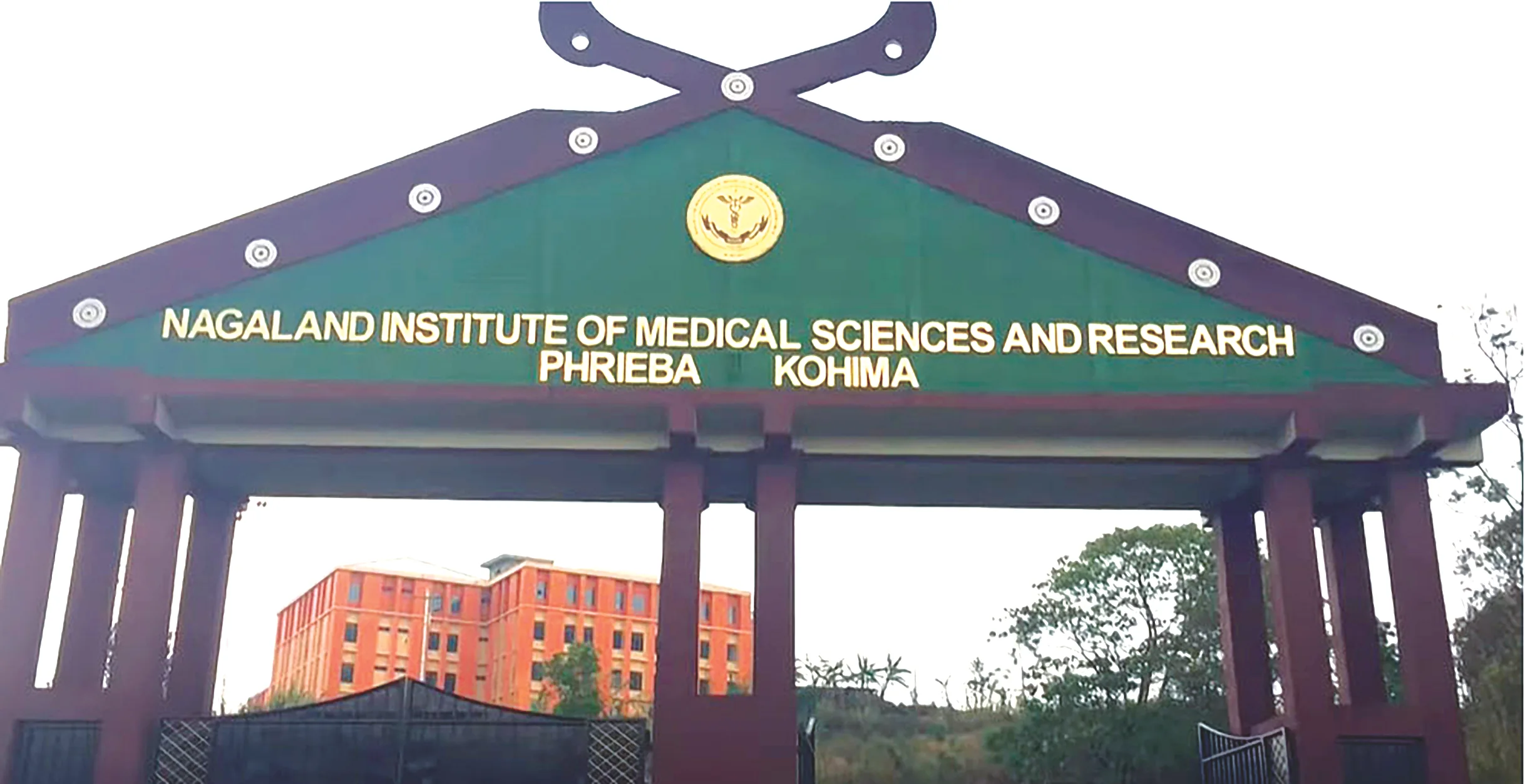
Association warns state’s first medical college faces possible de-recognition
DIMAPUR, SEP 5 (NPN): Nagaland In-service Doctors Association (NIDA) has flagged serious anomalies of three years of mounting incidences of irregularities and discrepancies which kept emerging into the MBBS program at the state’s first ever medical college- Nagaland Institute of Medical Sciences and Research (NIMSR).
NIDA said it had been closely monitoring the events and raised serious and urgent concerns and also written several representations to the appropriate authority for corrective measures on violations of established norms.
Medical education without faculty: NIDA pointed out that NIMSR is currently running its MBBS course without any faculty member in the Paediatrics Department and with only one faculty member in departments such as Pharmacology, raising concerns over the possibility of de-recognition by the National Medical Commission (NMC). NIDA said it has been pressing for more than a year for the urgent recruitment of adequate teaching faculty and has sought advertisement of the vacancies under the Teachers Eligibility Qualification (TEQ) 2025.
According to NIDA, before TEQ 2025, NIMSR made a hurried attempt to recruit faculty beyond the required vacancies. It also said such recruitment could impose an additional financial burden on the State government and reduce employment opportunities for indigenous doctors.NIDA said TEQ 2025 provides an opportunity for competent and eligible indigenous doctors, particularly those with government-sector experience, to fill the available faculty vacancies.
Monopoly: NIDA has raised concerns over the concentration of administrative authority at NIMSR in a single Director-cum-Dean without supporting senior officers. IT said the institute should ideally have six separate heads—Director, Dean (Academics), Deputy Director (Administration), Deputy Director (Finance), Registrar and Medical Superintendent.
It said the existing arrangement creates excessive dependence on one individual, risks administrative monopoly and could affect the institute’s efficient functioning. NIDA also expressed concern over the institution’s functioning when the Director-cum-Dean is on leave or away on official duty, as NIMSR may be left without a competent executive head with full administrative authority.
NIDA also has raised concerns over the reported use of the National Medical Commission (NMC) to pressure authorities and justify certain demands at the NIMSR.
It said an earlier attempt to recruit faculty beyond sanctioned vacancies was reportedly justified on the grounds of possible NMC de-recognition. It said NIMSR must meet the NMC’s Minimum Standard Requirements (MSR), but the norms should not be used to justify demands beyond the requirements that could impose additional financial liabilities on the government.
At the same time, NIDA pointed out that NIMSR’s failure to recruit adequate faculty for over a year, while allowing academic semesters to continue without faculty in some departments, could itself jeopardise NMC recognition.
NIDA urged the authorities to act urgently and called for separation of the Director and Dean posts and deployment of a complete administrative team to strengthen NIMSR.
Society pretext: NIDA has alleged that the NIMSR has, on several occasions, bypassed official procedures by citing its status as a ‘Society’.
NIDA said technical inputs from the Directorate of Health and Family Welfare were sought mainly when NIMSR faced legal issues, had to respond to show-cause notices from the National Medical Commission (NMC), or required government funds. It alleged that this had reduced the Directorate to a “safety net” during difficult situations.
NIDA further claimed that former Deputy Directors (Administration and Finance), deputed from the respective government departments, were removed after attempting to establish government protocols and procedures for administrative and financial accountability.
NIDA said routing NIMSR’s official administrative matters through the Directorate would provide an oversight mechanism and help mentor and guide the nascent medical college while ensuring greater administrative and financial accountability.
Unions banned: NIDA has alleged that NIMSR is suppressing students’ rights and grievances by banning student welfare unions and representative bodies. NIDA said the NMC encourages student councils and unions under its 2009 regulations. However, it alleged that NIMSR authorities have prohibited such student representation, preventing students from raising grievances.
The association claimed the ban was aimed at stopping students from voicing concerns over issues including compulsory uniform purchases and use, inadequate transportation facilities and high mess fees. NIDA said student representation was necessary to provide students with a platform to raise concerns and seek redressal from the authorities.
Faculty exodus: NIDA also claimed that more faculty members were leaving NIMSR , while several others were reportedly in line to leave. Despite the growing faculty shortage, NIDA alleged that NIMSR authorities were making no efforts to recruit the much-needed teaching faculty. The association expressed concern that continued faculty attrition, coupled with the lack of fresh recruitment, could further affect the functioning of the medical institute and its academic programmes.
The Nagaland In-Service Doctors Association (NIDA) said it had no pride or pleasure in issuing the statement but felt morally bound to speak out on matters affecting public interest. It said the State’s lone medical college was a matter of pride and deserved the best faculty and administrators to produce quality doctors.
7 Steps: NIDA suggested seven measures to strengthen and safeguard the NIMSR such as (1). immediate faculty recruitment under TEQ 2025,(2) segregation of the Director and Dean posts(3)deputation of full time Deputy Directors for Administration and Finance, a Registrar and appointment of a Medical Superintendent; (4) Inclusion of more medical subject experts in decision-making bodies for NIMSR to give technical inputs(56) routing official correspondence through the Medical Education Unit of the Health and Family Welfare Department to act as oversight and guidance mechanism, (6) appointment of competent personnel to technical posts through proper procedures and (7) establishing a separate Directorate of Medical Education to streamline and regulate medical and paramedical education in the State.
NIDA said several alleged irregularities at NIMSR, including granting Central Pay Scale to non-faculty employees, NPA to non-doctor staff and appointments without advertisements, warranted proper investigation. However, it said the immediate priority was ensuring adequate faculty and filling vacant administrative posts to stabilise the institute. NIDA called for a complete revamp of NIMSR’s administrative system, recruitment of faculty as per Minimum Standard Requirements, and constitution of neutral bodies to examine administrative and financial matters, investigate irregularities and recommend corrective measures. It warned that failure to act urgently could jeopardise students’ careers and threaten NIMSR’s existence.