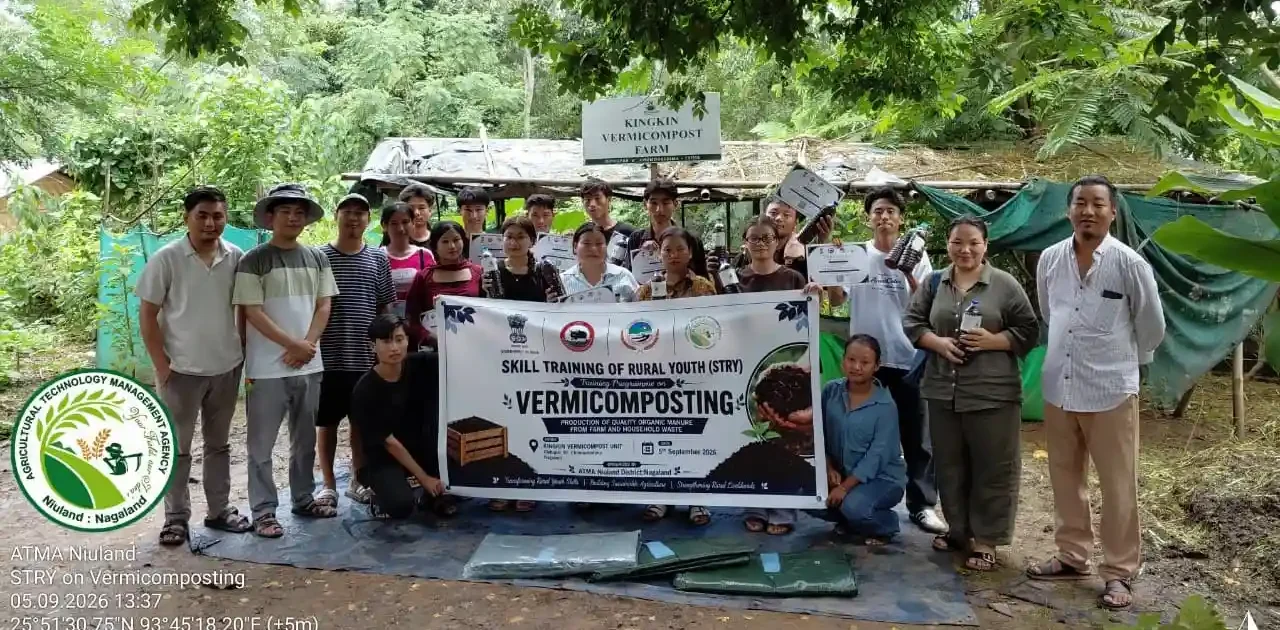
DIMAPUR: Agricultural Technology Management Agency (ATMA), Niuland district organised a Skill Training of Rural Youth (STRY) programme on vermicomposting from September 4-5, 2026 at KingKin Vermicomposting Unit, Diphupar ‘B’. The programme was attended by 15 rural unemployed youth aged 18–35 years.
The training aimed to impart practical skills in vermicomposting, promote conversion of farm and household biodegradable waste into quality organic manure, and create awareness among rural youth about vermicomposting as a source of self employment and income generation.
The programme was chaired by Kaiho Achumi, Assistant Technology Manager (ATM), ATMA Niuland. Avitoli K. Yeptho, Deputy Project Director, ATMA Niuland, delivered the introductory and welcome address, highlighting the importance of skill development and encouraging participants to utilise the knowledge gained for livelihood generation and dissemination of agricultural technologies.
Technical sessions and practical demonstrations were conducted by Sharong Mangyang and Dr. Limasunep Ozukum, co owners of KingKin Vermicomposting Unit, who served as resource persons. They shared practical experiences on aspects such as raw material selection, site preparation, vermi bed construction, earthworm introduction and management, moisture maintenance, feeding, harvesting, storage and utilisation of vermicompost.
A major highlight was the hands on component, where participants were divided into three groups. Each group was provided with a vermi bed plastic and earthworms, and guided through the process of establishing a vermicomposting unit. The group based approach aimed to enable replication of the technology beyond the training, encouraging participants to expand production, produce vermicompost for agricultural use, and explore its sale as an income generating activity.
The training also emphasised the entrepreneurial potential of vermicomposting, particularly the use of locally available biodegradable waste as a resource. Participants were sensitised on how recycling organic waste contributes to cleaner surroundings, improved soil health, sustainable agriculture and livelihood generation.
At the conclusion, participants expressed gratitude to ATMA Niuland and the resource persons, noting that they had gained considerable knowledge and practical understanding of vermicomposting. Mlato Swu, ATM, ATMA Niuland, delivered the vote of thanks.
The programme concluded with the objective of creating a group of skilled rural youth capable of adopting, replicating and disseminating vermicomposting technology, while exploring its potential as a small scale enterprise and source of supplementary income.