
Staff Reporter
DIMAPUR, SEP 7 (NPN): Nagaland Pollution Control Board (NPCB) has cautioned producers and manufacturers in the state to comply with Extended Producer Responsibility (EPR) obligations, warning that failure could invite regulatory action, including closure of establishments.
Senior Environmental Engineer Er. Aghali A. Swu stated this during the interactive session of the Workshop cum Sensitization Programme on Environmental Rules and Compliance, held on the occasion of “International Day of Clean Air for Blue Skies 2026” under the theme “Clean Air, Healthy Choices: Acting Together for People and Planet.”
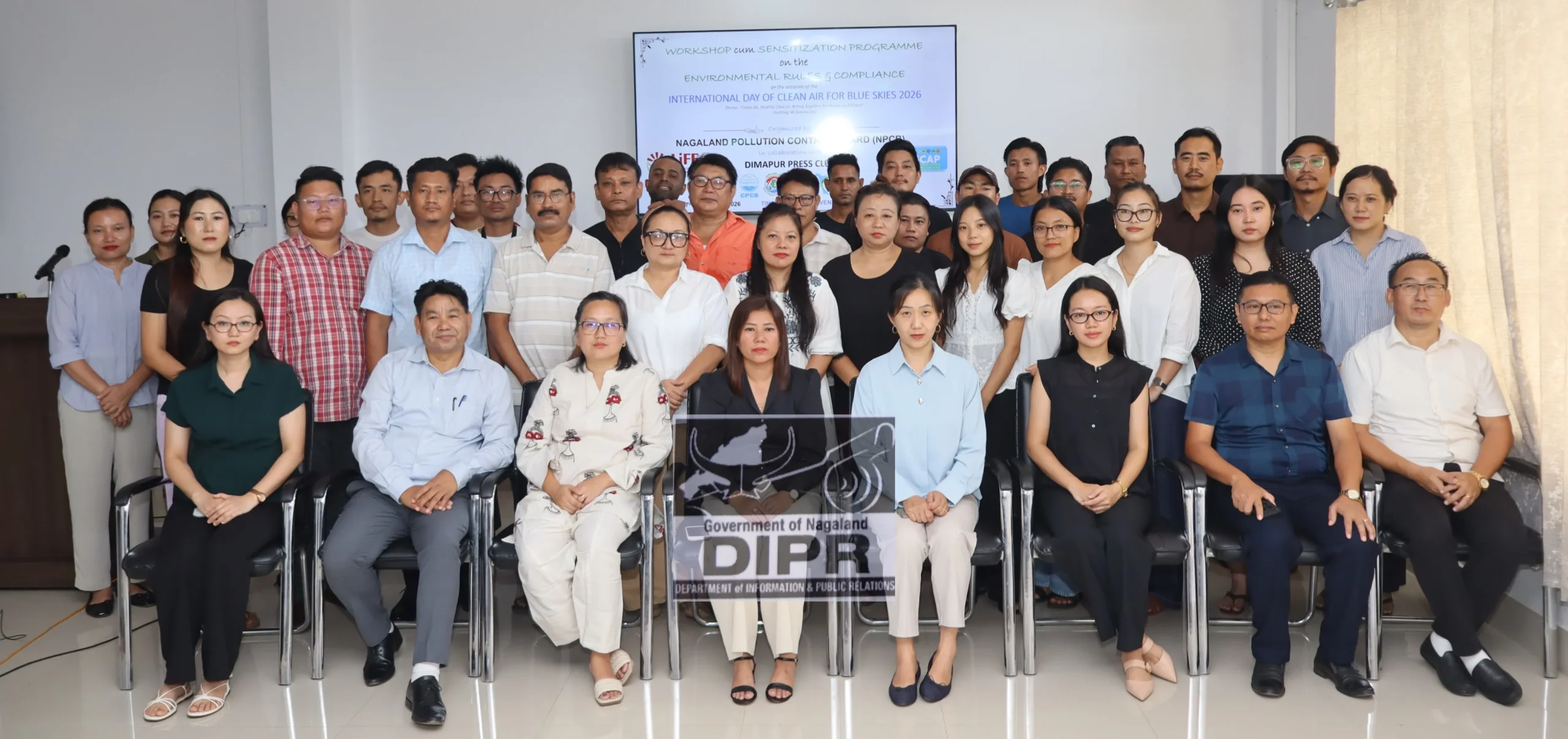
Organised by NPCB in collaboration with Dimapur Press Club (DPC), the programme was attended by members of the media fraternity, DIPR and NPCB officials.
Er. Swu explained that EPR is an environmental policy principle under which producers and other obligated entities are responsible for managing waste generated from their products, including collection, recycling, processing and environmentally sound disposal. She said NPCB has the mandate to monitor compliance and can invoke Section 5 of the Environment (Protection) Act, 1986 to take action against violators.
Er. Swu explained that the Board first issues directions and provides a timeline for EPR registration and compliance. Failure to comply could lead to a show cause notice, followed by further action, including closure. She added that NPCB can also advise Urban Local Bodies (ULBs) to cancel trade licences of businesses failing to meet environmental and waste management requirements.
Delivering the keynote address, Er. Swu noted that many businesses remain unaware of waste management rules and their responsibilities. She stressed that the workshop aimed to raise awareness and inspire collective action by governments, industries, communities and individuals to improve air quality.
Citing World Health Organization (WHO) findings, she said a large majority of the global population is exposed to polluted air, while air pollution has emerged as a major health risk in India. Locally, Dimapur and Kohima have been identified as “non attainment cities,” failing to meet prescribed National Ambient Air Quality Standards.
She further highlighted concerns over groundwater depletion, referring to a University of Michigan study published in Science Advances, which warned of rising temperatures contributing to increased groundwater withdrawal in India. “Climate change is happening faster than we ever imagined and it is high time that we all take collective action before it is too late,” she cautioned.
Er. Swu emphasised that environmental concerns are global and urged the media to play a proactive role in educating the public. She said journalists must remain updated on environmental Acts, rules, scientific data and emerging challenges to report accurately.
DPC vice president Bendangchuba, in his remarks, acknowledged that environmental issues often receive less coverage compared to politics and governance. He observed that reporting tends to be reactive, surfacing only during disasters, and called for greater cooperation between NPCB and the media fraternity. He urged NPCB to provide regular updates on air quality, pollution hotspots, water quality and violations, enabling journalists to translate technical data into meaningful public interest stories.
He stressed that environmental journalism should focus on local realities such as health impacts of air pollution, open burning of garbage and indiscriminate dumping of waste. “A cleaner environment is not the responsibility of the Pollution Control Board alone, or of the government alone, or of the media alone. It is a shared responsibility,” he said, adding that environmental damage could take generations to recover.
During the technical sessions, junior scientist assistant (JSA), NPCB, Rongsenben Longkumer, spoke on the topic, “Ambient Air Quality & its impact”, JSA, Hanpong Y Konyak, on “Noise Pollution (Regulation and Control) Rules, 2000”, Scientist ‘C’, NPCB, Akangmeren Imchen, on “Water Quality & its impact”, Asst. Environmental Engineer, NPCB, Er. Kevisede Pucho, on the topic, “Hazardous and Other Wastes (Management & Transboundary) Movement Rules, 2016 (as amended)”, Scientist ‘B, NPCB, Limitsa Sangtam, on the topic, “Battery Waste Management Rules, 2022”, Scientist ‘B, NPCB, Mvudzeviu Shuya, on “E-waste Management Rules, 2016 (as amended)”, Scientist ‘B, NPCB, Mvudzeviu Shuya, on “E-waste Management Rules, 2016 (as amended)”, Senior Scientific Assistant, NPCB, Sentinaro Angami, on “Plastic Waste Management Rules, 2016 (as amended)”, Junior Environmental Engineer, NPCB, Nikato Swu, on “Bio-Medical Waste Management Rules, 2024”, Scientist ‘B’ NPCB, Yanathung Kithan, on “Solid Waste Management Rules, 2026”, and Sr. Environmental Engineer, NPCB, Aghali A. Swu, on “Consent management & environmental compliance of industries”.