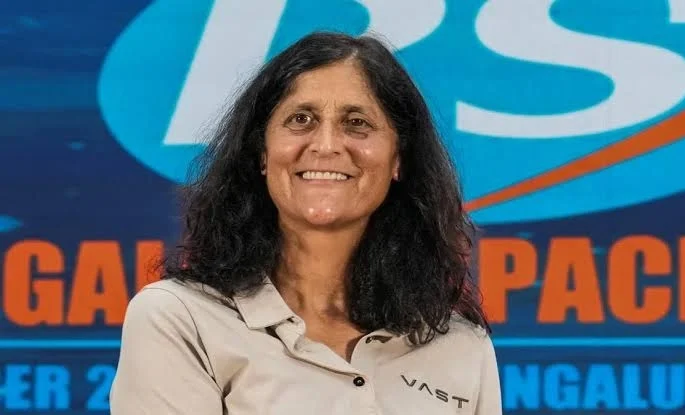
Renowned astronaut Sunita Williams on Wednesday said greater international cooperation is needed for future human spaceflight, and that humanity would return to the Moon and go farther into space “as human beings, not as one country.”
She was speaking during an interaction on ‘The Next Chapter of Space: A Conversation on Exploration, Science and Innovation’ at the ninth edition of the Bengaluru Space Expo here.
Williams said countries could benefit from each other’s approaches to solving problems as they prepared for increasingly ambitious exploration missions.
Responding to a question on international cooperation in human spaceflight, she said, “International cooperation is wonderful because we see how other cultures think and solve problems. We get to compare modules, spacesuits, and experiments.”
She said that as “we go back to the Moon and further, we are going as human beings, not as one country. We need all those thought processes to solve new problems.”
Williams said future space stations would need to become more self-reliant as humans travelled farther from Earth.
“On Earth, you can pull out your phone and find the answer to any question. On the ISS, we don’t have that database. We rely on communication with the ground. For future stations, especially as we go farther with communication delays, we need that database onboard to troubleshoot things,” she said.
She highlighted the need for reliable 3D printing and the ability to analyse experimental data and samples in space instead of sending them back to Earth.
Tom Shelley, Vice President, Crew Partnerships, VAST Space, said the US company, which is five years old, was building what would become the first commercial space station, Haven-1, scheduled to launch next year.
“We are trying to develop as quickly and safely as possible, and at a more sustainable cost. The ISS took a huge investment from many countries. We want to show it can be done quicker and more efficiently to provide a platform for governments, private individuals, and private companies to do important scientific research,” he said.
On implementing new ideas on the International Space Station, Williams said future commercial stations such as those being developed by VAST could allow things to move faster.
“That is one thing I like about future commercial stations like VAST. We can do things quicker. On the ISS, we have bureaucracy because we want to be safe and reliable, and the station is very busy,” she said.
Group Captain Angad Pratap, one of the astronauts selected for the Gaganyaan Mission, said India still needed critical technologies for the Bharatiya Antariksh Station, including regenerative life-support systems, a functional Extravehicular activity spacesuit and docking capability.
BAS will offer a platform for microgravity research and scientific studies in fields such as life sciences and medicine.
“We are at a stage where we cannot do things one by one. We have to think about the transportation vehicle, the space station, and the lunar mission all at once. It is telescopic,” he said.
On Gaganyaan, Pratap said the programme was about acquiring the capability to launch humans into space domestically from India.
“Gaganyaan may sound like just sending one person for one orbit, but it lays the foundation for much bigger things. The ultimate aim is to push the boundaries of human knowledge. Technology will be shared between the private sector and government sector,” he said.
On the role of robotics and AI, Williams said humans, technology and robotics needed to work together. (PTI)