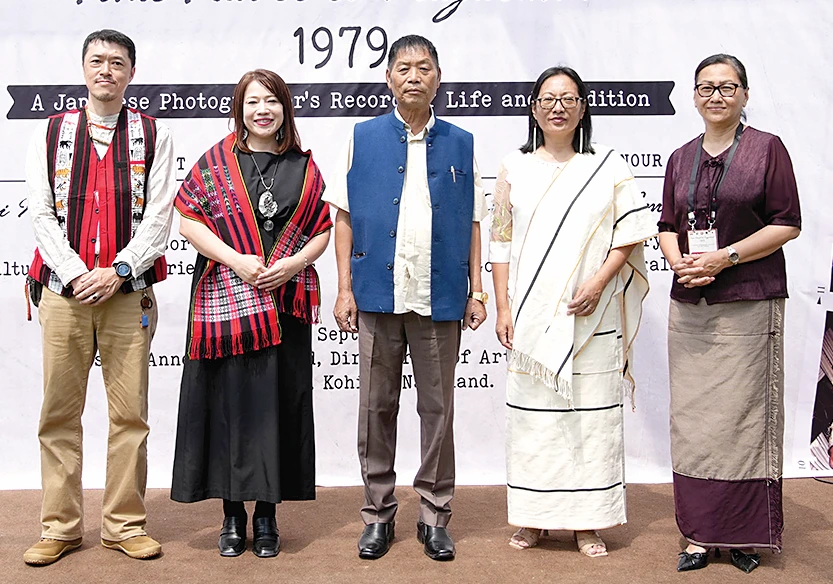
A joint photography exhibition documenting Nagaland’s people, traditions and everyday life as captured in 1979 by Japanese ethnographic photographer Yuzo Morita was inaugurated at the Museum Annexe Courtyard, Directorate of Art & Culture, Bayavü Hill, Kohima, on Wednesday.
Titled “Time Travel to Nagaland 1979: A Japanese Photographer’s Record of Life and Tradition,” the exhibition features selected photographs taken by Morita during his extensive travels across Nagaland more than four decades ago.
Speaking at the inaugural programme, Advisor, Art & Culture and Treasuries & Accounts, K. Konngam Konyak, said the exhibition offered an opportunity to look back at Nagaland through Morita’s photographs, which document its people, traditions, landscapes and everyday cultural life.
Konyak also highlighted the collaboration between the Nagaland State Museum and the National Museum of Ethnology (NMoE), Osaka, Japan, saying the partnership provided opportunities for cultural exchange, research, documentation and knowledge sharing.
As part of the collaboration, the Database of Naga Collection at NMoE, Osaka, and the Digital Archives of Morita’s Photography Collection were also launched during the programme.
Giving an overview of the exhibition, Director, Art & Culture, Adela Moa, and Associate Professor, National Museum of Ethnology, Osaka, Emi Okada, said NMoE houses 249 artefacts related to the Naga people. These include items presented to Morita by people in Nagaland during his 1979 visit, with the collection comprising several shawls and ornaments, including necklaces and headdresses.
The exhibition is being organised as a follow-up to the Statement of Cooperation signed between NMoE, Osaka, and the Nagaland State Museum on August 5, 2025.
The project brings together historical photographs, museum collections and the communities connected to them, with the aim of encouraging conversations and shared understanding across generations.
The exhibition project team comprises Okada as Project Director and Ethnomusicologist, Hitoshi Endo as Project Member and Archaeologist, and Mitsuko Watanabe as Project Member and Geographer.
The programme also featured folk performances by Rüsokhrie Krotho, Kohima Village, and the Pochury Cultural Troupe, Kohima. The four-day programme includes lectures on September 17 and 18. The sessions will cover traditional polyphony, indigenous knowledge systems and the preservation and transmission of material culture.
The exhibition is part of the continuing cultural and academic engagement between Nagaland and Japan, using photographs and museum collections to connect contemporary audiences with aspects of Nagaland’s past.
(Correspondent)