
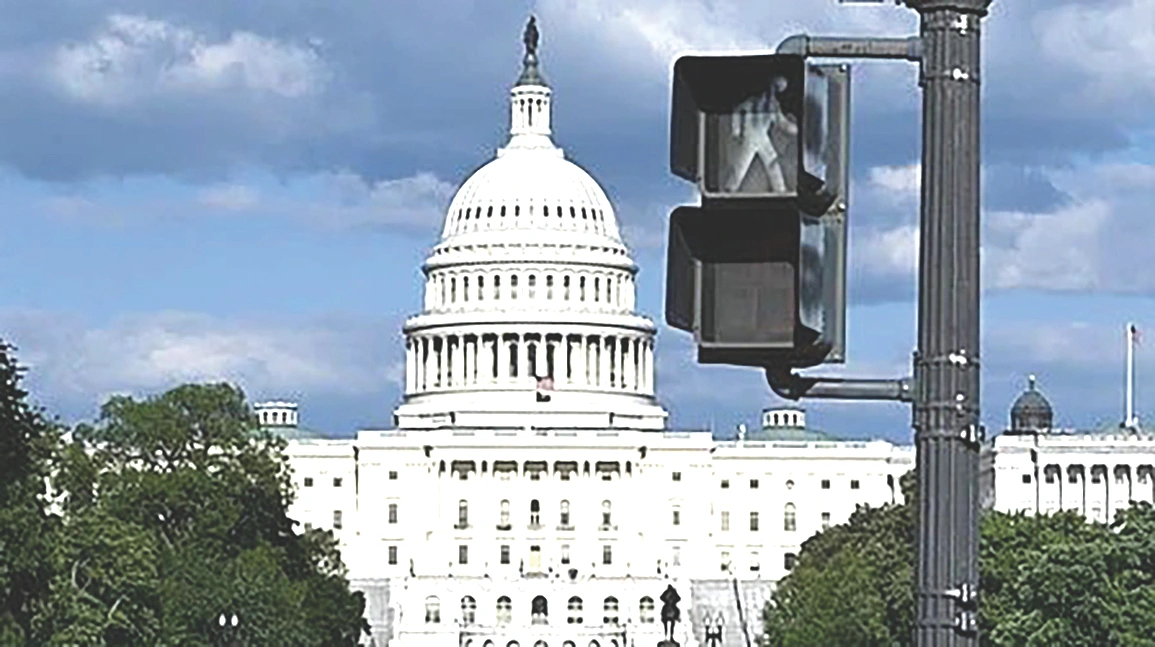
WASHINGTON, SEP 17 (AGENCIES): For a third time, the US House has voted to end the war in Iran, approving a war powers resolution that would halt President Donald Trump’s ability to continue military action without congressional approval.
The roll call late Tuesday, 220-204, was similar to earlier efforts this summer, with a few more Republicans joining all Democrats voting to bring an end to the conflict.
Seven House Republicans backed the resolution, including three voting in favour for the first time.
Iowa congressman Zach Nunn, a Republican, explained his vote saying that “with the negotiating window closed, sustained combat operations now require congressional authorization.” “I will not support another open-ended war,” Nunn said.
None of the resolutions has made it to the president’s desk, where Trump would almost certainly veto the measure.
Republican Representative Brian Mast of Florida, the chairman of the House Foreign Affairs Committee, questioned which military resources Democrats would want to remove from the region where he said Iran remains a threat.
Mast said Trump is against “forever wars, and that is what he is ending” – the decades of hostilities from Iran.
“They are a continuous ongoing threat to the United States,” Mast said. “Enough is enough.”
The action is likely to be the last House vote on the Iran war ahead of the midterm elections, where the conflict overseas is playing a substantial role in the political campaigns. The war that Trump launched on February 28 has dragged on, with on-again, off-again deadly missile strikes being exchanged and causing havoc in the region for nearly seven months.
Lawmakers are heading home at the end of the week to campaign nearly full-time, with fewer than 50 days to go before the elections that will determine control of Congress as Democrats try to wrest power from Republicans.
The US war on Iran is worsening inflation and straining the country’s munitions stockpiles, a report from the nonpartisan Congressional Budget Office (CBO) has found.
The report, released on Tuesday, found that the cost of the six-month war has reached $38bn and is expected to rise by $3bn per month.
The war is projected to increase inflation by 0.5 percentage points in the first three months of 2027.
Trump himself had promised not to involve the US in foreign wars when he won a second term in the White House, and his actions against Iran are weighing on the Republican Party that controls the House and Senate.
Most Americans say the war in Iran has not been worth fighting, according to an AP-NORC poll in July.
Congress has tried repeatedly to alter the trajectory of the war against Iran, but efforts to limit the Trump administration’s military action remain a long shot so long as the president can fend off or veto the measures.
The House first approved a war powers resolution in June, and followed up with another one in July, both seeking to halt US action in Iran. The Senate on its 10th try also approved a war powers resolution to end the conflict, but Republican senators quickly reversed course the next day after Trump berated them during a closed-door lunch.
While the Constitution gives Congress the authority to declare war, it also gives the president authority as the commander-in-chief to engage in some military actions. The War Powers Act, created after the Vietnam conflict, sought to impose a more specific time limit on the president’s power, requiring congressional approval for sustained military actions after 60 or 90 days.
UN-backed experts cite possible US war crimes in Iran strikes
GENEVA, SEP 17 (AP): Human rights experts commissioned by the UN’s top human rights body say they have found “reasonable grounds” to believe the United States committed war crimes in two strikes in Iran, including on a school in the southern city of Minab.
The international fact-finding mission on Iran says the findings center on a pair of airstrikes that killed at least 178 civilians, including women and children.
At the start of the U.S.-Israeli war against Iran in February, at least one U.S. missile hit the Shajareh Tayyebeh school in Minab, according to an Associated Press investigation. There has been no final accounting of what happened. Iranian state media have said 168 people were killed in the strike, most of them children. “Following the United States and Israeli attacks on 28 February, the mission found reasonable grounds to believe the United States committed the war crime of launching indiscriminate attacks resulting in the loss of life or injury to civilians or damage to civilian objects,” the fact-finding team said in a statement. The Trump administration has yet to directly accept the blame or release findings of a Pentagon investigation into the school bombing. The UN-backed team cited the allegations of war crimes over two strikes — one involving Tomahawk missiles on the “clearly identifiable” school, and another airstrike where precision strike missiles dispersed tungsten pellets over a “clearly identifiable sports complex and residential area” in the southern city of Lamerd, also on Feb. 28.
The UN-backed team said 22 civilian men and women were killed. U.S. Central Command has denied responsibility for the strike on Lamerd. The team also said that killings by state security forces occurred on a “staggering scale” in Iran, and alleged crimes against humanity committed by the Iranian government.
It said civilians were caught between “gross human rights violations and crimes against humanity committed by their own government and the nation’s deadly conflict with the United States and Israel.”
The fact-finding mission on Iran, chaired by jurist Sara Hossain of Bangladesh, is made of of independent experts and was created in 2022 by the Human Rights Council, the UN’s top human rights body.
Both US and Iran should provide reparations, they say: The experts said the United States and Iran should halt all rights violations and crimes, and provide “full reparations to victims.” The report, built on a “victims-centred approach,” was based on interviews with 73 people both inside and outside Iran, along with documentation, satellite imagery, photographic and video material and information from “credible” organizations and experts, the experts wrote.
The ongoing conflict that has driven people from their homes in Iran as well as an internet shutdown and a lack of full cooperation from the two governments partially impeded the team’s efforts to get information.
Nearly three dozen requests from the experts for information from Iran’s government went unanswered, they said, as have requests in June to the US government for information and meetings with officials.