
Staff Reporter
DIMAPUR, SEP 18 (NPN): Lawmakers from the North East region on Friday highlighted gaps in the implementation of the National Education Policy (NEP) 2020, ranging from employability and student retention to school access, funding and digital literacy, while calling for approaches tailored to the region’s distinctive social, geographic and economic realities.
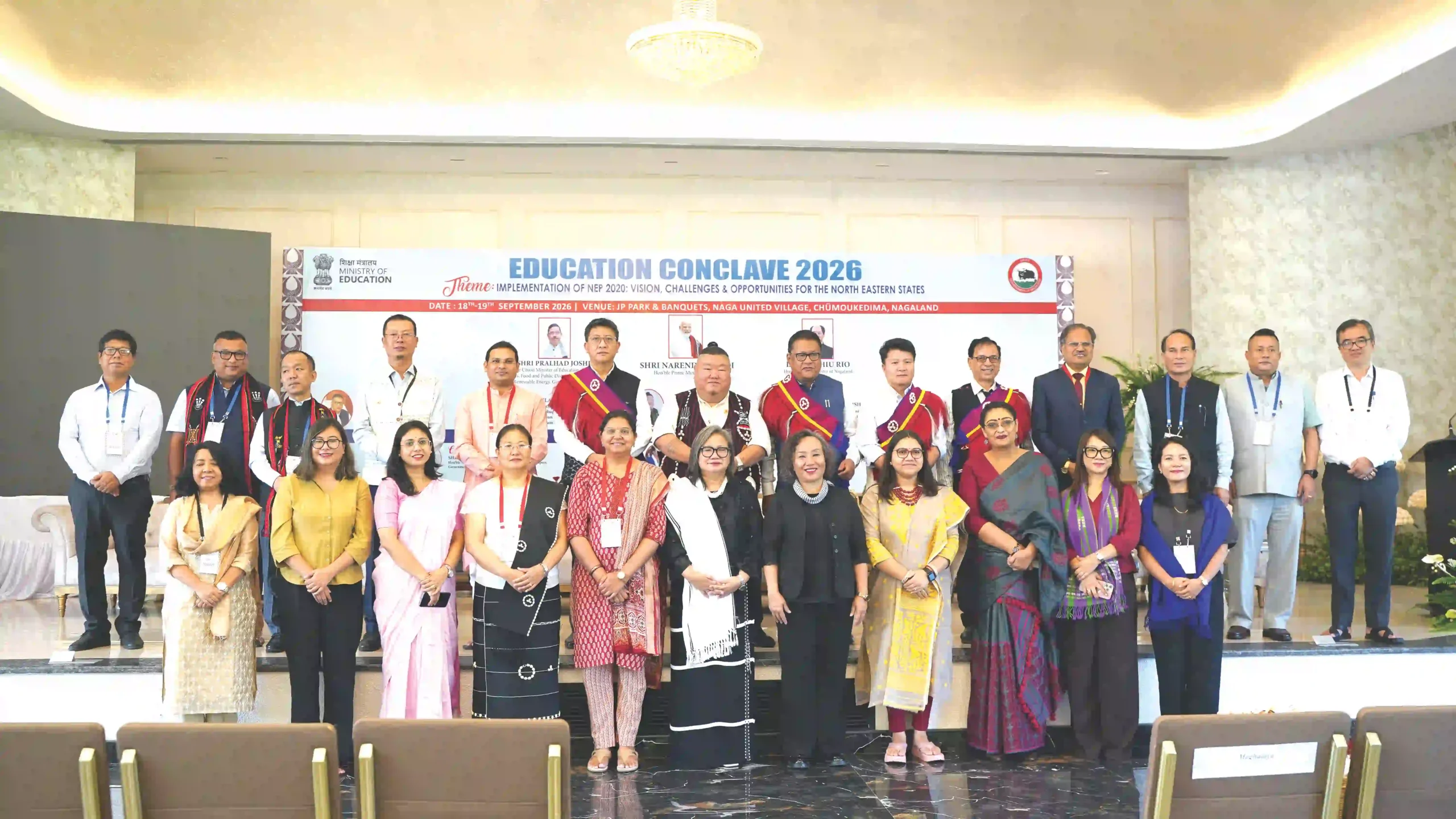
Speaking at the inaugural North East Education Conclave on NEP 2020 at JP Parks and Banquets, Naga United, Chümoukedima on the theme “Implementation of NEP 2020: Vision, Challenges & Opportunities for the North Eastern states”, Nagaland minister higher education and tourism Temjen Imna Along said greater regional dialogue, critical thinking and comprehensive inputs were needed to translate the policy into effective outcomes.
Along said the debate around NEP had shifted from initial apprehension to the challenge of integrating its various components into a more holistic education system. He questioned the traditional link between degrees and employment, saying “degrees are no more giving jobs” and stressed the need to equip young people with relevant knowledge and skills for a changing employment landscape.
He also raised the possibility of introducing Christian studies as an academic subject in universities in the North East, particularly in Nagaland, Mizoram and Meghalaya. He said the proposal related to curriculum and academic discourse, not the functioning of churches, and pointed to the region’s theological institutions as an area requiring discussion on academic integration and affiliation.
Assam minister for education, tribal affairs and information technology Dr. Ranoj Pegu said the emphasis on JEE, NEET and other competitive examinations risked overshadowing the needs of the much larger group pursuing general education. He said only 2.6% of students in Assam pursue medical, engineering or similar professional education, while around 1% pursue civil services or other competitive examinations.
“This leaves almost 97%” pursuing general education, Pegu said and underscored that education policy must focus more strongly on employability, entrepreneurship and skills.
He said Assam had introduced skill-based certificates alongside regular Class X and Class XII qualifications and was expanding the definition of skill education to include soft skills and areas such as artificial intelligence. He said Assam has also incorporated Bihu dance into the secondary-level curriculum, with 32,000 students enrolled this year, allowing students to receive marks and a separate certificate.
Pegu said Assam’s four-year undergraduate programme, introduced in 2021, had also exposed a major transition challenge, with only about half of the students who entered the first semester reaching the seventh semester.
He questioned the employability of generic diplomas under NEP’s multiple-exit system and suggested linking qualifications to skills such as content writing, translation, creative writing, proofreading and copy editing. Mizoram education minister Dr. Vanlalthlana, meanwhile, said becoming India’s first fully literate state in 2025 should be regarded as the beginning rather than the culmination of educational development. Citing UDISE+ 2025-26 data, he said Mizoram had a pupil-teacher ratio of 11.2, compared with 24.1 nationally, but continued to face problems of enrolment, staffing and access. Of 2,563 government schools, 1,655 have fewer than 50 students, while some have no enrolment and around 50 have only one teacher. He also said 45.7% of villages lacked higher secondary schools within prescribed norms.
Vanlalthlana said the imbalance in teacher deployment was particularly concerning at the foundational and preparatory stages, where 55% of students were enrolled but only about 24.9% of teachers were deployed. He said this posed a challenge to NEP’s priority on foundational literacy and numeracy.
He also called for education norms suited to the Northeast’s terrain and sparse population, including a terrain-based approach to school access, separate norms for small schools and construction standards for hilly areas. For higher education, he proposed a multidisciplinary university jointly governed by the eight North Eastern states, a shared regional faculty pool and twice-yearly meetings of education ministers under the North Eastern Council.
Tripura minister Kishor Barman said NEP should bring a shift in how educational outcomes are understood, moving beyond marks to what students learn, what they can do, how they think and what they contribute to society.
He called for a balance between local roots and global aspirations, with students remaining connected to their language, culture and traditions while gaining exposure to artificial intelligence, digital technology, research, innovation and entrepreneurship. Barman identified infrastructure, teacher training, digital connectivity, research opportunities and industry-education partnerships as key challenges in translating the policy into classroom practice.
Arunachal Pradesh MLA and advisor to the home minister Mutchu Mithi said financial constraints remained a major challenge for North Eastern states despite the importance attached to education under NEP 2020.
He said Arunachal Pradesh had allocated around Rs.500 crore in the current financial year for infrastructure under Mission Shiksha, while also facing an estimated annual shortfall of Rs.4,000 crore in devolution under the 16th Finance Commission.
Mithi also highlighted digital literacy as an emerging concern, saying widespread access to smartphones and the internet had made it increasingly important for students to distinguish reliable information from misinformation. He called for greater attention to digital literacy and safeguards within the education system.
The speakers called for education policies and implementation mechanisms that account for the North East region’s diverse cultures, difficult terrain, sparse populations and varying institutional capacities, while ensuring that NEP 2020 translates into practical gains in learning, skills and employment.
The inaugural session featured a keynote address by Nagaland University (NU) vice-chancellor Prof. Jagadish K. Patnaik, a special number by the school choir of PM Shri GHSS Chümoukedima and a performance by Zisela Rudi Thonger (Azi Rudi).
Nagaland commissioner and secretary, school education and SCERT, Asangla Imti, delivered the welcome address, while additional secretary, higher and technical education and ex-officio director, higher education, V Lovitoly Sema, proposed the vote of thanks.
The programme followed parallel plenary session presentations by the state of Arunachal Pradesh, Assam, Manipur and Meghalaya.