
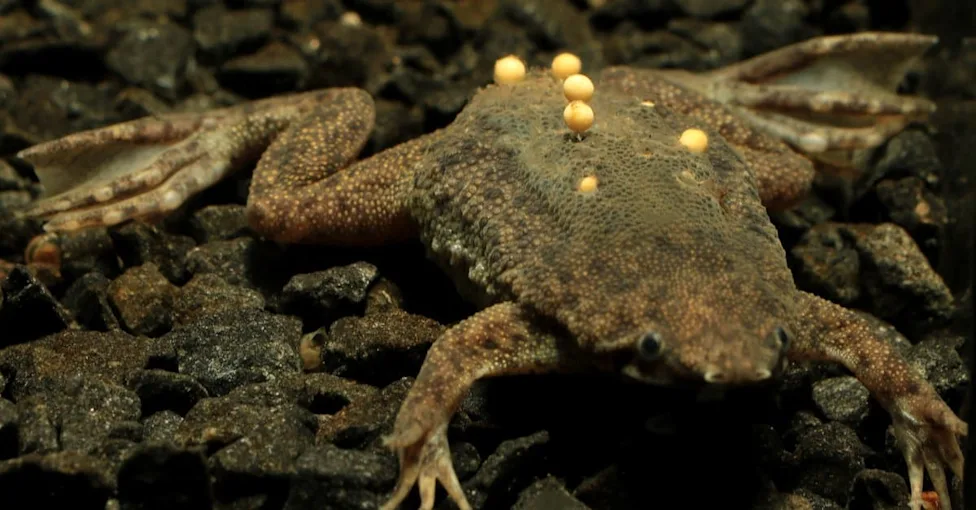
The post Blind and Tongueless, This Toad Hunts with Human-Like Fingertips appeared first on A-Z Animals. In the murky depths of rivers across the Amazon basin, a species of frog lies motionless, doing its best impression of a dead leaf. The frog, a Suriname toad, is not only nearly blind, but it also has no tongue.
But that doesn’t slow the toad down. The Suriname toad is a precision hunter that can suck an unsuspecting fish into its mouth in less than a second. So how does a toad that can’t see and hunts in water so cloudy that it can’t see its prey survive?
For the Suriname toad, Pipa pipa, beauty is in the eye of the beholder. Evolution has shaped the toad to mimic a fallen leaf or small piece of driftwood. With a flat body, tiny eyes on the top of a triangular head, and a brown-to-olive camouflage coloring, the Suriname toad is easy to miss. It calls the slow-moving rivers and canals across the Amazon and Orinoco basins that run through Bolivia, Brazil, Colombia, Ecuador, the Guianas, Peru, and Venezuela home. You can also find the toads on the tiny Caribbean island of Trinidad.
But how does a toad without a tongue catch its prey? It turns out the toad catches its prey using powerful suction, not a tongue-flick like most other frogs. Once prey is in the toad’s mouth, it’s swallowed whole.
How Did This Toad Get Its Unusual Nickname?Locals have a nickname for this unusual toad — star-fingered toad. The name describes the toad’s most remarkable feature. Each of its four fingers splits into four tiny lobes, and each of those lobes splits into an additional four smaller lobules. This gives the toad 16 lobes per finger and 128 lobes across its four fingers in total.
The design of splitting into four and then four again is officially called “quadrification.”
Scientists who study Suriname toads have long wondered what purpose these many-lobed fingers serve. While the shape was originally described and drawn by scientists in the 1800s, nobody since then has ever determined if there is a purpose for the design.
“I was reading an anatomy report that described how the tips of the fingers of Surinam toads split into four, and each of those four little lobes split again into four,” Duncan Leitch, a corresponding author and UCLA assistant professor of integrative biology and physiology, said in a press release announcing the study. “It immediately seemed to me like these lobes might be somewhat analogous to antennae that the frogs extend so they can feel the space around them.” He and a team of biologists set out to prove that hypothesis
Researchers used high-speed camera experiments to identify the toad’s hunting strategy. Filming at 1,000 frames per second, researchers were able to capture the frogs hunting live fish.
The frogs began their suction stroke when a fish was still about one-half centimeter away, even before the prey touched the toad’s fingers. This happened even in total darkness.(Yahoo)