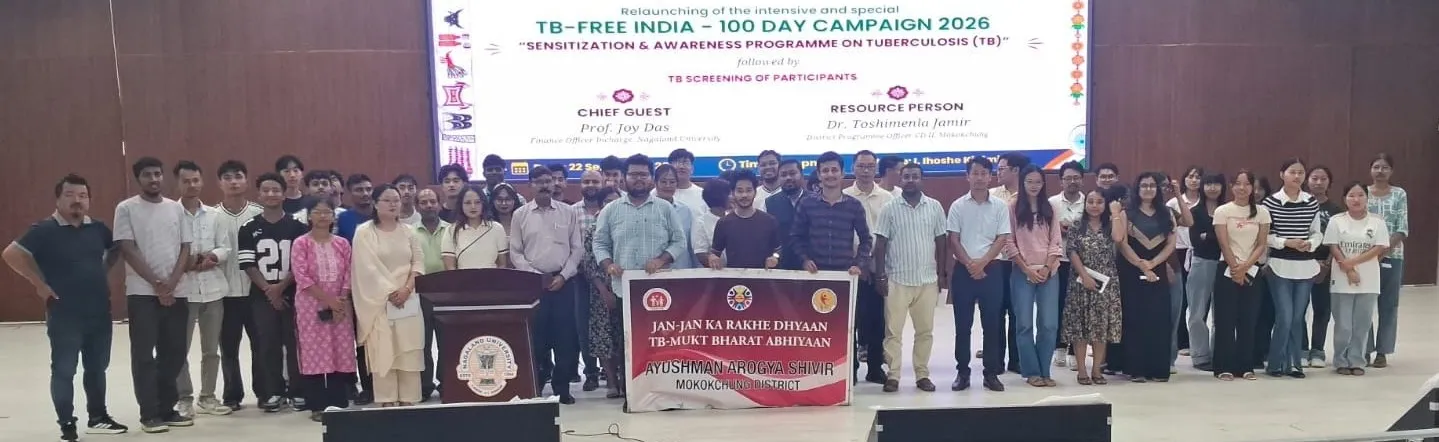
DIMAPUR: Nagaland University (NU) organised a sensitisation and awareness programme on tuberculosis (TB) followed by screening of participants at I. Ihoshe Kinimi Hall, Lumami, on September 22. The event was held under the aegis of the TB Free India 100 Day Campaign 2026, relaunched by the Ministry of Health and Family Welfare, Government of India.
The programme focused on raising awareness about TB, its prevention, early detection and the importance of timely medical intervention. Addressing the gathering as chief guest, Prof. Joy Das, Finance Officer In charge, NU, said the University has the responsibility not only to impart academic knowledge but also to create awareness about important social programmes to make society a better place. Highlighting the awareness drive, he noted that while many people recognise the name TB, public understanding remains limited regarding its symptoms, preventive measures and cures. Stressing that stigma and fear often prevent people from coming forward for testing, he urged students and scholars to use their credibility as educated members of society to discuss TB openly with families and communities.
Speaking as resource person, Dr. Toshimenla Jamir, District Programme Officer, CD II, Mokokchung, said TB continues to be a major global public health issue, affecting millions annually. She pointed out that despite repeated commitments to end TB, progress remains slow due to funding gaps and global uncertainty. She emphasised the need for reaffirming global ambition and collective efforts across governments, communities, civil society, donors, researchers, private sector and youth to turn commitments into action.
Dr. Jamir noted that TB is the leading cause of death globally and India bears the world’s highest TB burden, accounting for one fourth of global cases. She informed that over 40% of India’s population is infected, with 27 lakh new cases detected annually and nearly four lakh deaths each year-around 1,400 daily. She added that approximately 2.2 lakh children are affected yearly.
She further explained that India follows the “Detect, Treat, Prevent, and Build” strategy to achieve the national goal of eliminating TB by 2030 through community participation, stigma free primary healthcare services and the leadership of TB champions.
The sensitisation session was followed by TB screening of participants, providing opportunities for early identification and referral where required.