
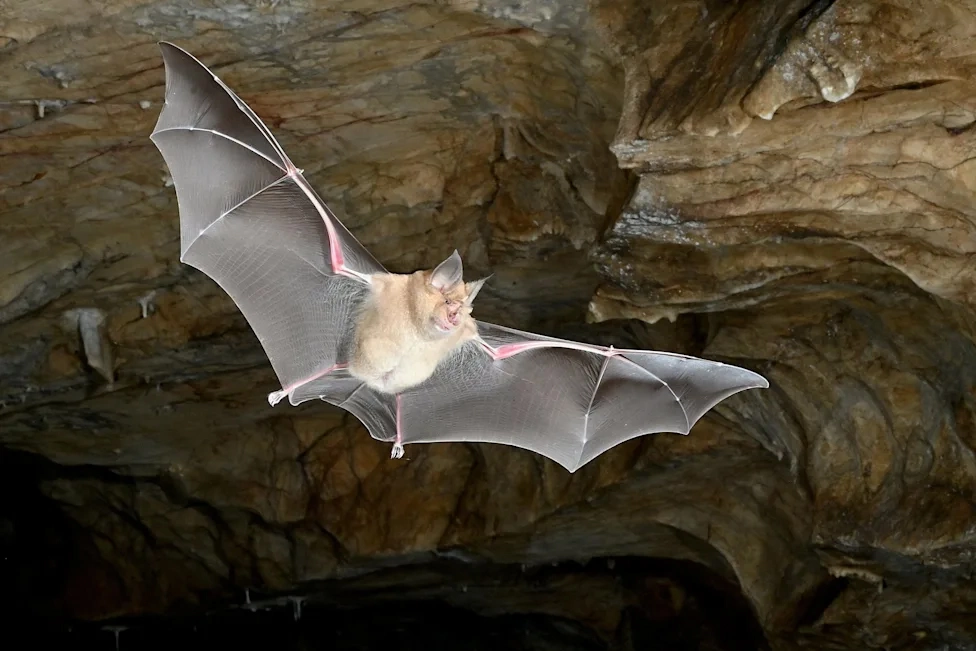
Bats originated in Europe around 65 million years ago, reveals new research. The groundbreaking study, which rewrites the world’s only flying mammals’ family tree, contradicts long-held assumptions that the species arose in Asia, Africa or North America.
Scientists led by researchers from the University of St Andrews in Scotland have created the largest combined bat genome and fossil study ever undertaken.
Their findings show that bats most likely originated in Europe about 65 million years ago, before spreading around the world.
The study also reveals that echolocation, like flight, evolved near the dawn of bat evolution.
The research team says their findings, published in the journal Nature, las the foundations for further study into the genetic basis of bats’ exceptional longevity and disease resistance – with potential to boost human health.
An international team of 137 researchers from 64 countries, working together as part of the Bat1K consortium, combined genomic and fossil evidence.
The results overturned previous theories proposing Asian, African or North American origins for the iconic species.
The new study suggests that the first bats’ earliest descendants dispersed into Africa, establishing a Europe-Africa hub from which bats then expanded into Asia, the Americas and Australia.
Covering 103 species and representing every one of the currently recognized 21 bat families, the researchers assembled the largest collection of high-quality bat genomes to date.
The team combined state-of-the-art DNA sequencing and computational methods to generate and compare the genomes and identify the genes they contained.They combined them with 44 fossil bats from across the globe to reconstruct their evolutionary history.
Building the dataset required samples collected over decades from bats around the world, including representatives of some of the rarest and most unusual bat families, found in the most remote locations.
With more than 1,500 bat species distributed around the globe, they account for 20% of all living mammals and play vital roles in maintaining healthy ecosystems by pollinating plants, dispersing seeds, and consuming vast numbers of insect pests.
The study sheds new light on their origins. The team analyzed the genomes and fossils using new methods and revised the bat evolutionary tree, resolving several long-running debates about how the major bat groups are related.
Study senior author and Bat1K director Sonja Vernes, from the University of St Andrews, said: “Bats constantly surprise us.
They are one of evolution’s greatest experiments. (Yahoo)