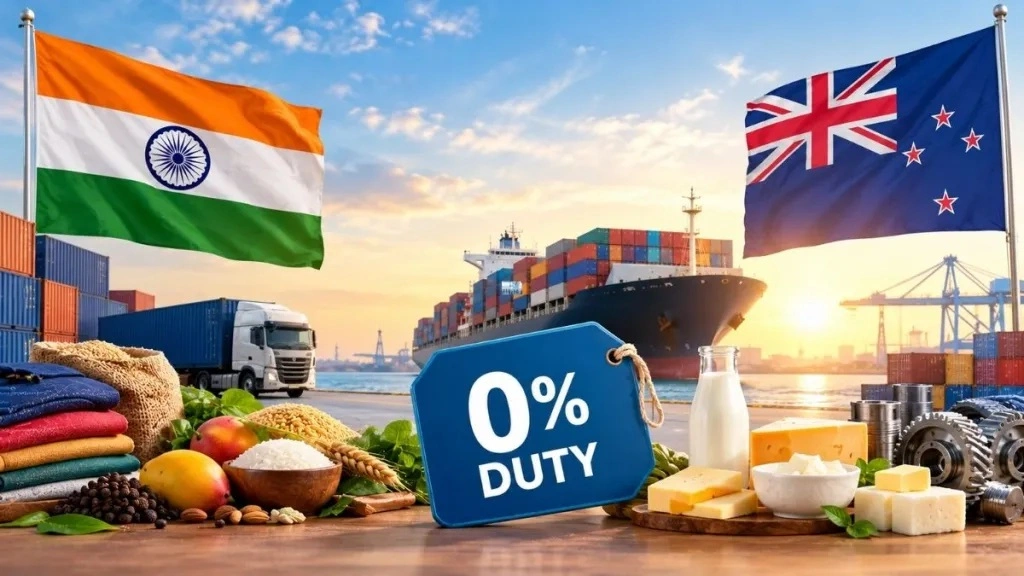
New Delhi, Oct 19 (Agencies): The India-New Zealand free trade agreement (FTA) came into force last midnight (New Zealand time), giving Indian exporters zero-duty access across all tariff lines in the island nation while opening India’s vast consumer market to New Zealand businesses through preferential concessions. The pact also provides for New Zealand to facilitate $20 billion investment in India and expands opportunities for services, professionals, students and agricultural cooperation, reports Financial Express.
The agreement aims to increase bilateral trade in goods and services from about $ 2.4 billion to around New Zealand $ 7 billion or Rs 35,000 crore, by 2030, Commerce Minister Piyush Goyal said, adding that the target reflected the ambition of both countries to deepen economic ties. The immediate benefit is duty-free access across 100% of New Zealand’s tariff lines, particularly for labour-intensive sectors such as textiles, apparel, leather, footwear and carpets, where tariffs previously reached 10%. Other beneficiaries include engineering goods, pharmaceuticals, plastics and rubber, electrical and mechanical machinery, chemicals and food-processing products.
New Zealand imported $47.5 billion worth of goods in 2025, but India accounted for only 1.9% of imports. India’s goods exports to New Zealand were $566.5 million in 2025-26, up 16% over four years. Indian manufacturers could also benefit from cheaper imports of wood logs, coking coal and metal scrap. New Zealand has offered market access across 118 services sectors and sub-sectors, with most-favoured-nation treatment in 139 sectors. India’s services exports to New Zealand stood at $ 634 million in 2024. The agreement provides for 5,000 professional visas for skilled Indians and 1,000 12-month multiple-entry working-holiday visas. Students can work at least 20 hours a week, while post-study work opportunities extend up to four years for doctoral graduates.
Pharmaceutical and medical-device companies will benefit from expedited regulatory pathways and acceptance of inspections by recognised comparable regulators in the US, EU, UK and Canada. An Agricultural Productivity Partnership will promote better farm yields and links to global value chains. New Zealand receives preferential access across 70% of India’s tariff lines, with 30% of those lines facing immediate tariff elimination. Other concessions will be phased in over up to 10 years or provided through tariff reductions and tariff-rate quotas. Selected products, including apples, kiwifruit, Manuka honey and albumins, will receive access through restricted quotas, minimum import prices and seasonal windows designed to safeguard Indian producers.
New Zealand Trade and Investment Minister Todd McClay said the agreement would create opportunities for exporters across key sectors. “Once fully implemented, 95 percent of New Zealand’s current exports to India will benefit from tariff elimination or substantial tariff reductions, creating new opportunities across many of our key export sectors,” he said.
New Zealand businesses will also gain opportunities to invest and establish commercial partnerships in India. Its overseas investments are estimated at $422 billion, largely concentrated in the US, Australia, UK and Japan. The agreement seeks to attract more investment into India through a $20 billion investment commitment.
Under the FTA, India and New Zealand will establish an Agricultural Productivity Partnership with a specific action plan covering apples, kiwifruit and honey. New Zealand will share its expertise in precision agriculture, orchard management and productivity-enhancing technologies, with proposed centres of excellence to help Indian farmers.
India has excluded dairy products, sugar, onions, chickpeas, peas, corn, almonds and various fats and oils, gems and jewellery, copper, aluminium and arms and ammunition.
Commerce Secretary Rajesh Agrawal said the challenge is turning the agreement’s provisions into tangible gains. “The job is now to see how we are able to take this FTA and translate this opportunity into actual benefits for our people,” he said.
The pact provides for customs clearance within 48 hours for cargo and 24 hours for express and perishable consignments. Digital certification and self-certification of rules of origin for eligible status holders are intended to reduce procedural delays and compliance costs.