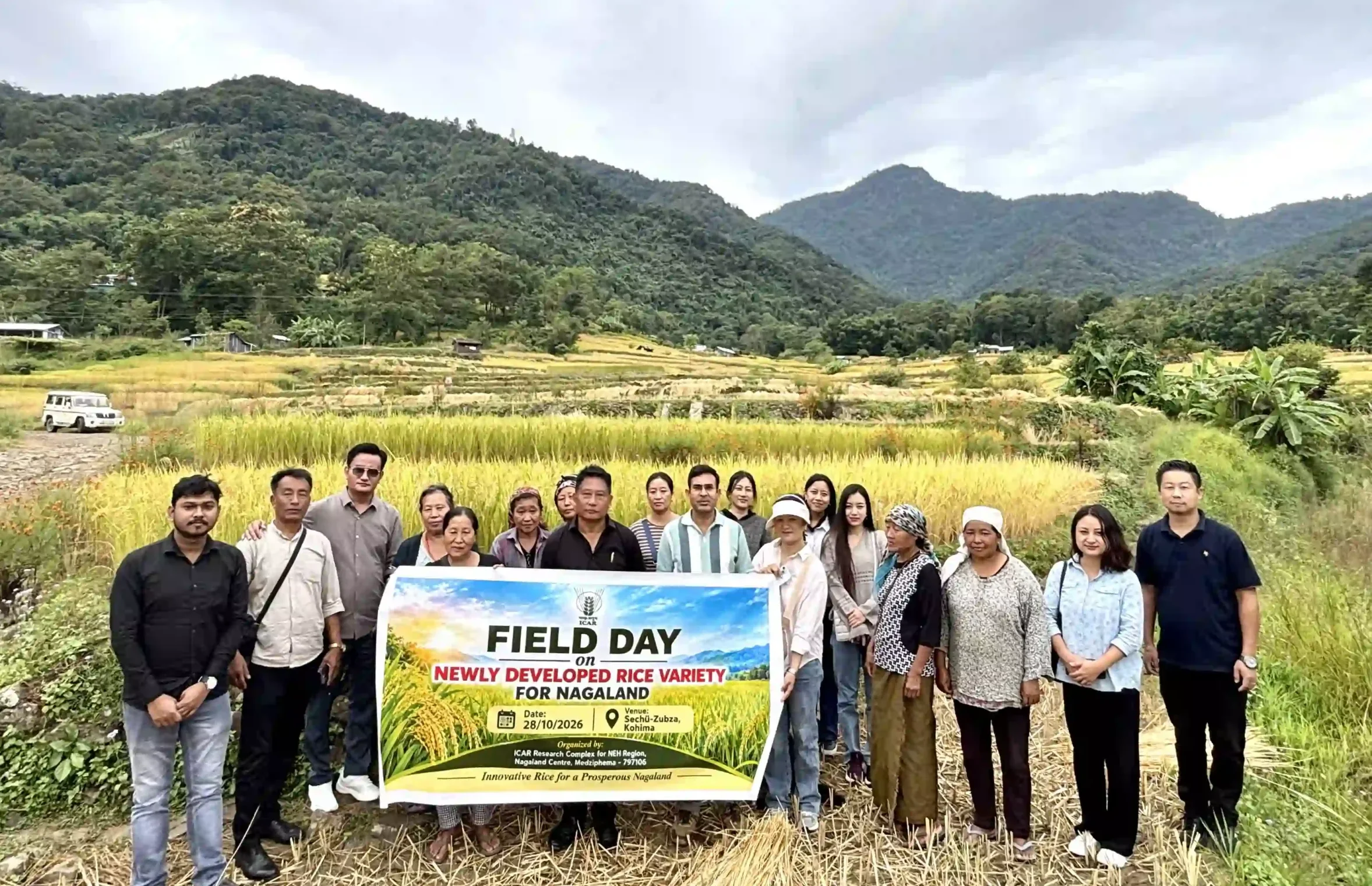
DIMAPUR: Four newly developed rice varieties have demonstrated a 30-40% yield advantage over locally cultivated varieties and traditional landraces under farmers’ field conditions at Sechü-Zubza, Kohima, highlighting their potential to enhance rice productivity and strengthen rice-based farming systems in Nagaland. The varieties were showcased during a Field Day on Newly Developed Rice Varieties organised by the ICAR Research Complex for NEH Region, Nagaland Centre, in collaboration with the State Department of Agriculture, Kohima.
The improved varieties demonstrated were Sekrenyi-lha 138, Ahuna-khi 395, Patkai Pearl 131 and Aoleang Tahwan 295. Farmers who cultivated the varieties alongside traditional cultivars and local landraces observed significantly better performance in the improved varieties, with an estimated yield increase of 30-40%. Their encouraging field performance, coupled with early maturity, highlighted their potential to improve productivity and provide greater flexibility in crop planning.
Speaking on the scientific significance of the varieties, Scientist (Plant Breeding and Genetics), ICAR Nagaland Centre, Dr Harendra Verma, highlighted their higher yield potential, early maturity and suitability for diverse agro-climatic conditions across Nagaland.
He said the varieties were developed to address major constraints faced by rice farmers, including prolonged crop duration, disease susceptibility and the need to improve productivity. According to him, early-maturing varieties would enable farmers to harvest rice earlier and establish subsequent rabi crops within the optimum planting window, thereby enhancing cropping intensity and land-use efficiency. Verma also stressed the importance of timely transplanting and proper crop management practices to realise the full potential of the improved varieties.
Appreciating the performance of the varieties, District Agriculture Officer (DAO), Kohima, Kekhrieletuo Yhome, encouraged farmers to adopt high-yielding, early-maturing and disease-tolerant rice varieties to improve farm productivity and income. He also emphasised the need for quality seed production and urged farmers to undertake community-level seed multiplication to facilitate wider dissemination and adoption of the improved varieties during the next cropping season.
Developed through sustained rice-breeding efforts at the ICAR Nagaland Centre, the varieties were intended to address key challenges affecting rice production in the region, including prolonged crop duration, disease susceptibility and limited opportunities for cropping intensification.
With a maturity period of around 115-120 days, the varieties offer scope for earlier harvesting and timely planting of subsequent rabi crops such as potato, onion, toria and field pea.
Officials said the adoption of short-duration, high-yielding rice varieties could help farmers make more efficient use of available land, diversify cropping systems and improve overall farm profitability. The side-by-side cultivation of improved varieties and traditional landraces also allowed farmers to compare their performance under local conditions and assess the advantages of improved genetic material.
Altogether, 28 farmers attended the programme along with officials from the State Department of Agriculture, including the Sub-Divisional Agriculture Officer (SDAO), Agriculture Officer (AO), Agricultural Inspector (AI), and technical staff from ICAR Nagaland Centre.
The programme generated considerable interest among participating farmers, many of whom expressed their willingness to adopt the newly developed varieties. Officials said the response underscored the importance of on-farm demonstrations and collaborative efforts between research institutions and the Agriculture Department in bringing improved technologies directly to farming communities.