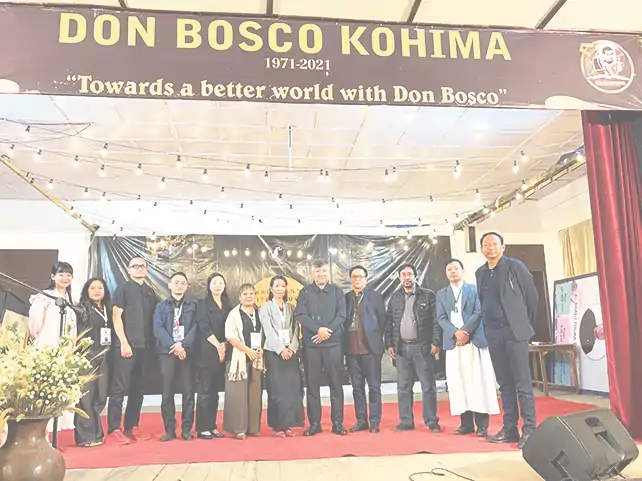
The Nagaland Literature Festival 2026 concluded on October 31, with Advisor to the Chief Minister of Nagaland and IDAN chairman Abu Metha attending the closing ceremony as the chief guest. Held under the theme “From Hearth to Page,” the two-day festival was hosted at the auditorium of Don Bosco Higher Secondary School (DBHSS), Kohima.
Addressing the gathering, Metha emphasised the need for institutions, schools, colleges, clubs and organisations promoting innovation, creativity and literature to understand the challenges faced by the younger generation and develop effective strategies to encourage reading and writing. He stated that while the importance of reading and writing was widely recognised, greater innovation and strategic approaches were needed to make literature more appealing to young people. He urged institutional and community leaders to formulate initiatives that would inspire the younger generation to read and write more, noting that their writings would help preserve the stories, history and legacy of the people for future generations.
He stressed that language and literature must go hand in hand, stating that the loss of a language meant the loss of an entire history, tradition and cultural legacy. While acknowledging the importance of English in communicating with the wider world, he maintained that preserving indigenous languages was equally important in safeguarding one’s identity and inner voice.
Emphasising the significance of storytelling, Metha said no story was too small and that every community, village and tribe had stories worth sharing with the world. He observed that for too long, others had written about, represented and sometimes misrepresented the Nagas. From the colonial period to decades of conflict, struggle and suffering, the Naga story had largely been narrated from the perspectives of outsiders.
He called upon the people to take ownership of their narratives and tell their stories from their own perspectives, adding that authentic accounts would enable the world to better understand and appreciate the Naga experience.
He also encouraged writers, authors and local publishing institutions to embrace modern technology, particularly social media, to take Naga stories, books, songs and cultural experiences to a global audience. He said the struggles and aspirations of the Naga people over the decades must be documented and communicated through poems, books, literature, films and documentaries to help the international community understand their history and experiences. Stating that the foundations laid by earlier generations must be valued, Metha said the present generation should draw knowledge, inspiration and lessons from the past while adapting to changing times and taking their stories forward through modern platforms.
He further observed that storytelling had become an integral part of everyday life, adding that everything, even something as simple as selling a bottle of honey, carried a story of its own.
Addressing the younger generation, he urged them to consider every opportunity as a chance to tell their stories. He also expressed gratitude to writers, authors and everyone involved in the literary movement for continuing to document and share the stories of the Naga people despite challenges such as limited recognition, financial difficulties and inadequate support. Encouraging writers to find fulfilment in their work, he stated that while people may eventually pass away, the stories they leave behind would continue to live for generations. He described this enduring legacy as the unique contribution of storytellers and writers to society.
Concluding, Metha said stories that might otherwise have been forgotten could reach international platforms through literature, art and other creative expressions, inspiring future generations. He urged the people to dream big, continue telling their stories and believe that nothing was impossible. The closing programme was chaired by Rita Krocha, while Vizovonoe Elizabeth delivered the vote of thanks.
Winners of the Nagaland Literature Festival 2026 competitions included Amenla I Chang, who won the NLF Short Story Prize for her story titled “Apang”; Temjenwapang, who bagged the NLF Poetry Prize for his poem “I Taste My Ashes”; and Atino Yeptho, who won the NLF Essay Prize for her essay titled “Hearth to Page”. ( Correspondent)