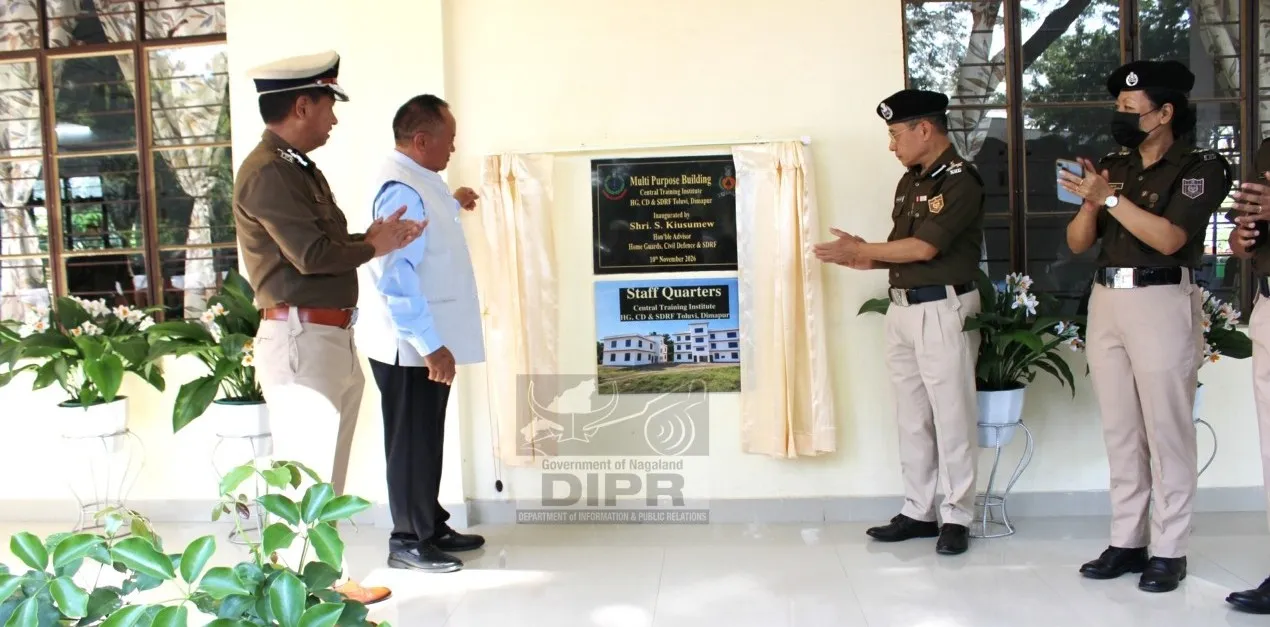
DIMAPUR: Advisor for Home Guards, Civil Defence and State Disaster Response Force (SDRF), S. Kiusumew Yimchunger, on Tuesday inaugurated the Multipurpose Building and Staff Quarters of the Civil Training Institute (CTI), Home Guards, Civil Defence and SDRF at Toluvi, Dimapur.
According to a DIPR report, the programme commenced with a guard of honour, followed by the unveiling of the inaugural plaque by the special guest. The formal function began with opening remarks by compere Ropfekhrlou Koza and a dedicatory prayer.
In his inaugural address, Kiusumew highlighted the importance of the newly constructed facilities in strengthening the functioning and operational capabilities of the Home Guards, Civil Defence and SDRF. He said adequate infrastructure was essential to enhance the efficiency, preparedness and effectiveness of personnel in discharging their responsibilities.
He observed that the Home Guards campus, which once suffered from poor infrastructure, had witnessed significant development under the leadership of Chief Minister Dr. Neiphiu Rio. Expressing gratitude to the chief minister for his vision and support, Kiusumew said the Toluvi campus was undergoing much-needed modernisation and expansion.
The advisor also appreciated the efforts of the contractors, Police Engineering Wing, Junior Engineers (JEs), Section Officers (SOs) and engineers for completing the projects within the stipulated timeframe.
Stressing the importance of maintaining public infrastructure, he said that while buildings could be constructed, their condition ultimately depended on the people who used and occupied them. He therefore urged personnel to care for the newly created facilities as they would their own homes.
Kiusumew further thanked the Director General, Additional Director General of Police and departmental officers for their continued support and cooperation. He encouraged personnel to remain disciplined and committed to their duties, emphasizing that collective responsibility was necessary to ensure the facilities served their intended purpose for years to come.
Speaking at the programme, Director General of Home Guards, Civil Defence and SDRF, Renchamo P. Kikon, underscored the need for sustained infrastructure development, adequate staff accommodation and modern training facilities to strengthen the department’s operational capabilities.
He said the department’s role in supporting the state’s internal security and disaster management framework had expanded considerably over the years. However, he noted that growing responsibilities required corresponding improvements in infrastructure, financial resources and operational facilities.
Highlighting the shortage of residential accommodation at CTI, Kikon informed that the institute had 87 non-gazetted personnel but only seven staff quarters. With the addition of 10 new residential units, the total number of available quarters would rise to 17. Similarly, against six gazetted officers, only two quarters were available, while one additional quarter was under construction.
He said adequate accommodation was vital not only for staff welfare but also for personnel availability, administrative efficiency and the smooth functioning of the institution.
Kikon further stated that CTI, spread across about 34.38 acres, had the potential to evolve into a modern training institution and a Centre of Excellence for disaster response and capacity building. He noted that the institute had been instrumental in training departmental personnel and had also conducted training programmes for officers from neighbouring states, including Manipur.
Emphasising the need to strengthen specialised training facilities, he highlighted the requirement for a swimming pool for water rescue and diving training, along with additional lecture rooms, conference halls and practical training facilities to meet emerging challenges in disaster response and emergency preparedness.
He also advocated improved facilities at the Directorate Headquarters, additional staff accommodation at district establishments and stronger operational infrastructure across the department. He called for sustained and phased investment to ensure that infrastructure development kept pace with the department’s expanding responsibilities.
Kikon maintained that the true measure of institutional progress lay not merely in the infrastructure created but in how effectively it enhanced the department’s capabilities and improved service delivery to the people.
He expressed gratitude to the advisor and the Government of Nagaland for their continued support and acknowledged the contributions of all stakeholders towards strengthening the Home Guards, Civil Defence and SDRF.
A technical report on the newly inaugurated facilities was presented by the Police Engineering Project. On the occasion, Kiusumew also released a coffee table book in the presence of officials and dignitaries.
The newly inaugurated infrastructure is expected to improve staff accommodation, administrative functioning and institutional facilities, while further strengthening the department’s training, preparedness and disaster response capabilities.