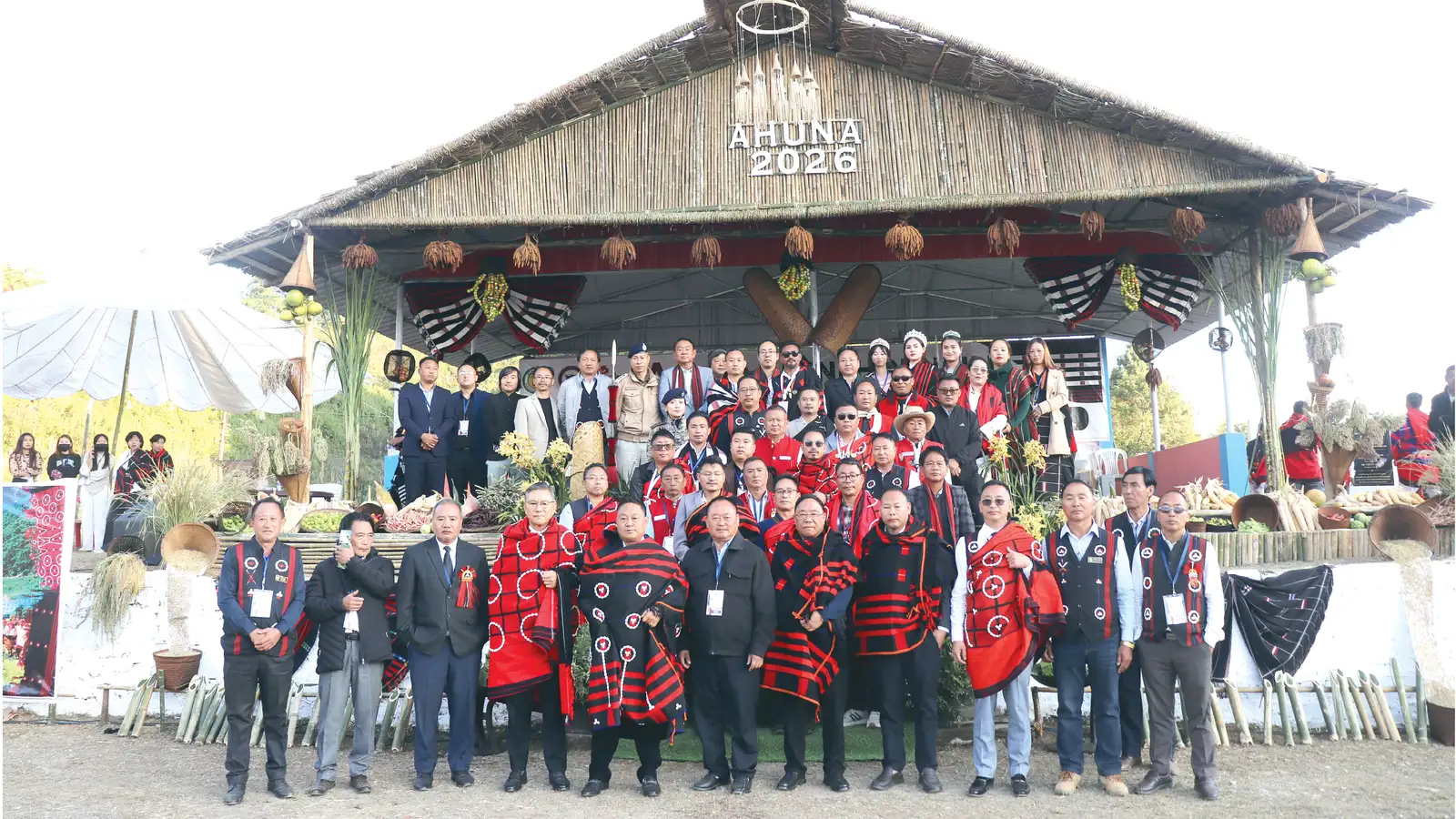
Dimapur, Nov 14 (NPN): The Ahuna cum Mini Hornbill Festival 2026, organised by the Sümi Hoho and hosted by the Suruhuto Area Public Organisation. The three-day festival was held on November 8, 13 and 14. The concluding day featured the second edition of the Sümi–Yimkhiung Cultural Exchange, bringing together leaders and representatives of the two communities to strengthen their longstanding relationship and promote mutual understanding.
Minister for Roads and Bridges G. Kaito Aye has called upon the Sümi and Yimkhiung communities to strengthen unity, preserve their cultural heritage and work collectively towards a peaceful and prosperous Naga society.
Addressing the Ahuna celebration as Father Ahuna, Aye extended greetings to the Sümi and Yimkhiung communities, wishing them a rich harvest, prosperity and divine blessings. He described Ahuna as a celebration of the agricultural heritage of both communities and said their traditions shared deep similarities, particularly the age-old practice of giving thanks for the harvest.
He said the Sümi-Yimkhiung Cultural Exchange provided an important platform for preserving ancestral values while strengthening friendship, mutual respect and unity.
Emphasising the need for a forward-looking approach, Aye urged the present generation to look beyond the Indo-Naga political movement of the 1950s and 1960s and focus on the challenges and opportunities ahead. He said Naga society needed to move away from repeatedly revisiting the past and concentrate on preparing for the future.
“Our focus should not be on revisiting the past again and again, but on preparing and working today for the challenges that lie ahead.
It is time we start talking about our tomorrow, where unity remains our only hope,” he said.
He called for collective responsibility in building stronger villages, communities and tribes, which would ultimately contribute to a stronger Naga society.
Expressing concern over the growing influence of alcohol, drugs and other anti-social activities among sections of the younger generation, Aye urged both communities to work together to address the problems, rescue affected youth and secure a safer future. He stressed that the responsibility should be shared by families, churches, community institutions, civil society organisations and public leaders.
Highlighting the importance of dignity of labour, honesty and hard work, he encouraged people to sustain themselves through agriculture and other productive livelihoods. He cautioned against excessive dependence on government welfare schemes, stating that such assistance might not continue indefinitely, and called for greater self-reliance and preparedness for the future.
Aye also urged the Sümi and Yimkhiung communities to look beyond their respective tribal interests and contribute to the wider Naga family. Stressing peace and reconciliation, he said communities must overcome differences and work together for common progress.
Referring to the Eastern Nagaland People’s Organisation (ENPO), he appealed to the organisation to remain sincere and committed to ensuring fair and equitable distribution of economic packages among all tribes and ministries, enabling communities to progress alongside the rest of the Naga people. He also called upon Naga stakeholders to establish a common platform to collectively represent the aspirations of the people.
On the State Government’s initiative to extend the Hornbill Festival to all districts, Aye encouraged communities to showcase their traditions, cultural attire, music, cuisine and customary practices to preserve their heritage, promote Naga identity and introduce the state’s cultural diversity to visitors.
He also expressed concern over the growing influence of money culture in electoral politics, particularly within the Sümi community, and urged people to reject the use of money to influence elections. He said electoral reforms would be meaningful only when citizens upheld honesty and integrity, choosing representatives on the basis of merit, vision and commitment to public welfare rather than financial influence.
On development, Aye sought the cooperation of the people of Suruhuto constituency in facilitating road development and other infrastructure projects, stressing that good roads and improved infrastructure required mutual cooperation between the government and the public.
Reaffirming his commitment to the advancement of Suruhuto constituency, he urged the people to remain united, preserve their cultural identity, reject social evils and work collectively towards a peaceful and prosperous future.
Advisor for Youth Resources and Sports (YR&S) S Keoshu Yimchunger, MLA, called upon the Sümi and Yimkhiung communities to preserve their longstanding brotherhood, mutual protection and shared sacrifices.
Thanking the Sümi Hoho for organising the cultural exchange, he said the relationship was built on mutual assistance during difficult times and should not be treated as a merely formal association. He urged the Sümi community to uphold the spirit of brotherhood and continue supporting one another during hardship and sorrow.
Advisor for fire and emergency services, home guards and civil defence, and relief and rehabilitation, S Kiusumew Yimchunger, MLA, also highlighted the historical ties between the two communities. He expressed hope that the relationship would be nurtured for the benefit of present and future generations.
In his welcome and presidential address, Sümi Hoho president Dr Vihuto Asumi explained the significance of Ahuna, a traditional harvest festival in which newly harvested rice is cooked in freshly cut bamboo and shared among family and community members.
He said the festival reflected the values of Sümi society and the responsibility to pass its traditions to future generations. Describing the cultural exchange as the most significant feature of this year’s celebration, Asumi traced the friendship between the Sümi and Yimkhiung communities to the 1930s.
He said the relationship had grown over the decades through mutual respect, understanding and goodwill. Thanking the Yimkhiung Tribal Council (YTC) for accepting the invitation, he expressed hope that the exchange would lead to more frequent interactions and lasting ties.
NLA deputy speaker and chief host S Toiho Yeptho appreciated the organisations and communities for bringing the two tribes together. He said the initiative to invite the Yimkhiung community reflected a commitment to strengthening friendship and called for continued unity and cooperation.
Western Sümi Kukami Hoho president Akükatou Khehovi Chophi said the gathering offered an opportunity to strengthen relationships and bridge gaps between communities. He urged people to respect one another and work towards collective welfare.
Western Yimkhiung Hoho (WYH) president H Akiumong Yim said the relationship between the two communities was unique and should remain unaffected by outside considerations.
Earlier, the cultural exchange featured the unveiling of a plaque by YTC president Throngso Yimkhiung, followed by a prayer by NCRC Suruhuto pastor Vitoxu Pucho.
The programme included an invocation by Suruhuto Town New Baptist Church pastor Vikaho Zhimomi, a welcome song by Tichipami Women Folk, and cultural performances by Yimkhiung and Sümi troupes. Special songs were presented by Akheto V Asumi and Inikali D Awomi.
The programme concluded with a vote of thanks by Sümi Kukami Hoho president Akükau Hetoho Zhimomi, followed by traditional cultural presentations. The Yimkhiung Tribal Council participated as the special tribal guest.