
Staff Reporter
DIMAPUR, NOV 14 (NPN): Former editor of Eastern Mirror and founder and executive director of Kheieto Nakhro Foundation, Diethono Nakhro, has called for more sensitive, inclusive and accountable journalism, particularly in reporting issues involving children.
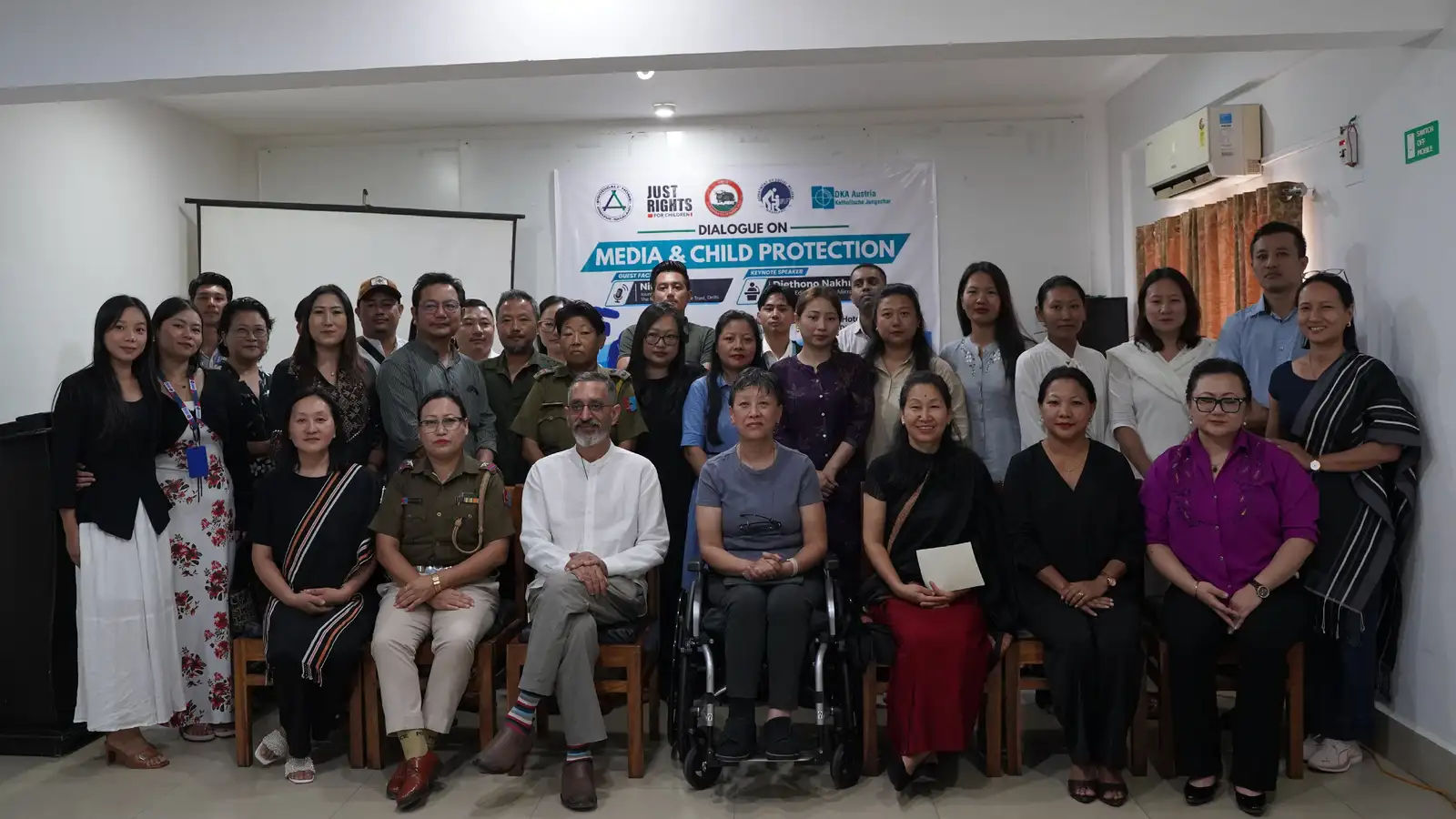
She was delivering the keynote address at the State-Level Dialogue on Media & Child Protection, organised by Prodigals’ Home in collaboration with Mission Vatsalya under the Department of Social Welfare, at Hotel Saramati, Dimapur, on Saturday. The dialogue aimed to strengthen engagement between media professionals and stakeholders working in child protection.
Emphasising the media’s responsibility in safeguarding children’s rights and dignity, Nakhro said that while the media play a vital role in informing society, exposing injustice and holding authorities accountable, such influence also carries significant responsibility when reporting on children.
She said responsible journalism should go beyond protecting a child’s identity and avoiding sensationalism. Rather, the media should actively investigate failures in child protection systems, highlight gaps in services, question institutional negligence and draw attention to children whose experiences often remain overlooked.
Referring to cases of child abuse, she said reporting should not end with the incident or arrest of the accused. Journalists, she maintained, should also examine whether warning signs were ignored, whether the child received adequate protection and support, and what systemic failures allowed the abuse to occur.
Highlighting challenges in Nagaland’s closely connected communities, Nakhro pointed out that withholding a child’s name may not always be sufficient to protect identity, as details about the child’s village, school, family circumstances or other personal information could make them easily identifiable.
She further stressed that journalists must exercise careful editorial judgment, especially in cases involving sexual abuse, trafficking and other forms of violence and exploitation, while ensuring that privacy concerns do not become an excuse to shield perpetrators or institutions from accountability.
Drawing attention to children with disabilities, Nakhro said they often face heightened risks of abuse, neglect, exploitation and discrimination due to communication barriers, dependence on others and difficulties in reporting violations. She said protection systems must be accessible and responsive to their specific needs.
Urging journalists to move away from narratives of pity, helplessness or tragedy, she said: “A child with a disability is first and foremost a child, with the same rights to safety, dignity, privacy, participation and protection as every other child.”
Nakhro also called for greater media attention to children living in remote villages, those from economically disadvantaged families, children outside the education system and others facing various forms of exclusion.
She noted that issues such as inaccessible schools, shortage of trained teachers, lack of learning support, assistive devices and rehabilitation services were equally important child rights concerns, though they often received less attention than visible incidents of violence.
On indigenous and tribal identity, Nakhro observed that respect for culture and community should never become a reason to overlook violations of children’s rights. She stressed the need for continued dialogue and reform to ensure that customary practices and laws remain aligned with human rights, equality and inclusion while preserving cultural values.
She also cautioned that in the digital age, reports, photographs and personal information can continue circulating long after publication, making accuracy, dignity and child safety more important than speed or competition for attention.
Calling for greater awareness among journalists on child protection laws, Nakhro urged that media guidelines adequately address the rights and needs of children with disabilities.
Maintaining that the media should become an active force for child rights, protection and inclusion, she said journalism must not only report incidents of abuse and exploitation but also question systemic failures, challenge prejudice and give visibility to children whose rights and experiences are frequently ignored.
Meanwhile, journalist and trustee of The Reporters’ Collective Trust, Delhi, Nitin Sethi, conducted a closed-door interaction with media personnel, police officials and other stakeholders. The session focused on media engagement in child protection and included discussions on responsible reporting and recommendations for strengthening child safety guidelines.
A separate session on “Sharing Challenges and Exploring Possible Solutions” featured participation from Imkong Walling, principal correspondent of The Morung Express; Veroli Zhimomi, sub-editor, Eastern Mirror; Bendangchuba, reporter, Nagaland Post; and Wangzei Konyak, reporter, Dimapur 24×7.
Earlier, the programme was chaired by Tushimenla Imlong. Invocation was offered by project lead, Building Resilient Families Mission, Prodigals’ Home, Hokhepu Achumi, while the welcome address was delivered by director of Prodigals’ Home, K. Ela. Concluding reflections were shared by programme manager, Mission Vatsalya, Department of Social Welfare, Raitale Zeliang, and editor of The Morung Express, Akangjungla. The benediction was pronounced by Christian Education Secretary, NBCA, Toshilila Longchar.