
Staff Reporter
DIMAPUR, NOV 15 (NPN): When official records show no cases of child trafficking in Nagaland, the obvious question is whether children are actually safe or whether the system has simply failed to see, identify and record those being exploited.
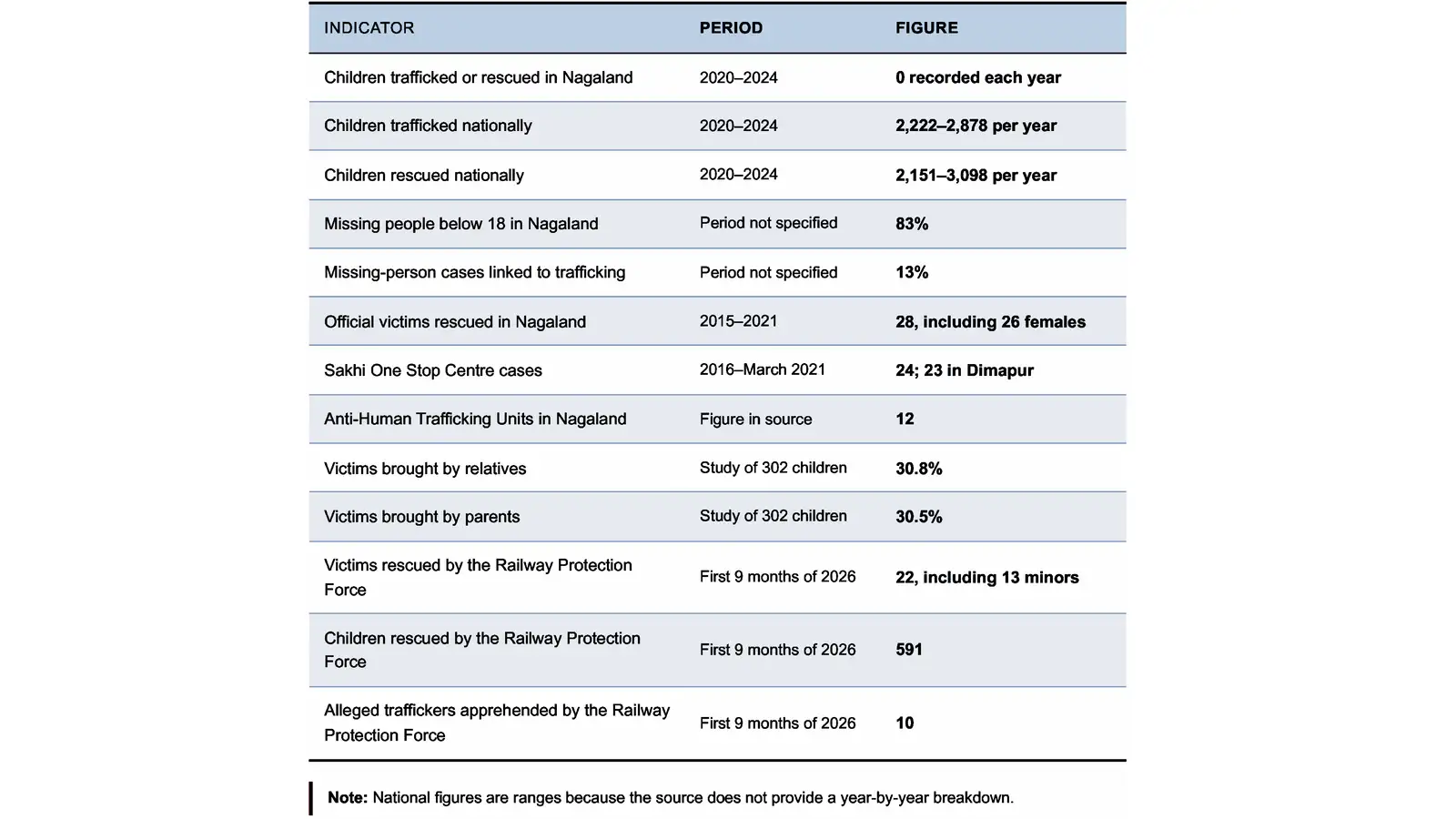
Figures are important, but figures that do not reflect ground realities can become an excuse for administrative complacency. Data from the Ministry of Home Affairs, tabled in the Lok Sabha in August 4, 2026 recorded zero children trafficked or rescued in Nagaland for five consecutive years between 2020 and 2024.
This is difficult to reconcile with reports of police operations, arrests and children rescued from railway stations. During the same period, national figures showed between 2,222 and 2,878 children trafficked annually, while rescues ranged from 2,151 to 3,098. The National Crime Records Bureau itself clarifies that trafficking figures cover only cases registered by Anti-Human Trafficking Units (AHTUs). Therefore, Nagaland’s zero entries cannot be interpreted as proof that trafficking does not exist. They raise a more serious question about the effectiveness of detection and reporting.
Other available figures make the discrepancy even more troubling. Statistics presented during an observance in Dimapur indicated that 83 per cent of people reported missing in Nagaland were below 18 years of age, while 13 per cent of missing-person cases were attributed to trafficking. Between 2015 and 2021, only 28 victims were officially recorded as rescued, 26 of them female.
The state’s Sakhi One Stop Centres recorded 24 trafficking cases between 2016 and March 2021, of which 23 were in Dimapur and none elsewhere. Such a concentration could reflect the location of reporting and detection rather than the actual geographical spread of exploitation. Nagaland has 12 Anti-Human Trafficking Units, one in each police district, yet none registered a case during the five-year period under question. One Stop Centres outside Dimapur and Kohima also recorded no cases. This should trigger an examination of whether these institutions have adequate personnel, training, resources and coordination, rather than be treated as evidence of success.
Recent operations further expose the gap between official records and events on the ground. In August 2025, Kohima Police rescued a minor from a hotel and arrested nine persons, including the alleged mastermind of a network arranging clients from Guwahati and Shillong.
Two months earlier, a Dimapur man was arrested for allegedly trafficking two teenage girls to Raipur through fraudulent social media job offers. During the first nine months of 2026, Railway Protection Force teams across the Northeast Frontier Railway network rescued 591 children and separately rescued 22 trafficking victims, including 13 minors, while apprehending 10 alleged traffickers.
These operations demonstrate that trafficking is not an imaginary threat. They also make five consecutive years of zero state entries difficult to explain.
Perhaps the most disturbing aspect is that exploitation does not always begin with strangers or organised gangs. A study by the V.V. Giri National Labour Institute involving 302 children found that relatives brought 30.8 per cent of victims to places of exploitation and parents accounted for another 30.5 per cent. In 61.3 per cent of cases, relatives or parents had enticed children with promises of education or a better life.
Poverty, financial advances paid to families and repeated placement of children for money expose how trust and economic desperation can become instruments of trafficking. Domestic labour emerged as the largest destination identified by the study, alongside commercial sexual exploitation and illegal adoption disguised as offers of free education.
Dimapur has increasingly been identified as both a destination and transit corridor, with trafficking routes reportedly extending as far as Dubai. Recruiters exploit social media through fraudulent hotel, spa and parlour job offers, often deleting their digital traces.
The problem is also becoming more complex, intersecting with cybercrime, financial fraud, money laundering and forced labour. Stigma, threats and psychological trauma further discourage victims from reporting abuse, while inadequate rehabilitation leaves rescued children vulnerable to being trafficked again.
The government must reconcile police records, missing-person registers, railway rescue data and reports from child protection agencies. Every missing child must be traced, every suspicious recruitment network investigated and every rescued victim given sustained rehabilitation and protection. The responsibility does not end with a rescue operation or an arrest.
The real tragedy is not merely that children are being trafficked, but that they may remain invisible in the very records meant to safeguard them. The zero figures should not reassure the state, instead, they should alarm it.