
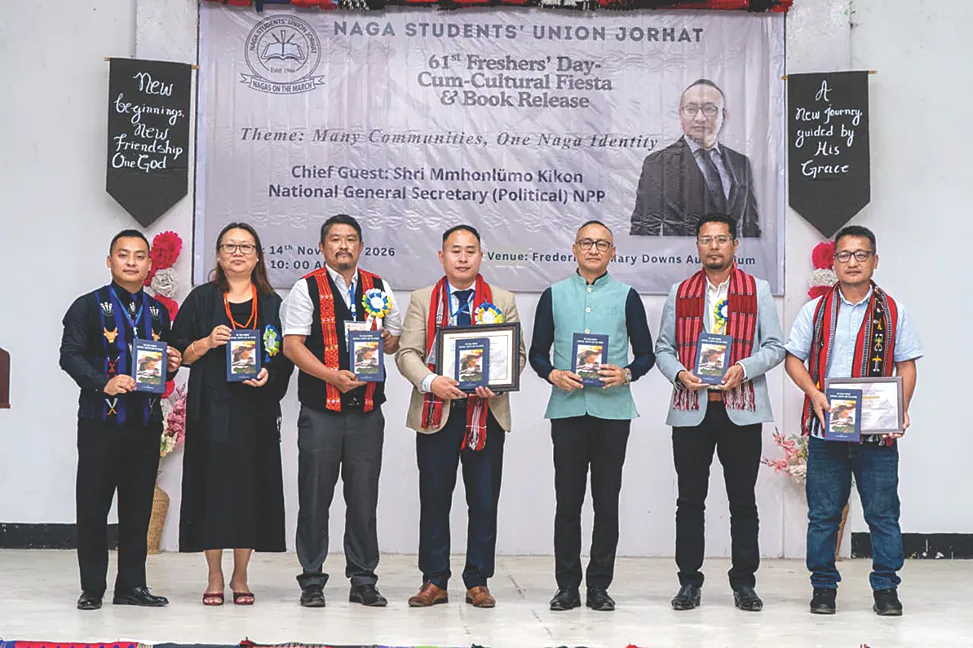
New book on Naga identity released
The Naga Students’ Union, Jorhat (NSUJ) marked its 61st Freshers’ Day-cum-Cultural Fiesta and Book Release on November 14 with a vibrant showcase of culture, talent and identity at the Frederick and Mary Downs Auditorium, Eastern Theological College (ETC), Jorhat. Held under the theme “Many Communities, One Naga Identity,” the event brought together around 600 students, church representatives, well-wishers and members of various Naga communities and educational institutions.
The entertainment-filled second session emerged as one of the highlights of the programme, featuring cultural performances and the eagerly awaited Mr and Ms Freshers competition. Jointly chaired by K. Vikali and Kapani David, the session commenced with an opening prayer by D.Th. Scholar, L. H. Nimreila.
The audience was treated to a variety of performances, including a special number by students of Kaziranga University, Jorhat, a musical rendition by Ecstasy, a dance performance by Kechu Gang and a duet by Yongtina and Eyingbeni.
A key attraction of the evening was the Mr and Ms Freshers contest, which assessed participants on confidence, cultural awareness, personality and presentation skills. The competition was conducted in three rounds: Cultural Elegance featuring traditional attire and self-introduction, Monochrome Magic fashion round, and a formal wear and questionnaire round. At the conclusion of the contest, Putusosang T. Jamir and Kwuisi Trakha were crowned Mr and Ms Freshers 2026-2027 respectively.
The session concluded with a vote of thanks delivered by NSUJ general secretary Shithum Chothe, followed by the closing prayer offered by associate professor ETC, Dr. Naomi Y. Yeptho.
Earlier, during the first session, NSUJ officially released its publication, The Naga Journey: Heritage, Identity and the Future. The session was chaired by Imnanaro Pongen and opened with a prayer by D.Th. Scholar, Limaakum Longchar.
NSUJ president Chibenthung Ezung welcomed the gathering, while ETC Principal Rev. Prof. Razouselie Lasetso encouraged freshers to value their cultural heritage and pursue their academic journey with commitment and responsibility.
The keynote address was delivered by Advisor to NSUJ, Dr S. Ekonthung Ezung, who outlined the significance of the Union’s latest publication. Published by NSUJ, the book contains 13 articles exploring themes such as Naga heritage, Christianity, indigenous knowledge, social challenges, economic development, ecological responsibility and collective aspirations.
The book was formally released by the chief guest, Mmhonlümo Kikon, National General Secretary (Political) of the National People’s Party (NPP), while the dedicatory prayer was offered by chaplain of ETC, Threiwang Konyak. Priced at Rs. 750, the publication seeks to encourage meaningful engagement with Naga identity, history and the challenges facing contemporary Naga society.
In his address, Kikon spoke on issues relating to Naga identity, politics and the future of the Naga people. He commended NSUJ for creating a platform for reflection and dialogue through the publication and stressed the importance of articulating and preserving indigenous narratives. Emphasising historical consciousness, he remarked that communities unable to articulate their own narratives may struggle to defend their identity. He also encouraged students to excel academically while remaining rooted in their history and cultural heritage.
The first session also featured a speech on behalf of the freshers by Sharon Zhimomi and a series of cultural presentations, including a folk song by the Tenyimi Fellowship, a Bihu folk dance by the Assam, Arunachal Pradesh and Tripura Fellowship, cultural showcases by different Naga tribes, a cultural play titled The Man Who Married a Heavenly Maiden presented by Lotha Khumshum, ETC and a folk song by Ao Laishir Telongjem featuring Waro Rang.
The programme concluded with NSUJ expressing gratitude to the chief guest, ETC faculty and staff, participating fellowships, performers, students and well-wishers for contributing to the success of the event, which celebrated Naga cultural diversity, heritage and the shared identity of the Naga people.