
Correspondent
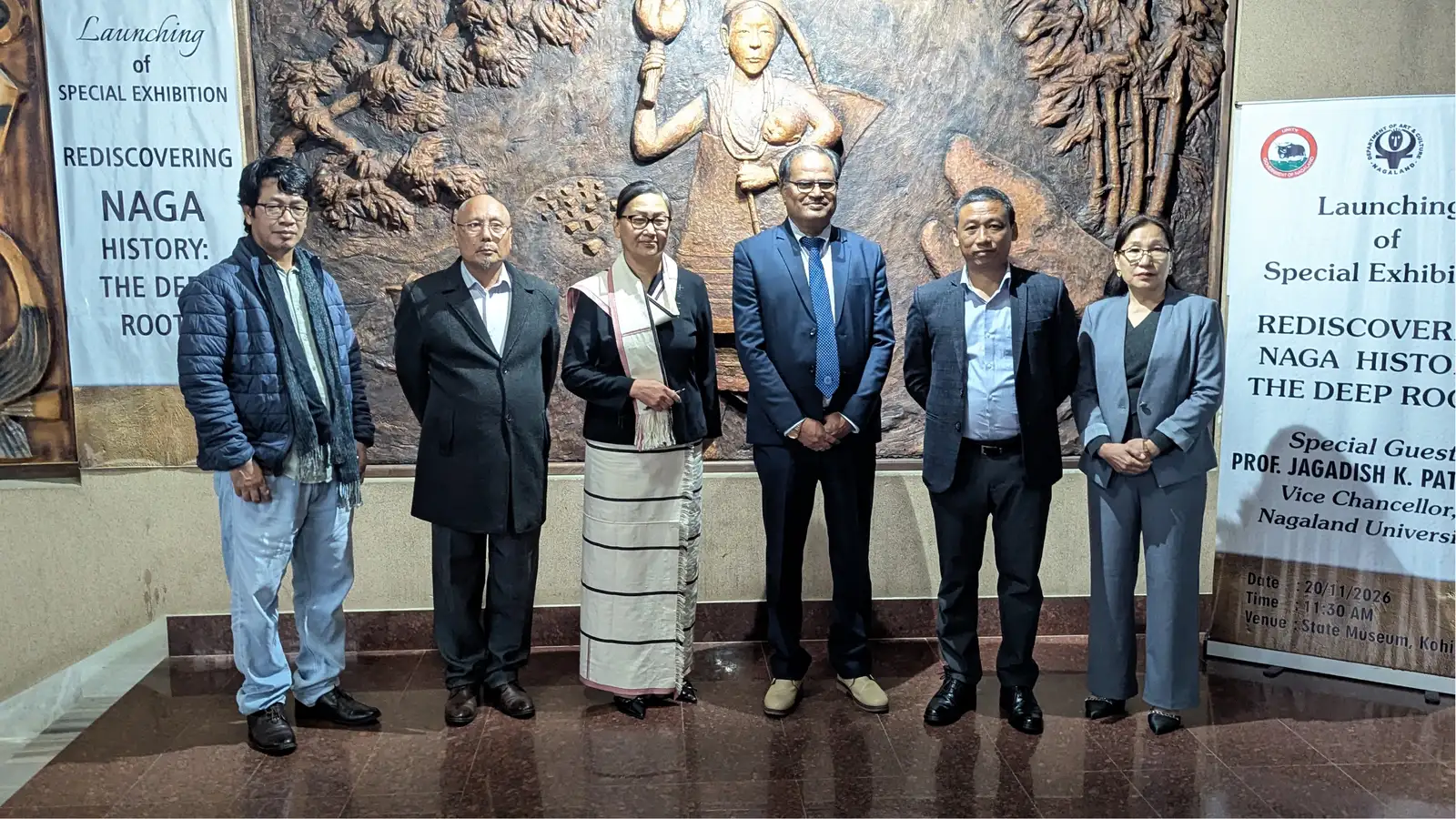
Kohima, Nov 20 (NPN): A special exhibition titled “Rediscovering Naga History: The Deep Roots” was inaugurated at the State Museum, Kohima, on November 20. The exhibition has been jointly organised by the Department of Art and Culture and the Department of History and Archaeology, Nagaland University.
Nagaland University Vice-Chancellor Prof. Jagadish K. Patnaik, who attended the programme as special guest, released a documentary film titled “Burakha: Reading the Land”, documenting archaeological excavations at New Phor, formerly known as Burakha. He lauded the Department of History and Archaeology, Nagaland University, led by Prof. Tiatoshi Jamir, for successfully carrying out excavations at two significant archaeological sites.
Speaking at the event, Director of Art and Culture Adela Moa said the exhibition was originally scheduled for October but was postponed due to prior commitments and institutional responsibilities. She described the exhibition as a collaborative effort aimed at showcasing Nagaland’s rich archaeological heritage and emerging research findings.
The exhibition features 15 photographic information panels presenting the historical background and excavation records of the sites, along with eight display tables showcasing artefacts recovered during excavations. The exhibits provide insights into the region’s material culture, settlement history and subsistence practices.
A dedicated section of the exhibition honours the pioneering work of Dr. Vikuosa Nienu, the first Naga archaeologist, who conducted the earliest excavation at Burakha, now known as New Phor. Moa informed that Dr. Nienu had donated artefacts excavated from the site in 1980 to the State Museum and stated that the collection would now be permanently displayed at the museum’s Archaeological Gallery.
Providing an overview of the archaeological findings, Prof. Tiatoshi Jamir said the first excavation at Burakha was undertaken by Dr. Nienu in 1980 following his doctoral studies at the University of California, Los Angeles. To build on his findings, Nagaland University carried out a trial excavation in 2008 before entering into collaborations with the University of Sydney and La Trobe University, Melbourne, through Memorandums of Understanding for further archaeological research.
Jamir said systematic excavations were conducted at the site during 2025 and 2026, involving extensive fieldwork. He emphasised the vital role played by local communities in supporting the research process.
Highlighting another significant site, Chipur village in Noklak district, Jamir said the area had never previously undergone systematic archaeological investigation. During an expedition in March 2026, researchers uncovered important evidence linked to caves and rock formations in the village.
According to Jamir, radiocarbon dating indicated evidence of human settlement in the region dating back to around 1900 BC, along with signs of early farming practices, including the cultivation of millet and Job’s tears. He said the discoveries offered an opportunity to study Naga history from an indigenous perspective and move beyond interpretations shaped largely by colonial-era anthropologists and historians. He urged indigenous scholars to take greater responsibility in documenting and interpreting the region’s past.
Jamir also pointed out that the research was important not only for understanding Naga history but also for studying early agriculture and plant domestication in Northeast India. He expressed hope that the findings would contribute significantly to broader academic understanding of the region’s early agricultural history.
Former New Phor Village Council chairman Chuthitu Thurr said excavations at the site initially faced several challenges but were eventually undertaken with the consent of the local MLA and the Pochury Hoho.
He informed that excavations were conducted over two consecutive seasons in 2025 and 2026. While findings from the first season suggested human settlement dating to the third and second centuries BC, results from the second season are still awaited.
Thurr said artefacts recovered from the site had been taken to Nagaland University for research and exhibition with the approval of the New Phor Village Council and would be returned upon completion of the study.
Emphasising the need to preserve the discoveries for future generations, he appealed to the Department of Art and Culture to establish a museum at New Phor village to safeguard the artefacts and facilitate future research and public exhibition.