One of the defining breakthroughs in mammal evolution was the rise of highly sensitive hearing. Modern mammals rely on a middle ear that includes an eardrum and several tiny bones, a system that makes it possible to detect a wide range of sounds at different volumes. This ability likely gave early mammals, many of which were active at night, a crucial edge as they navigated environments dominated by dinosaurs.
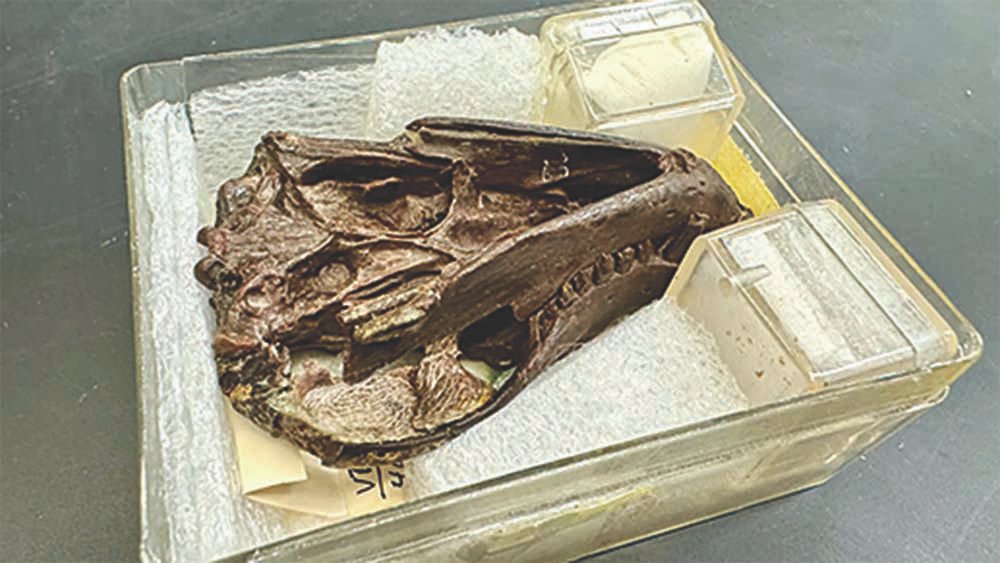
New findings from paleontologists at the University of Chicago suggest that this advanced form of hearing appeared far earlier than scientists once believed. Using detailed CT scans of the skull and jaw of Thrinaxodon liorhinus, a mammal ancestor that lived about 250 million years ago, the researchers applied engineering-based simulations to test how sound would have traveled through its anatomy. Their results indicate that Thrinaxodon probably had an eardrum large enough to detect airborne sound efficiently, pushing the origin of this trait back by nearly 50 million years.
“For almost a century, scientists have been trying to figure out how these animals could hear. These ideas have captivated the imagination of paleontologists who work in mammal evolution, but until now we haven’t had very strong biomechanical tests,” said Alec Wilken, a graduate student who led the study, which was published recently in PNAS.
Thrinaxodon belonged to a group called cynodonts, animals from the early Triassic period that show a mix of reptile and mammal traits. These included specialized teeth, changes in the palate and diaphragm that supported more efficient breathing and metabolism, and likely features such as warm-bloodedness and fur. In early cynodonts, including Thrinaxodon, the ear bones (malleus, incus, stapes) were still connected to the jaw. Much later in evolution, these bones separated to form the distinct middle ear seen in modern mammals, a shift considered critical to improved hearing.
About 50 years ago, paleontologist Edgar Allin of the University of Illinois Chicago proposed that cynodonts like Thrinaxodon may have had a membrane stretched across a hooked part of the jawbone, serving as an early version of the mammalian eardrum. At the time, most researchers thought these animals primarily detected sound through bone conduction, or through so-called “jaw listening,” by placing their lower jaws against the ground to sense vibrations.
(Science Daily)