A study led by the EPFL suggests that shipping emissions influence climate-relevant cloud formation and may affect regional climate processes far beyond the polar region.
Over the last few decades, the Arctic has lost roughly half of its September sea ice, the equivalent of almost twice the size of Switzerland. Like the retreat of the Alpine glaciers, the drastic transformation of the polar ecosystem is unfolding at a pace rarely observed in nature.
At the same time, the melting of the Arctic is freeing previously inaccessible shipping routes. According to recent estimates, maritime traffic through the Arctic has increased by 40% in the last 12 years, and by 2100, traffic in the polar region is expected to handle an amount of global trade that will surpass the Suez and Panama canals. Moreover, the current geopolitical context in the Middle East and the blockage of the Strait of Hormuz intensify the situation by diverting vessel transit toward the Arctic Circle.
Yet, a sudden increase in traffic can raise concerns about its effect on the air quality of the polar atmosphere. Therefore, a study led by Julia Schmale, tenure-track assistant professor, and Benjamin Heutte, Ph.D. student at the Extreme Environment Research Laboratory, evaluated the effect of aerosol emissions from vessels operating in polar waters.
Published in Environmental Research Letters, the study finds that emissions from a single vessel increased local cloud radiative power by as much as 22%, meaning that clouds retained substantially more heat than under clean conditions. These changes in the polar ecosystem can influence regional climate processes and may affect weather patterns in lower latitudes beyond the polar region.
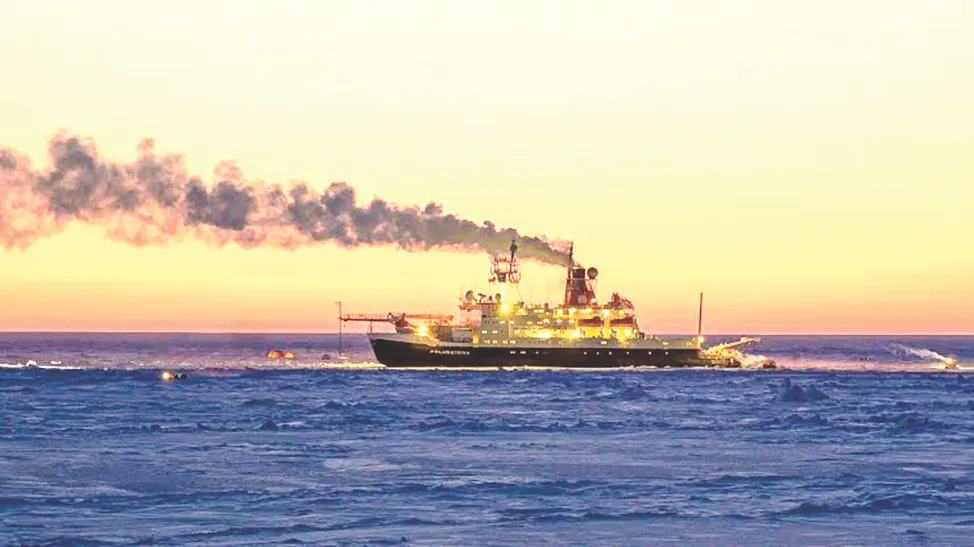
The study was conducted aboard the research vessel Polarstern within the framework of the MOSAIC expedition, whose objective was to better understand rapid Arctic climate change. Schmale’s team focused on understanding the contribution of aerosols to these changes, as well as the interaction between aerosols and clouds.
Researchers wanted to measure local natural aerosols and the pollution transported from the midlatitudes to the polar regions. However, the reality was that much of their data was contaminated by the research vessel itself. The persistent winds that blew from the same direction for much of the year had been transporting Polarstern’s exhaust emissions toward the sampling inlets.
“60% of our data were contaminated by our own ship,” Schmale says. “In contrast to the relatively clean Arctic background, ship emissions produced concentration spikes that were 10 to 100 times higher than typical background levels,” Heutte explains.
While at first it was not the main focus, the team decided to make use of this inadvertent atmospheric experiment. Schmale and Heutte came up with the idea of studying the effect of the ship exhaust on the clouds. “The presence of the ship modified the atmosphere and we measured its effect,” Schmale explains.
Schmale and Heutte measured the particle concentration, as well as its size distribution, and the number of condensation nuclei around which cloud droplets form. “We used black carbon to understand the pollution from the ship and other chemical components,” Schmale explains. To fully characterize aerosol-cloud interactions, the observations were complemented by observations from other research groups.
The sensitivity of the clouds to the ship exhaust was measured during the summer season, when most ship traffic occurs. “Contaminated clouds can act like a blanket. They warm the surface more than a pristine cloud. In our case, we found that a polluted cloud may lead to accelerated sea ice melt,” Schmale explains.
One of the biggest challenges was determining how far the pollution could be detected and still affect cloud formation. “We had to rely on models to simulate the physical and chemical evolution of the emissions as they dispersed through the atmosphere,” Heutte says.
“Despite using one of the cleanest fuels, with a very low concentration of sulfur, we observe a notable impact. Using clean fuels is a step in the right direction, but it is not enough,” Schmale notes.
To evaluate the actual effect of shipping traffic in the Arctic, researchers needed to scale up the results obtained from a single vessel and integrate them into models that account for factors such as fuel type, engine technology and shipping routes. “Moreover,” Schmale remarks, “there are effects on the Arctic ecosystem through the deposition of nutrients and contaminants from the exhaust.”
The effect of changes in the Arctic climate can expand well beyond the polar circle. The extent of the sea ice determines the air temperature and the moisture of high-latitude regions. As the winter season approaches, the amount of sea ice that forms has a strong effect on the polar vortex, which influences lower-latitude winter weather. Reduced sea ice may increase the amount of moisture available in the cold air masses, potentially changing winter precipitation patterns in Europe, which may translate into heavier snowfalls in Switzerland. (Phys Org)