
Protesters angry over Iran’s ailing economy conducted a sit-in on Tuesday at Tehran’s Grand Bazaar, witnesses said, with security forces ultimately firing tear gas and dispersing demonstrators as the rest of the market shut down.
The protest at the Grand Bazaar, the beating heart for centuries of both Iran’s economic and political life, represents the latest signal that the demonstrations are to continue as the country’s rial currency fell to a record low Tuesday. Already, violence surrounding the protests has killed at least 35 people, with authorities detaining more than 1,200 others, activists abroad say.
Meanwhile, the situation is likely to worsen as Iran’s Central Bank drastically reduced the subsidised exchange rates for dollars it offers to importers and producers in the country. That likely will see merchants pass on price hikes in the coming days for goods directly onto consumers, whose life savings have dwindled over the years of international sanctions targeting the Islamic Republic.
Iran’s reformist President Masoud Pezeshkian, while ordering a government investigation into one incident involving the protests, otherwise signalled Tuesday that the crisis may be rapidly moving beyond the control of officials.
“We should not expect the government to handle all of this alone,” Pezeshkian said in a televised speech. “The government simply does not have that capacity.”
Turmoil shakes the Grand Bazaar
In the Grand Bazaar, a labyrinth-like warren of covered passages and alleyways, demonstrators sat down in one passage in front of security forces as other shops nearby shut down on Tuesday, online videos showed, and witnesses said. Other demonstrations similarly have seen people sit down in front of police after a photo circulated earlier of a man seen sitting alone in front of security forces.
Authorities later fired tear gas to disperse the protesters. Iranian state-run media did not immediately acknowledge the incident, which has been common in the days since the demonstrations began on Dec. 28.
Iran has faced rounds of nationwide protests in recent years. As sanctions tightened and Iran struggled after a 12-day war with Israel in June, its rial currency collapsed in December, reaching 1.4 million to USD 1. Protests began soon after, with demonstrators chanting against Iran’s theocracy.
On Tuesday, USD 1 traded at 1.46 million rials, a new low, with no signs of slowing. Prior to Iran’s 1979 Islamic Revolution, the rial was broadly stable, trading at around 70 to USD 1. At the time of Iran’s 2015 nuclear deal with world powers, USD 1 traded for 32,000 rials.
Exchange rate change points to more pain coming
More pain may be coming for Iranian consumers. Iran’s Central Bank, in recent days, greatly reduced a preferential, subsidised dollar-rial exchange rate. Iran’s government offer that rate to importers and producers to try to ensure the flow of food, medicine and other essential goods despite international sanctions over its nuclear program and other issues. However, many of those firms took advantage of the difference in rates, pocketing ever-greater profits as normal Iranians watched their savings rapidly lose value against the dollar. That’s led to the Central Bank drastically reducing that rate. The currency and rate depreciation have directly impacted what’s available in stores — and at what price.
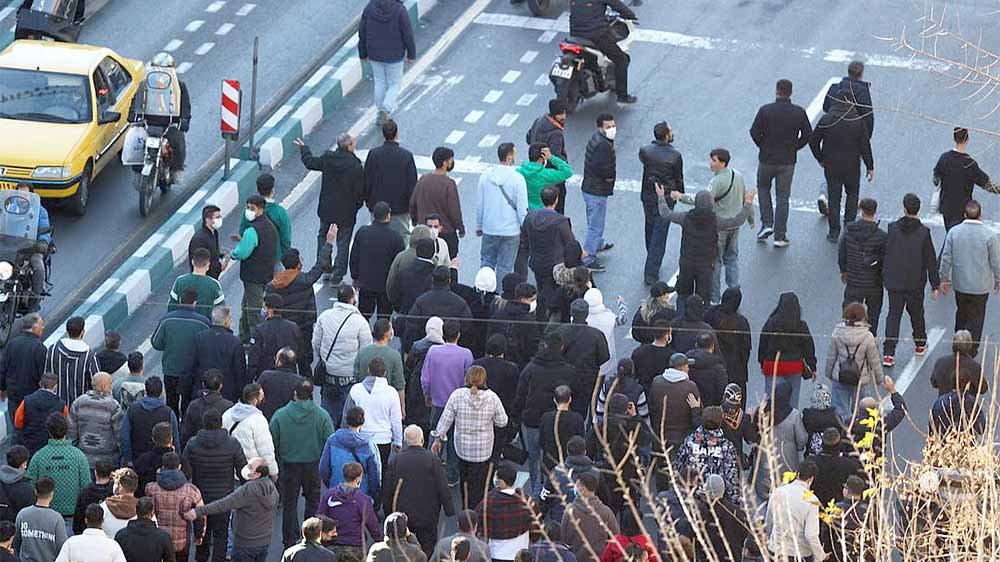
At least 35 killed in Iran demonstrations
Dubai, Jan 6 (AP)