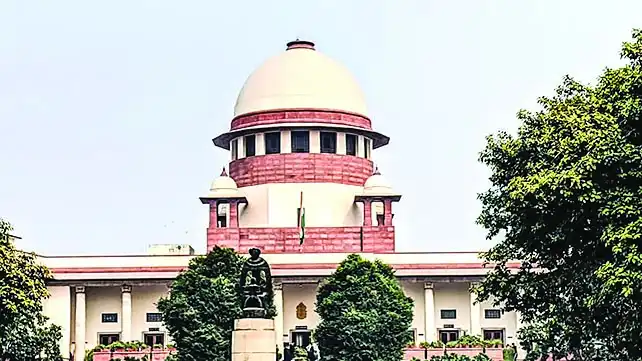
NEW DELHI, MAY 19 (PTI): The Supreme Court on Tuesday said the duty of the State and its officials while arguing a case and filing a counter-affidavit before a court is to provide real assistance and it is not expected from authorities that they will support any party, contrary to the law.
The observations came from a bench of Justices J K Maheshwari and A S Chandurkar that referred to the conduct of certain officers of the Uttar Pradesh government and the contentions raised by them that they “vociferously support” the stand of an appellant in a case.
The bench delivered its verdict on an appeal challenging a May last year order of the Allahabad High Court in a matter relating to the appointment of a college principal.
The bench said it was clear that after the commencement of the Uttar Pradesh Education Service Selection Commission Act, 2023, on August 21, 2023, it was not open to the authorities to act in terms of the list prepared under the Uttar Pradesh Higher Education Services Commission Act, 1980, which was repealed.
It said there was absolutely no occasion for the director to get the old list revived and write in favour of the appellant on December 13, 2023.
“It is suffice to say that the chief secretary of the state of Uttar Pradesh may look into the conduct of the officers who have filed the affidavit taking such unlawful stand before the high court and even before this court, which is completely impermissible under the law and contrary to the findings of the high court,” the bench said.
“It is necessary to observe that the duty of the State and its officials while filing their counter-affidavit and arguing the case before the court is to provide real assistance,” it said.
The bench added that such assistance ought to be based on facts and by applying the law applicable to the case at hand.
“It is not expected from the authorities to support any party, contrary to the law, or by filing affidavit which does not disclose the facts in conformity with the law,” the top court said.
The bench said it was not inclined to issue any adverse direction since the officers concerned were not a party to the case before it.
It, however, left it open to the Uttar Pradesh government to look into the court’s observations and take the recourse in accordance with law, if necessary.
The court noted that the appellant before it had found a place in the panel of waitlisted candidates for the posts of principal in post-graduate and under-graduate non-government aided colleges in Uttar Pradesh.
It said an advertisement was issued by the Uttar Pradesh Higher Education Service Selection Commission in 2019, inviting applications for the posts of principal in PG and UG colleges.
The selection proceedings were held by the commission and a final list of 290 candidates, along with 73 waitlisted candidates, was published in October 2021, the bench pointed out.
It said in August 2022, the appellant’s name came to be recommended for the principal’s post in a college at Ballia but he did not take any step to take charge there on account of his family circumstances.
The bench said the appellant had requested to be appointed as a principal on the vacant posts in some other college, which also included a college in Meerut.
It said a consequential order was issued in January 2024 to the director for a change in the place of posting of the appellant to a college in Meerut in exceptional circumstances and in the interest of higher education.
Thereafter, the then officiating principal of the Meerut college filed a petition before the high court, contending that once a waitlisted candidate was issued a direction for appointment at one place, the scheme of the old Act does not allow any change to the same.
The high court allowed his petition and quashed the order for a change in the place of posting of the appellant to a college in Meerut.
Dismissing the appeal, the top court said after the commencement of the new Act, the validity of the list or the panel under the old law would automatically lapse.