
Staff Reporter
DIMAPUR, AUG 20 (NPN): Nagaland Home Commissioner Abhijit Sinha has stressed the need for a balanced implementation of the Bengal Eastern Frontier Regulation (BEFR), 1873 and Inner Line Permit (ILP) system to protect indigenous interests without restricting economic activity, tourism, investment and development in the state.
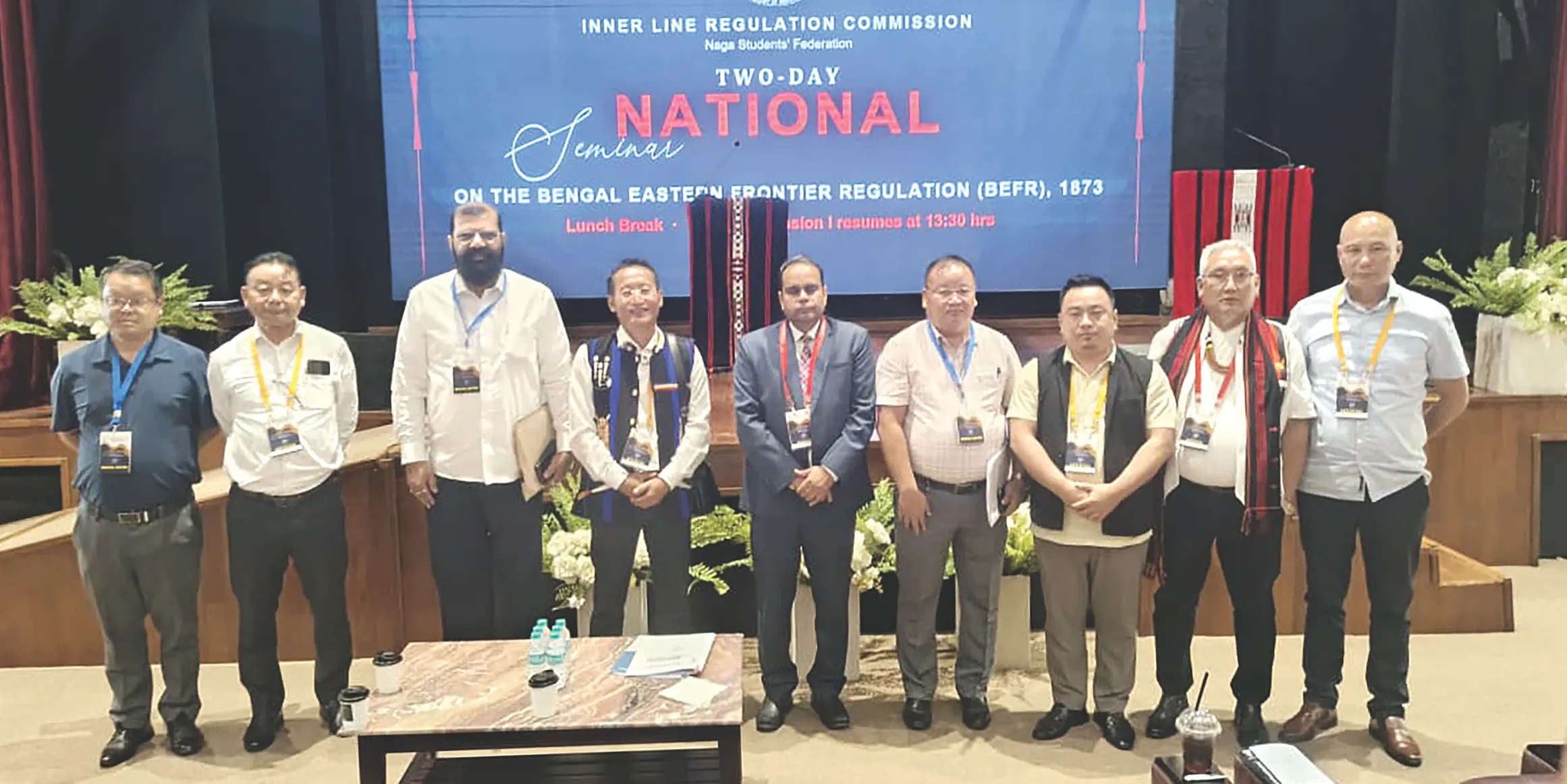
Addressing a two-day national seminar on BEFR, 1873 organised by the Naga Students’ Federation (NSF) and coordinated by the Inner Line Regulation Commission (ILRC-NSF) at Town Hall, Dimapur, Friday, Sinha said ILP should not be viewed as a mechanism to prevent people from entering Nagaland, but as a regulatory system requiring visitors to identify themselves, complete formalities and obtain the necessary pass.
He said excessive restrictions or cumbersome procedures could discourage visitors and adversely affect development. The objective, he said, should be to allow visitors to enter Nagaland easily after completing the required formalities while protecting indigenous interests.
Sinha said BEFR was more than 150 years old and was introduced by the British for a different historical purpose. Its retention after Independence, he said, reflected the recognition that indigenous and minority communities required safeguards against demographic pressure and imbalance. He said the regulation was adopted by independent India under the Adaptation of Laws Order, 1950, with “British subjects” replaced by “citizens of India”.
On the evolution of ILP in Nagaland, Sinha said the state was brought fully under the ILP regime in 2019. Following concerns raised by civil society organisations after the Citizenship (Amendment) Act, the government in December 2019 extended ILP to areas of Dimapur that had remained outside its ambit. Following the creation of Chümoukedima and Niuland districts, he said, the government issued a clarification on the applicability of ILP in the newly created districts.
He further said a notification issued on September 20, 2024, took into account the rights of people settled in the area for a long period. Those settled before December 1, 1963, were allowed to obtain Permanent Residence Certificates (PRCs) and exempted from ILP requirements. Another category was created for those covered by the September 21, 1979 notification declaring Dimapur a tribal belt.
Referring to a recent Gauhati High Court judgment on the constitutional and legal validity of BEFR and ILP, Sinha said the court had upheld the powers of the state government concerning the Inner Line regime and clarified several legal and constitutional issues. He said the judgment also supported the Nagaland Government’s authority to extend the Inner Line to areas previously outside its ambit.
On enforcement, Sinha acknowledged that Nagaland’s demographic and geographical circumstances made implementation challenging. He said the government had modernised the system and moved the ILP process online in 2025 to make it easier for applicants and more efficient for enforcement agencies.
Under the online system, applicants can upload documents and apply through the portal, while law-enforcement agencies can access records. The manual system continues for those unable to use digital processes.
Sinha said provisions had also been introduced for different categories of people, particularly the floating population in areas such as Dimapur, which has a railway station, airport and significant movement of people from neighbouring states. Procedures had also been simplified for businesspeople entering the state for specific purposes.
He highlighted the role of hotels, guest houses, resorts and homestays in monitoring visitors, saying accommodation providers should participate in reporting visitors to police and local administration. House owners renting out properties were also urged to ensure tenants complied with ILP requirements.
Sinha stressed that effective implementation required the participation of civil society, indigenous communities, student organisations, accommodation providers, landlords and other stakeholders.
He maintained that BEFR had undergone extensive academic scrutiny, public debate and legal examination and that there was nothing inherently illegal about its continued implementation.
Earlier, ILRC-NSF chairman N.S.N. Lotha, speaking on “Enforcement of the BEFR, 1873 in Nagaland”, traced the historical background of the regulation and its implementation in the state.
Lotha said BEFR was introduced in 1873 amid British colonial expansion and was intended, among other objectives, to regulate movement between the plains and hills. He also traced the NSF’s involvement in the ILP issue, referring to correspondence between the organisation and then chief minister Vamuzo in January 1980.
Lotha referred to various committees constituted by the state government to examine the issue, including one headed by Sinha, whose recommendations, he said, eventually contributed to the constitution of the Register of Indigenous Inhabitants of Nagaland (RIIN).
Citing RTI information, Lotha said around 25,000 ILPs had been issued in Mokokchung district since statehood, generating Rs 47,37,403 in revenue. He also cited an RTI response from Kohima showing that 2,26,563 ILPs were issued between January 2003 and October 2020, with no records available for the period before 2003.
Chief Advisor of the All Assam Students’ Union (AASU) and North East Students’ Organisation (NESO), Dr Samujjal Bhattacharjya, also stressed effective ILP implementation to protect indigenous communities.
Bhattacharjya said ILP should not be portrayed as a barrier to development or a mechanism to prevent citizens from other parts of the country from entering Nagaland. Rather, it should protect indigenous communities, including their land, resources, culture, language and future generations.
He called for a balanced approach, saying indigenous communities in ILP-protected areas should feel secure, while visitors from other parts of India should feel welcome and safe, with ILP functioning as a regulatory mechanism rather than a prohibition on entry.
Bhattacharjya also sought stronger safeguards for indigenous communities across the Northeast and supported the demands of Assam, Meghalaya and Tripura for introduction of ILP. He reiterated the demand for an NRC for the entire Northeast.
The two-day seminar brought together academicians, legal experts, student leaders, administrators and representatives from across the Northeast to deliberate on the historical significance, constitutional validity, present status and effective implementation of ILP.
Technical sessions included “Enforcement of the BEFR, 1873 in Arunachal Pradesh” by Prof. Nani Bath of Rajiv Gandhi University and “Enforcement of the BEFR, 1873 in the State of Manipur” by Prof. (Dr.) Ch. Priyoranjan Singh of Manipur University. The event also featured a cultural programme.