
Staff Reporter
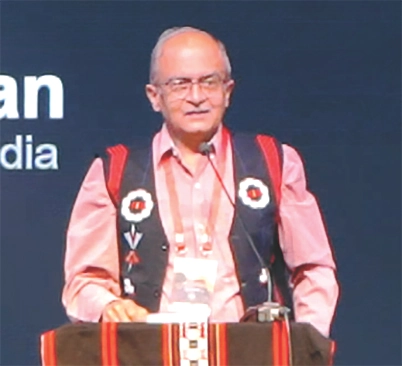
DIMAPUR, AUG 29 (NPN): Senior Advocate of the Supreme Court Prashant Bhushan questioned the constitutional basis of the ILP system and called for a more open and decentralised approach to protecting Naga culture and indigenous rights.
Speaking on “Fundamental Rights and the BEFR, 1873: A Constitutional Correlation”, Bhushan said he was offering a different perspective on the ILP and BEFR while appreciating the NSF for inviting him despite differences in views.
Bhushan acknowledged the richness and diversity of Naga culture, including its languages, traditions, cuisine and traditional practices. He said indigenous knowledge and practices had considerable value and that protecting them was important.
However, he argued that isolation was not the best way to preserve culture.
According to Bhushan, a strong culture should have nothing to fear from interaction with other cultures. Rather than isolating Nagaland from outsiders, he said interaction could strengthen society by allowing people to learn from and appreciate one another’s cultures.
He cautioned that cultures could be threatened when outsiders acquired political power and used it to suppress indigenous cultural or religious practices.
Fundamental rights and movement: Bhushan referred to Article 29, which provides citizens the right to conserve their language, script and culture, while also pointing to the fundamental right to move freely throughout the territory of India.
He questioned how restrictions under the ILP system could be reconciled with the constitutional guarantee of freedom of movement and argued that, in his view, such barriers to entry were unconstitutional.
He also referred to the constitutional right to practise any profession under Article 19. While acknowledging the special protections available to Nagaland under Article 371A, Bhushan said restrictions on outsiders engaging in professions or economic activities needed to be examined in light of fundamental rights.
On land ownership, he said concerns over outsiders acquiring large amounts of land and exploiting local communities could be addressed through specific restrictions on the quantity of land an outsider could purchase rather than through broader restrictions.
He cited hill States such as Himachal Pradesh and Uttarakhand, as well as some northeastern States, where restrictions on land purchases by outsiders exist.
Greater decentralization: Bhushan said the broader solution lay in decentralisation of power, arguing that decisions affecting villages, wards and districts should primarily be taken by the people directly concerned.
He said India had developed a system in which power was concentrated at the Central level, followed by the State, district, ward and village institutions.
He advocated reversing this structure so that local communities had greater authority over matters concerning them while remaining within the framework of fundamental rights guaranteed by the Constitution.
Addressing the Nagaland-Myanmar boundary, Bhushan noted that Naga people living across the border frequently cross into Nagaland for work and other purposes.
He said such boundaries could create difficulties for people whose social and economic lives extended across them.
He argued that greater freedom of movement could foster greater understanding among people and reduce conflicts between communities and countries.
AI and future of borders: Bhushan also raised the emerging issue of Artificial Super Intelligence (ASI), warning that advances in artificial intelligence could lead to systems vastly more intelligent than humans and capable of operating autonomously.
While acknowledging concerns among AI scientists about the potential risks, Bhushan expressed a contrasting view, saying he believed a rational and autonomous superintelligence could potentially manage society more fairly than humans.
He argued that human societies were often driven by emotions such as power, dominance and greed, contributing to conflict and poverty, while a rational superintelligence could potentially recognise the benefits of cooperation over competition.
Bhushan predicted that technological development could eventually lead to the removal of national and internal boundaries, including visa and ILP requirements.
He said people could potentially move freely between States and countries while still being required to follow the laws of the places they entered.
Bhushan reiterated that preserving Naga identity did not require an isolationist policy and expressed confidence that Naga culture was sufficiently strong to survive, grow and spread beyond Nagaland.