The Constitution (131st Amendment) Bill to tweak the women’s quota law was introduced in the Lok Sabha on Thursday after a division of votes.
Two ordinary bills — the Delimitation Bill and the Union Territories Laws (Amendment) Bill to implement the proposed amended women’s quota law in Union territories of Delhi, Puducherry and Jammu and Kashmir — were also introduced in the House. The Bills were introduced after a fiery 40-minute debate following which the opposition pressed for the division of votes to introduce the Constitutional (131st Amendment) Bill.
The Bill was later introduced with 251 members supporting it and 185 members voting against the introduction.
Congress’ K C Venugopal questioned why the proposed changes in the women’s quota law were not incorporated when it was passed earlier by Parliament.
“Bills to tweak the women’s quota law and set up a delimitation panel are anti-constitutional,” he said.
Samajwadi Party’s Akhilesh Yadav questioned the rush to introduce the bills. “We support women’s quota in legislature but why not hold a census?” he asked.
Union Home Minister Amit Shah hit back, saying the Census 2027 is on and the Centre has also decided to go for caste enumeration, but reservation based on religion is “unconstitutional”.
DMK members dressed in black clothes in the Lok Sabha to protest amendments to the women’s reservation law. “We favour the 2023 women’s quota law, but the present Bill is aimed at delimitation,” DMK’s T R Baalu said.
RSP’s N K Premchandran opposed the women’s quota law amendment, saying it is not meant for reservation but delimitation.
Venugopal said a Constitutional amendment bill cannot be discussed together with other ordinary bills. Shah, however, rejected his objection saying it can be done.
Congress MP Gaurav Gogoi alleged that the government wanted to “bulldoze” delimitation in the name of women’s reservation, and asserted that if it is really committed to implementing the women’s quota law it should do so immediately on the basis of the current strength of Lok Sabha.
Speaker Om Birla cited precedents to say that the Constitution amendment Bill can be discussed with other Bills as they relate to the same subject.
According to the Constitution (131st Amendment) Bill, Lok Sabha seats will be increased to a maximum of 850 from the current 543 to “operationalise” the women’s reservation law before the 2029 parliamentary polls, following a delimitation exercise based on the 2011 Census.
Under this proposal, most North Eastern (NE) states are expected to see a 50% increase in their parliamentary seats, while those with a single seat will remain. These states-Nagaland, Mizoram and Sikkim, which currently have only one Lok Sabha seat, will see no increase in their parliamentary representation under the current proposal.
The seats reserved for women in the Lok Sabha and legislative assemblies “shall be allotted by rotation to different constituencies in a state or Union territory”, the draft bill circulated among Lok Sabha members said.
Several opposition parties on Wednesday decided to unitedly vote against the delimitation provisions in the Constitution amendment bill in Parliament, while asserting that they are not against reservation for women in legislative bodies.
How is a constitution amendment Bill passed?
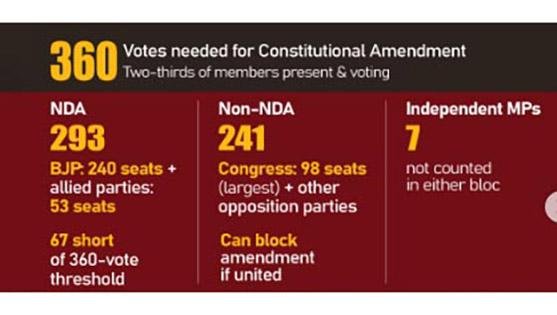
The constitutional amendment Bills require a special majority of two-thirds of those present and voting to be passed. Any walkout or abstention by the Opposition could lower the effective majority threshold. With an effective strength of 537 in the Lok Sabha, the two-thirds mark comes to 360. The ruling NDA, with 293 members, falls short by 67 seats. In the Rajya Sabha, the magic number is 163, while the NDA’s strength of 142-plus members leaves it 21 seats short of the majority mark. Adding to the government’s challenges, parties such as Naveen Patnaik’s Biju Janata Dal and K. Chandrasekhar Rao’s Bharat Rashtra Samithi, which had extended issue-based support earlier, have now hardened their stance on delimitation. However, the government has maintained that it has the numbers. “I am not going into the politics of which party is saying what. No party is opposing the women’s reservation in Parliament and assemblies. In principle and in spirit, everybody is together,” said Union Minister Kiren Rijiju.