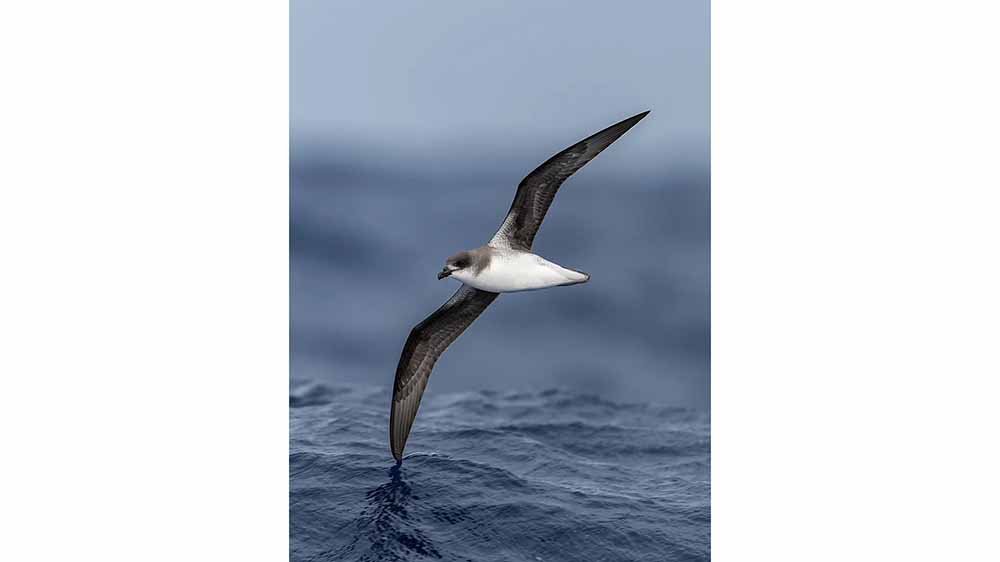
When hurricanes pass over the ocean they churn up creatures from the deep – a chance to feast for predators brave enough to weather the storm.
High on a rocky plateau, one small nocturnal seabird is nestled in its burrow, where far below waves lap gently against the cliffs. In the blackness of night, it senses a storm brewing 1,000 miles (1609km) from the coast of Morocco.
Drawing energy from the warmth of the ocean’s surface, a tropical cyclone begins to form until a powerful column of rotating air is marching across the globe. The cyclone the bird senses is hundreds of miles wide, and lightning strikes speckle its outer bands, while 150mph (240km/h) winds churn the ocean waters below. Hurricanes are known for their destructive force. Seabirds will often forgo foraging trips and stay ashore when they sense a storm is coming, or they’ll fly hundreds of miles to circumnavigate the dangerously strong winds. Frigatebirds climb to extreme altitudes to quickly bypass a cyclone at high speeds, and even albatrosses – known for their ability to fly in high winds – seek calm in the eye of the storm. But not all animals see them as a threat. For some, the fearsome energy of the storm provides a banquet, as delicacies from the ocean depths – like squid, octopus and cuttlefish – are dragged up to the surface. One such predator is the Desertas petrel, a small agile seabird with long slender wings. This petrel seeks out the most powerful storms, seeing an opportunity to hitch a lift. It darts straight into the bands of spinning air, reaching areas within 200km (124 miles) of the eye of the storm. “Honestly, I cannot imagine what the conditions would be like,” says Francesco Ventura, a biologist and postdoctoral investigator at US ocean research organisation Woods Hole Oceanographic Institution. “They’re pigeon-sized, just a few hundred grams, experiencing winds up to 100km/h [62mph] – most likely much more than that – and gigantic waves, with ocean swells up to 8m [26ft]. They’re really amidst the madness of the storm.” When the tropical cyclone passes, continues Ventura, “the birds align their movement trajectory along the wake of the hurricane”. Now, this delicate little bird rides on the tail of the storm, foraging on creatures churned up from the twilight zone.
We’re all too familiar with the human tales of devastation associated with hurricanes, from lives and homes lost, to flattened and drowned cities. But these mega-storms also impact the oceans – turning life upside-down for the myriad creatures that live beneath the waves. (BBC)
Tropical cyclones – otherwise known as hurricanes or typhoons, depending on where they crop up in the world – churn the ocean as they travel, thrusting warm surface water into the depths where it is trapped and can travel for thousands of miles before resurfacing. Meanwhile cool water wells up from the deep.
This underwater turmoil can have a profound negative impact on oceanic and coastal ecosystems, stirring up the seabed, destroying turtle nesting sites and decimating shellfish beds, sending migrating animals miles off-course, and smashing through delicate coral reefs.
However, this ocean churning can also kickstart phytoplankton blooms as the nutrient-rich waters rise to the upper layers of the water column. Zooplankton and other tiny swimming prey are followed by larger predators such as small fish and cephalopods usually found in the ocean’s “twilight zone” at 200-1,000m (656-3,280ft) depth. All this makes for a delicious treat for predatory seabirds like the Desertas petrel.
This entire population of Desertas petrels, a threatened seabird native to the North Atlantic Ocean, gathers on the wild and rugged island of Buigo in the Madeiran archipelago to breed during the North Atlantic hurricane season. That might sound like terrible timing, but this small seabird belongs to the order Procellariiformes – meaning storm-like – and has long been associated with heavy seas and oncoming storms.
Desertas petrels spend their lives foraging far out to sea, but until recently scientists knew very little about where they went. “We only had some hints, some clues, from the fact that sailors would see them very, very far off the coast. And fishermen would see them thousands of kilometres away from land.”
It was in 2015 that Ventura and his colleagues first set out to uncover the secrets of these birds’ mysterious lives over the open ocean.
To reach the nesting site, Ventura had to climb the near-vertical cliffs to the top of “a ridge sticking out of the ocean”. On top, the plateau was dotted with burrows. At night, says Ventura, “the whole island comes alive. You hear birds calling from underneath, from their burrows. You can hear them swooping and flying by fast to approach the colony. It’s an eerie sound – it makes you understand why fishermen were superstitious about these birds. It’s as if the island is talking”.
After attaching the super-lightweight GPS trackers onto the birds, Ventura waited. Two to three weeks later the petrels returned to their nests, and the trackers could be retrieved. “Then you connect the loggers to the computer, and you see that they went completely to the other side of the Atlantic, while the partner was sitting on the egg,” says Ventura.
Desertas petrels, the researchers found, make some of the longest foraging trips ever recorded in any species – travelling as far as 12,000km (7,460 miles) over deep, pelagic waters – all the way from Africa, to the New England coast and back again.