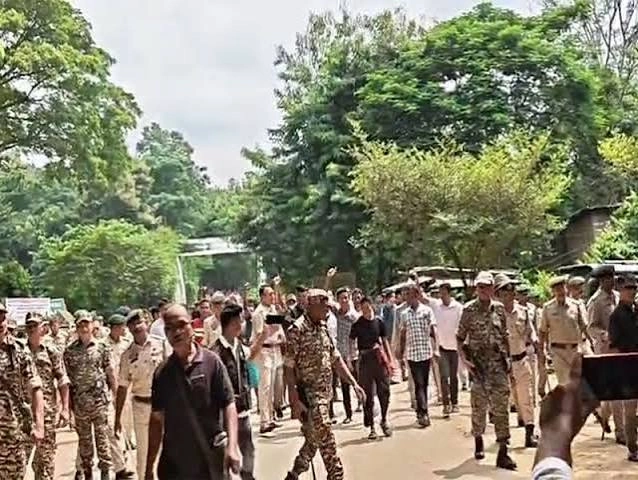
Agartala, Sep 5 (PTI): Rail and vehicular traffic were hit in parts of Tripura on Saturday, the second day of a 72-hour blockade called by a forum of surrendered militants over their multiple demands, including the implementation of a tripartite agreement under which they laid down arms.
The opposition parties urged the BJP government in the state to talk to the surrendered militants to end their protest, highlighting that the common people of the state were the worst sufferers of the agitation.
Protesters under the banner of All Returnees’ Rehabilitation Committee blocked roads at Hataikotor, Brigudasbari and Khowai Chowmuhani in West Tripura district. They also squatted on railway tracks at Brigudasbari, prompting the Northeast Frontier Railway (NFR) to short-terminate, cancel and reschedule several trains.
“The blockade has disrupted train services and vehicular movement, but it has been peaceful,” the police officer said.
Vehicular movement on the Assam-Agartala national highway, considered a lifeline in Tripura, was severely affected due to the blockade at Hataikotor, leaving the northeastern state completely isolated from the rest of the country.
The All Returnees’ Rehabilitation Committee, representing seven surrendered militant groups, started the 72-hour blockade on Friday on an 11-point charter of demands, including implementation of the peace accord signed in 2024, under which they laid down arms before Chief Minister Manik Saha.
“We had a discussion with former rebel leaders at Hataikotor on various points of the peace accord. They have raised some demands to which the government is ready to work. The government is committed to implementing the accord in a time-bound manner,” West Tripura District Magistrate Vishal Kumar told reporters after the meeting on Friday.
He said the former rebel leaders assured the administration that they would deliberate on the government’s proposals with the cadre and would communicate to the authorities as soon as possible.
The 11-point charter of demands includes land rights for the indigenous people and withdrawal of all pending cases against the surrendered militants.
Jibanjoy Reang, a former rebel leader, said, “We appealed to the government to suggest a solution for our rehabilitation or else the surrendered militants will go for an indefinite blockade. We will not compromise on livelihood issues.”
Left Front Convener Manik Dey said the government must fulfil the commitments it had made to the surrendered militants during the signing of the peace agreement.
He said the government should sit with the surrendered militants to end the blockades, keeping in mind the elections to Village Committees of the Tripura Tribal Areas Autonomous District Council (TTAADC) scheduled on September 28.
Congress leader Sudip Roy Barman also strongly advocated for fulfilment of promises given in the peace accord.
“We want the government to implement promises made to the surrendered militants at the time of signing the peace accord. The party also favours the TTAADC getting direct funding and a share of central tax directly,” he told reporters.
Expressing strong reservations over the frequent disruption of the state’s connectivity, he urged the surrendered militants to go for fast unto death instead of a “routine” blockade to compel the government to fulfil its promises.
“The common people are the worst sufferers of such agitation,” he said.