
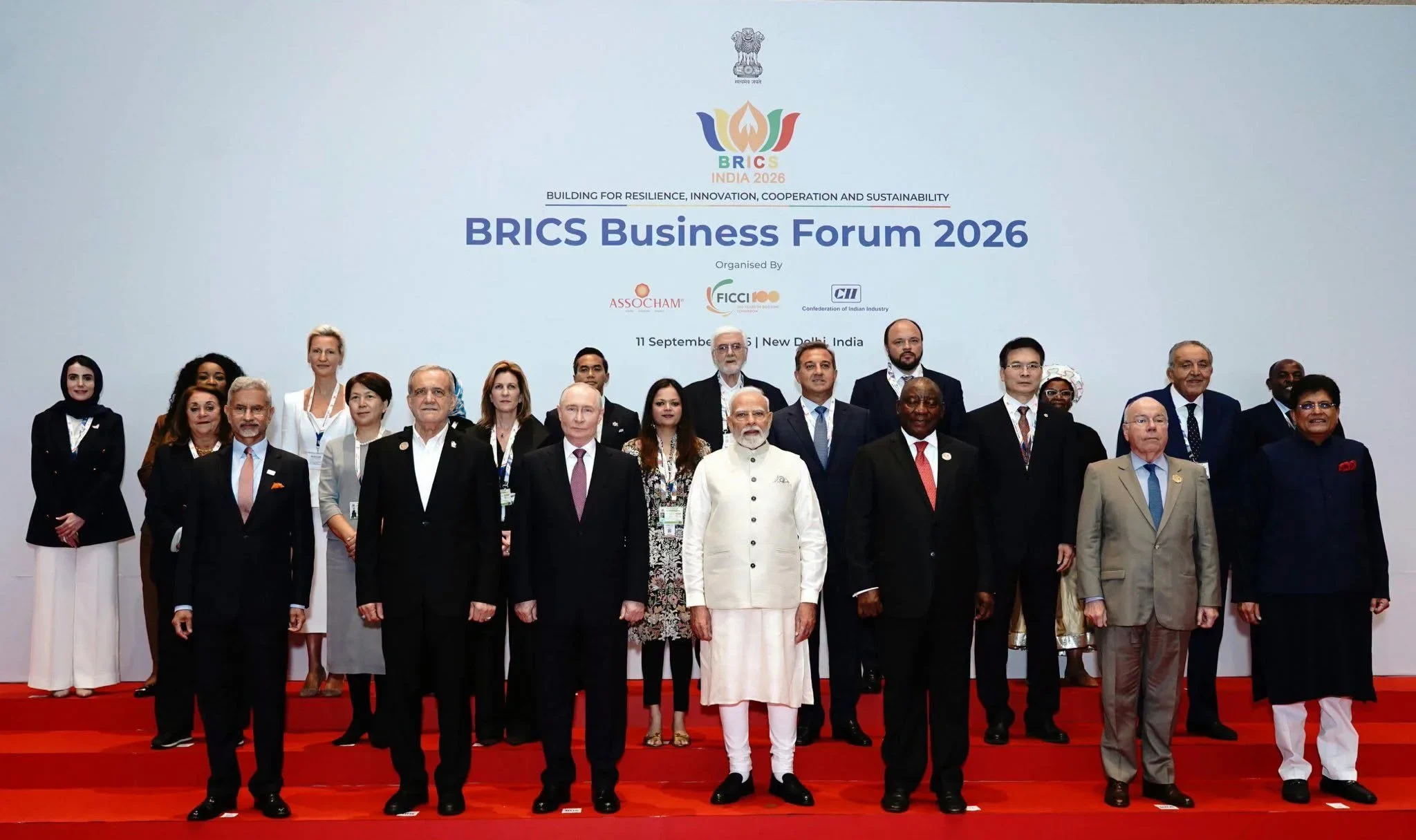
NEW DELHI, SEP 11 (PTI): As global trade disputes and geopolitical upheavals unleash economic headwinds, Prime Minister Narendra Modi, Chinese President Xi Jinping, Russian President Vladimir Putin, and other leaders from BRICS nations will gather on Saturday for the India-hosted summit to navigate global challenges, including insulating developing economies from the impact of conflicts in Ukraine and West Asia.
In a strategic balancing act, New Delhi is looking at leveraging the two-day annual summit to position the grouping as a complementary engine for economic growth while being mindful of sensitivities of the United States and other Western powers, especially in the trade and energy domains.
As the BRICS chair, India has placed the Global South at the heart of its agenda by seeking actionable solutions for food, energy, and supply chain security primarily to insulate the developing nations from the economic consequences of the conflicts in Ukraine and West Asia.
The summit assumed greater significance as it is taking place against the backdrop of a global economy facing the adverse impacts of the Russia-Ukraine war, the West Asia crisis, especially the blockade of the Strait of Hormuz, and the Trump administration’s trade and tariff policies.
In an address at an event on the sidelines of the summit, External Affairs Minister S Jaishankar on Friday said the BRICS must work towards addressing economic challenges, including by ensuring transparent trade and investment practices.
“The common thread is how to make it easier for businesses in our countries to find more partners, access more markets, connect supply networks and convert complementarities into viable commercial partnerships,” he said.
“The objective is to strengthen our ability to absorb shocks while remaining connected and competitive,” he said.
With just a day left before the summit begins, it remains unclear whether member nations will reach a consensus on a joint statement, as differences between Iran and the United Arab Emirates (UAE) over the West Asia crisis persist within the consensus-based grouping.
Reportedly, Iran has been pushing to explicitly condemn US-Israel military actions, while the UAE insists that the statement highlight the necessity of maintaining freedom of navigation across critical maritime routes.
Under the resilience pillar, India has been focusing on strengthening collective cooperation in areas such as health, agriculture, food, energy, disaster risk reduction and supply chains, officials said.
In addition to these areas, the leaders will exchange views on strengthening intra-BRICS cooperation on common priorities and share perspectives on global and regional matters of mutual importance, according to the Ministry of External Affairs.
Under India’s Chairship this year, over 350 meetings and high-level engagements have been held in over 25 cities across the country to further strengthen the BRICS strategic partnership across three fundamental pillars: political and security, economic and financial, and cultural and people-to-people exchanges.
India is a founding member of BRICS, and has previously held its chairship in 2012, 2016 and 2021. India assumed its fourth BRICS chairship on 1 January 2026. According to the Ministry of External Affairs (MEA), the summit will begin at 2:35 pm on Saturday with a closed-door session for BRICS member countries themed “Inclusive Global Governance and Strengthening Multilateralism.”
Following the session, leaders will tour the “Bharat Innovates Exhibition,” scheduled to open at 4:25 pm.
At 5:05 pm, the leaders will assemble on the lawns of Bharat Mandapam — the summit venue — for a photo, followed by a joint tree-planting ceremony.
The first day’s engagements will conclude with a gala dinner hosted by Prime Minister Modi at 7:30 pm.
On Sunday, leaders from BRICS member states, partner nations, and outreach invitees will arrive starting at 9:55 am, followed by a official group photo at 10:35 am. The open session, titled “Resilience, Innovation, Cooperation and Sustainability: Shaping the Future for Inclusive Global Growth,” is scheduled to begin at 10:50 am, according to the schedule released by the MEA.
The summit will culminate with the release of the New Delhi Declaration. Formalised at the 2006 UN General Assembly, BRIC held its first summit in Yekaterinburg, Russia, in 2009.
The group expanded to BRICS after agreeing to admit South Africa during the 2010 UNGA Foreign Ministers’ meeting, with South Africa joining its first summit in Sanya in 2011.
Modi pushes BRICS to tear down trade barriers, backs freedom of navigation and seafarers’ safety
Prime Minister Narendra Modi on Friday called for BRICS to turn its growing economic weight into greater investment and expanded business ties, stressing that freedom of navigation, secure sea lanes and the safety of seafarers were essential to keeping global trade running.
Addressing the BRICS Business Forum in India, Modi urged the grouping to identify and remove its top 10 trade barriers, scale 100 BRICS startups into other member markets every year and build 1,000 new business partnerships annually.
The grouping, he said, should convert its growing economic weight into concrete opportunities for businesses, positioning India as a country building “economic bridges” at a time when trade barriers are rising globally.
“Global trade can only progress if sea lanes are secure, supply routes remain open, and seafarers are safe. Therefore, India is a staunch supporter of freedom of navigation and the safety of seafarers,” he said.
The remarks came amid wars in two theatres and geopolitical conflicts disrupting energy and other trade through vital sea lanes, raising prices and disrupting supply chains. Indian ships have been attacked during the US-Iran conflict and the country’s seafarers have been abducted by pirates.
Modi highlighted the scale of the expanded BRICS grouping, saying member-countries and partners now represent around half of the world’s population, 40 per cent of global GDP and more than a quarter of global trade. Over the past two decades, he said, the combined GDP of BRICS economies expanded around four-and-a-half times, compared with a roughly two-and-a-half-fold increase in global GDP.
Modi placed infrastructure and strategic technologies at the centre of India’s pitch to global businesses, pointing to rapid expansion of roads, railways, ports and airports alongside new capacity in shipbuilding, semiconductors, quantum technology, critical minerals and biotechnology.
“Make in India, Innovate with India, and Scale for the World,” Modi said, presenting India as both a manufacturing base and a source of technology and innovation for global markets.
He also sought to use India’s digital public infrastructure as a platform for deeper BRICS cooperation. Modi highlighted UPI’s population-scale deployment and said BRICS innovators could draw on India’s experience to develop digital solutions suited to their own markets.
The Prime Minister pointed to more than 200,000 startups and over 120 unicorns in India, saying BRICS should help take such innovations to global markets. Initiatives under India’s chairship include the BRICS incubator network, BRICS MSME portal and BRICS Startup Innovation Fund, alongside new cooperation networks in agriculture, health care, skills and smart grids.
Trade connectivity was another central theme. Modi said India had pursued free-trade agreements with nearly 40 countries since 2014 and argued that BRICS should similarly focus on reducing barriers and expanding opportunities for businesses.
He also stressed the importance of secure sea lanes and open supply routes for global trade, reaffirming India’s support for freedom of navigation and the safety of seafarers.
Looking ahead, Modi challenged the BRICS Business Council to establish measurable targets rather than limit itself to dialogue: identify the bloc’s top 10 trade barriers for removal, support 100 BRICS startups each year in expanding into other member markets, and create 1,000 new business partnerships annually.
“We must review our progress on these three parameters every year,” he said.
The pitch came as India seeks to make its BRICS chairship centred not only on the bloc’s economic weight, but on turning that weight into trade, investment, technology and business activity across member economies.
When it comes to resilience, Modi said, India has made its supply chains — spanning sectors from energy to technology — more diversified and reliable. It is a result of this very resilience that, even amidst global uncertainties, India today offers an assurance of growth and stability, he added.
At a time when trade barriers are rising globally, India is building economic bridges, he said, adding that since 2014 India has entered into free trade agreements with nearly 40 countries.
“Our approach within BRICS is the same: to reduce barriers and expand opportunities for businesses,” he said.
The Prime Minister said that India is rapidly expanding roads, railways, ports, and airports.
“Simultaneously, we are building new capabilities in strategic sectors such as shipbuilding, semiconductors, quantum technology, critical minerals, and biotechnology. In these areas, India is emerging as a hub of new opportunities for global businesses,” he said.
Modi said with over 200,000 startups and more than 120 unicorns, India is emerging as a hub for global solutions.
“Our startups are transforming education and health care through AI, working on Green Hydrogen and batteries, and breaking new ground in the defence and space sectors. Now, we must take these world-class innovations to global markets through BRICS as well,” he said.
On the Unified Payments Interface (UPI), he said at present 50 per cent of the world’s real-time payments take place using this technology.
“We have provided an open ecosystem to the industry and startups to develop new solutions on this digital layer. We are proud that many countries are adopting this world-class ecosystem from India. Innovators from BRICS nations can also leverage this experience to create new solutions for their own countries,” he said.
Modi, Putin hold high-stakes talks ahead of BRICS summit
Prime Minister Narendra Modi on Friday held wide-ranging talks with Russian President Vladimir Putin, focusing on enhancing annual bilateral trade to USD 100 billion by 2030 and ramping up existing cooperation in areas such as defence, energy, critical minerals, and fertiliser supplies.
The meeting took place hours after Putin landed in New Delhi on a three-day visit to participate in the high-stakes BRICS summit. Following the talks, the two leaders travelled in the same car inside the Bharat Mandapam complex to reach the venue of a business forum.
It is understood that during the talks, Putin briefed Modi on the overall situation regarding the Ukraine war and ongoing peace initiatives, while Modi reiterated India’s position on resolving the conflict through dialogue and diplomacy.
Modi and Putin previously met on the sidelines of the SCO summit in Astana, where the prime minister called for an immediate end to the conflict and urged the Russian leader to shift from an “endless war towards the end of war”.
The two leaders also deliberated on ongoing cooperation in trade and investment, energy, and fertiliser security, among other areas.
Ways to boost trade and investment ties dominated the talks, with the Indian side pitching for greater market access for Indian exporters in Russia to address the ballooning trade deficit in Moscow’s favour, it is learnt.
The two sides also deliberated on strategies to reach the ambitious bilateral trade target of USD 100 billion by 2030. The current annual trade volume stands at around USD 65 billion.
In addition, the two sides delved into expanding their already strong defence cooperation.
Kremlin spokesperson Dmitry Peskov on Tuesday said both sides are exploring BrahMos missile upgrades, adding that Moscow remains committed to fulfilling its remaining S-400 system deliveries and discussing the proposed supply of Su-57 fighter jets.
In the energy sector, the two sides reviewed the overall scenario and agreed to further ramp up cooperation in civil nuclear energy.
Expanding industrial cooperation, collaboration in the rail and tunnelling sectors, developing the steel value chain, and broadening access to the Russian market for Indian exporters also figured in the talks, it is learnt.
Increasing the mobility of skilled Indian labourers to Russia and cooperation in critical minerals were also understood to have been discussed.