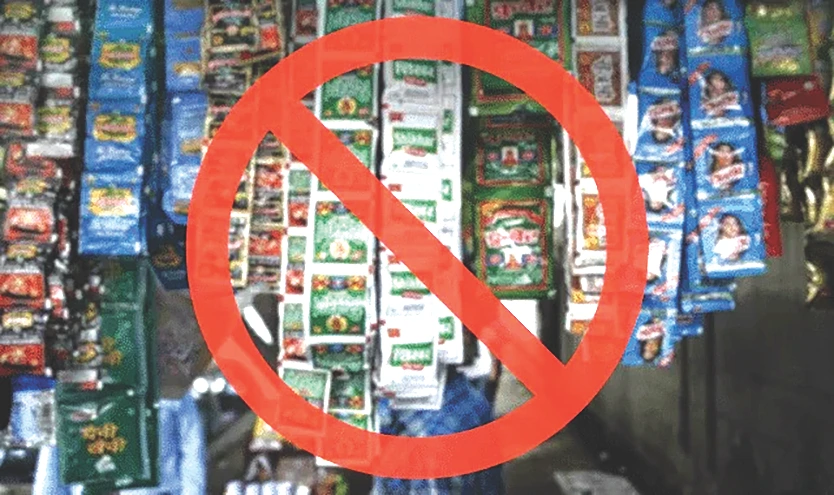
DIMAPUR, JUN 13 (NPN): Dimapur Chamber of Commerce and Industry (DCCI) and Chümoukedima Chamber of Commerce and Industry (CCCI) and Kohima Chamber of Commerce and Industry (KCCI) have expressed concern over the sudden ban on tobacco products, including pan masala, gutka and related items, imposed by the state government on June 2 without prior notice.
It may be recalled that during the quarterly meeting of the District Level Coordination Committee (DLCC) of the District Tobacco Control Cell (DTCC), Kohima, held on June 10, the food safety officer had clarified that the prohibition order applies only to food products containing tobacco or nicotine as ingredients and does not cover cigarettes or other standalone tobacco products. The officer reportedly stated that products such as pan masala are not banned unless tobacco or nicotine is mixed with them.
DCCI &CCCI: In a joint statement, DCCI president Akashe Zhimomi and CCCI president James Kin said the products were legally procured by wholesalers, distributors, stockists and retailers after payment of all applicable taxes, including GST. They stated that businesses had no indication of an immediate ban and, as a result, substantial investments remain locked in existing inventories across the state.
While acknowledging and supporting the government’s efforts to address public health concerns arising from the consumption of tobacco and related products, the two chambers urged the government to provide a reasonable and time-bound window period for traders to return the products to manufacturers or dispose of existing stocks lawfully.
According to the chambers, such a measure would help mitigate significant financial losses currently being faced by traders and retailers.
DCCI and CCCI also sought clarity on the provision of a one-year ban, questioning whether the sale of such products would be permitted after the ban period expires and whether the desired public health objectives could be achieved within a single year.They further pointed out that if the products were considered harmful to public health, a longer-term or permanent policy might be more appropriate.
The chambers also expressed concern that the prohibition could lead to black marketing and the emergence of illegal supply networks, potentially undermining the objectives of the ban and creating additional enforcement challenges.
Reaffirming their support for public health measures, DCCI and CCCI appealed to the government to consider granting a grace period for traders to liquidate, return or otherwise lawfully dispose of existing stocks, stating that such a step would provide relief to businesses that had invested heavily in the products through legitimate channels.
KCCI: Kohima Chamber of Commerce and Industry (KCCI) has urged the state government to grant a 30-day grace period for retailers affected by the recent ban on tobacco and nicotine-containing food products, arguing that immediate enforcement has left many traders facing financial losses.
In a notification, KCCI president Ruokuoneilie Kesiezie acknowledged the June 4, 2026 notification issued by the health & family welfare (H&FW) department prohibiting the sale of gutkha, pan masala and twin-pack chewable products containing tobacco or nicotine.
The chamber said it also recognised the order as a public health measure issued under the Food Safety and Standards Act, 2006, and did not challenge its legal basis.
However, KCCI pointed out that enforcement began immediately without any transition period, leaving small retailers unable to recover investments made in legally acquired stock purchased under valid licences.
The chamber maintained that traders who acted in good faith under the prevailing regulatory framework were entitled to a reasonable transition period before the ban took effect. It, therefore requested the state government to allow a 30-day grace period during which existing stock could either be sold or returned without penalty.
KCCI also highlighted what it described as confusion over product classification. It maintained that cigarettes, beedis and loose tobacco were governed by the Cigarettes and Other Tobacco Products Act (COTPA), 2003, and were not classified as food products under the Food Safety and Standards Authority of India (FSSAI) framework.
The chamber argued that such products fell outside the scope of the June 4 notification and warned that enforcement actions against COTPA-regulated products could amount to a misapplication of jurisdiction, resulting in unnecessary losses for traders.
To avoid confusion, KCCI urged the district administration and the H&FW department to issue a clear public order specifying which products were prohibited under the notification and which remained permissible under existing laws.
The chamber further raised concerns over tobacco vendor licences (TVLs) issued by the Kohima Municipal Council (KMC), noting that licence fees had already been collected from traders for the current tenure before the ban was notified.
According to KCCI, no revised guidelines have been issued by KMC since the notification came into force, nor has any mechanism been announced to address fees already paid by licence holders who can no longer fully utilise their licences.
The chamber has, therefore called upon KMC to either provide prorated refunds for the remaining licence period or permit a limited sell-out window for existing stock under the current TVLs.
In the light of the above, KCCI has placed four-point request KCCI on behalf of the business community of Kohima: Sate govt grant 30-day grace period for retailers; H&FW département and Kohima district administration issue a definitive clarification on products covered by the ban; KMC remedial measures for affected licence holders, and all concerned authorities constitute a joint working group involving KCCI representatives to address implementation-related issues.
Reaffirming its support for public health objectives, KCCI said its appeal was aimed at ensuring due process and a balanced implementation of the ban that also safeguards the livelihoods of law-abiding members of the business community.